TL;DR

Play games on Amazon Luna for your next adventure, included with Prime
- A rotating selection of games, no download needed
- Play on TV, laptop or phone
- Fast, free delivery for your gear, too
The Oculus Quest headset detects user movements using a combination of internal sensors, including accelerometers, gyroscopes, and cameras. Recent discussions suggest a sophisticated system that interprets sensor data to track head and hand positions accurately, though some technical details remain unconfirmed.
The Oculus Quest headset detects user movements primarily through internal sensors that track head and hand positions in real time. This detection capability is essential for immersive virtual reality experiences, and recent insights from r/OculusQuest shed light on the underlying technology involved.
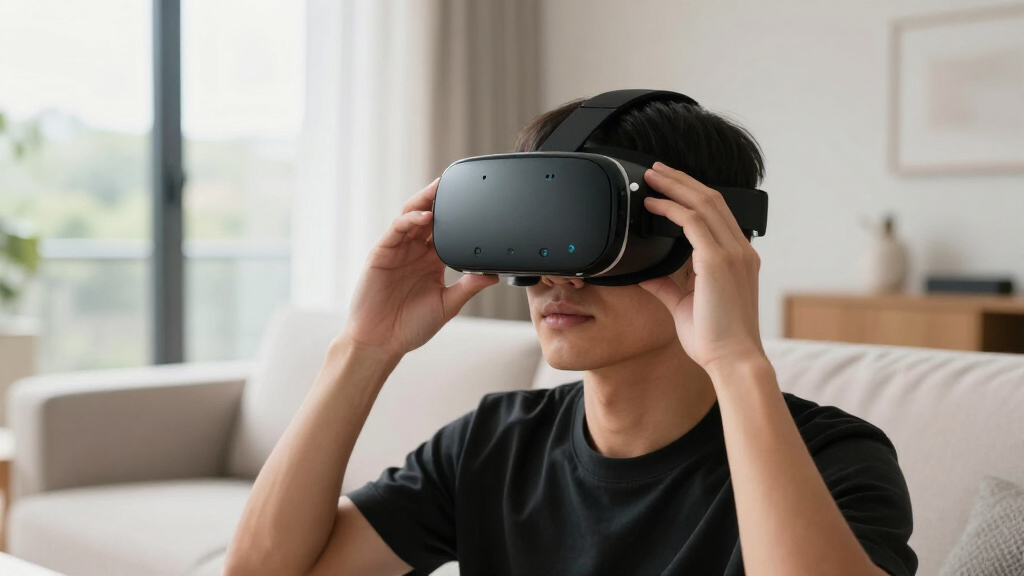
According to discussions on r/OculusQuest, the Oculus Quest uses a combination of accelerometers, gyroscopes, and outward-facing cameras to monitor user movements. These sensors collect data about the headset’s orientation, acceleration, and position in space, which is then processed by onboard algorithms to interpret user actions.
While Oculus has not publicly disclosed all technical specifics, users and developers note that the system’s ability to accurately track head and hand movements relies on sensor fusion—integrating data from multiple sensors to improve precision. The cameras play a significant role in positional tracking, especially in detecting hand gestures and spatial location.
Some community members speculate that the headset employs advanced machine learning techniques to refine movement detection, but Oculus has not confirmed this. The detailed mechanics of how sensor data is processed internally remain proprietary and are not fully disclosed.
How Does the Headset Detect This?
TL;DR: Oculus Quest headsets combine accelerometers, gyroscopes, and outward-facing cameras. Onboard software fuses those signals into a continuously updated estimate of head and hand movement in three-dimensional space.
Three inputs, three different jobs
No single sensor can explain every movement reliably. The headset cross-checks rapid internal measurements against what its cameras observe.
Accelerometers
Measure changes in velocity along multiple axes. They help detect translation, sudden movement, and gravity-relative tilt.
Gyroscopes
Measure angular velocity. They respond quickly when the user turns, tilts, or rolls the headset.
Cameras
Observe environmental features, controllers, and hands to estimate position, direction, and spatial change.
What each component can see
The highlighted column shows why sensor fusion matters: combining imperfect inputs produces a more useful tracking result.
| Tracking task | IMU sensors | Fused system | Cameras |
|---|---|---|---|
| Fast head rotation | ✓ Strong | ✓ Strong | ~ Supporting |
| Position in the room | ~ Drifts over time | ✓ Strong | ✓ Strong |
| Hand or controller location | ✗ Limited alone | ✓ Strong | ✓ Primary input |
| Low-latency prediction | ✓ Strong | ✓ Strong | ~ Frame dependent |
| Long-term stability | ✗ Weak alone | ✓ Strong | ✓ Corrects drift |
From raw signal to virtual movement
The exact internal algorithms remain proprietary, but the publicly understood workflow follows a recurring sensing, comparison, estimation, and rendering loop.
Sense
Motion sensors and cameras continuously produce fresh measurements.
Compare
Visual observations are checked against rapid inertial readings.
Estimate
Sensor fusion calculates the most likely pose in 3D space.
Render
The virtual camera and tracked hands are updated to match the user.
Complementary strengths
Conceptual contribution by tracking task—not a published Oculus performance benchmark.
Known hardware, guarded software
Community reporting clarifies the broad architecture, but discussion should not be mistaken for full technical disclosure.
What is known
- Accelerometers and gyroscopes measure rapid headset motion.
- Outward-facing cameras support inside-out positional tracking.
- Multiple sensor streams are combined through sensor fusion.
- Firmware updates can improve tracking accuracy and latency.
What remains unclear
- The precise algorithms used to weight and reconcile each signal.
- The extent and role of machine learning in movement refinement.
- Exact public accuracy metrics across all environments and gestures.
- A timeline for deeper technical or privacy disclosures.
Immersion depends on the loop
Movement detection influences not only responsiveness, but also safety expectations and questions about continuously processed spatial data.
Accuracy
Stable pose estimates keep virtual objects aligned with the user’s real movement and reduce distracting drift.
Responsiveness
Fast sensing and prediction help minimize the delay between a physical action and its visible result.
Privacy
Cameras and motion sensors continuously process spatial information, making transparent data practices important.
“The hardware components are broadly understood. The proprietary advantage lies in how their signals are interpreted together.”
Summary of community discussion · r/OculusQuestRelated guides kept up to date
Vetted buying resources from the vrgearguide.com team.
5 Best VR Headsets With Eye Tracking for 2026
See the top picks →10 Best VR Headsets for VRChat in 2026
See the top picks →15 Best VR Headset Storage Cases in 2026
See the top picks →Implications for VR Experience and Privacy
Understanding how Oculus Quest detects user movements is crucial for assessing the accuracy and responsiveness of VR experiences. It also raises questions about data collection and privacy, as sensor data is continuously monitored and processed. Improved detection enhances immersion but also necessitates transparency about data use, especially for developers and consumers concerned about privacy.As an affiliate, we earn on qualifying purchases.
Technical Foundations of Oculus Quest’s Movement Detection
The Oculus Quest, launched in 2019, was among the first standalone VR headsets to offer inside-out tracking, eliminating the need for external sensors. Its movement detection relies on a combination of built-in sensors—accelerometers and gyroscopes—similar to those used in smartphones, combined with outward-facing cameras that track the environment and user’s hands.
Over time, Oculus has upgraded its tracking algorithms through firmware updates, improving accuracy and reducing latency. The system’s ability to interpret complex gestures depends on sensor fusion techniques that combine data streams from multiple sensors, creating a cohesive understanding of user movements in 3D space.
Community discussions on r/OculusQuest highlight that while the hardware components are well-understood, the specific algorithms and processing methods remain proprietary. Oculus has emphasized that the system is designed to optimize user experience and safety, but detailed technical disclosures are limited.
“The headset uses a combination of accelerometers, gyroscopes, and cameras to track movement, and the data is fused to interpret user actions accurately.”
— an anonymous researcher
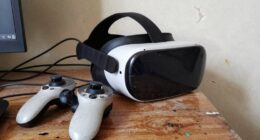
VR headset hand tracking controllers
As an affiliate, we earn on qualifying purchases.
As an affiliate, we earn on qualifying purchases.
Unconfirmed Details About Internal Processing
Specific details about the internal algorithms and whether machine learning techniques are employed remain unconfirmed. Oculus has not publicly disclosed how sensor data is processed beyond general descriptions, leaving some aspects of the detection system unclear.
As an affiliate, we earn on qualifying purchases.
Future Updates and Transparency Efforts
Oculus is expected to continue refining its tracking technology through firmware updates and possibly disclose more technical details in future developer communications. Monitoring official Oculus or Meta announcements will be key to understanding further advancements and transparency about movement detection.
VR headset with outward-facing cameras
As an affiliate, we earn on qualifying purchases.
As an affiliate, we earn on qualifying purchases.
Key Questions
What sensors does the Oculus Quest use for movement detection?
The Oculus Quest uses accelerometers, gyroscopes, and outward-facing cameras to track head and hand movements in real time.
Are the algorithms used in movement detection publicly available?
No, Oculus has not disclosed the specific algorithms, citing proprietary technology and privacy considerations.
How accurate is the Oculus Quest in detecting movements?
Community reports suggest high accuracy in tracking head and hand gestures, especially after firmware updates, but exact metrics are not publicly available.
Does movement detection involve machine learning?
It is suspected that machine learning techniques may be employed, but Oculus has not confirmed this detail.
Will Oculus release more technical details in the future?
Future updates or developer disclosures may reveal more about the internal processing, but no specific timeline has been announced.
Source: r/OculusQuest
Fall Picks
fall essentials
As an affiliate, we earn on qualifying purchases.