
When choosing a codec for VR streaming, H.264 is a reliable, widely-supported option that keeps things simple and offers good quality with low latency. HEVC, on the other hand, compresses video more efficiently, so it delivers higher quality at smaller sizes, especially at higher resolutions. This can reduce buffering and improve smoothness. Keep in mind, HEVC may need more processing power and isn’t compatible everywhere. Exploring the details can help you pick the best for your VR setup.
Key Takeaways
- H.264 is an older, widely supported codec that offers decent quality with moderate compression, suitable for many devices.
- HEVC (H.265) provides about double the compression efficiency of H.264, resulting in smaller files and better high-resolution quality.
- Using HEVC reduces bandwidth needs, allowing smoother VR streaming with less lag and buffering.
- HEVC requires more processing power for encoding and decoding, which may not work well on older devices.
- H.264 remains compatible with most devices, while HEVC is better for modern systems seeking higher quality at lower data rates.
Virtual reality streaming relies heavily on efficient video compression to deliver high-quality experiences in real time. When you’re immersed in a VR environment, every millisecond counts, and how your device processes and transmits video plays a pivotal role in this. Compression techniques are the backbone of this process, reducing the size of the video data so it can stream smoothly over your internet connection. Without effective compression, the high-resolution visuals would cause delays, buffering, or even disconnections, ruining your experience. That’s why understanding the core differences between popular codecs like H.264 and HEVC is vital, especially when it comes to latency optimization. These codecs determine how efficiently the video data gets compressed and decompressed, directly impacting how responsive and seamless your VR session feels.
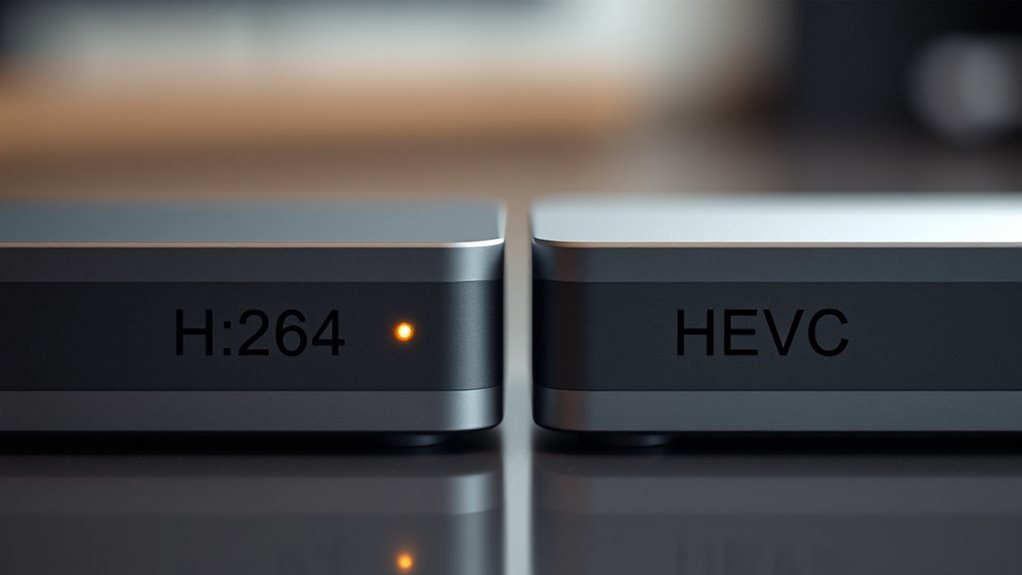
H.264, also known as AVC, has been around for quite some time. It’s widely supported and well-established, making it a reliable choice for many streaming applications. Its compression techniques are effective at reducing video size without sacrificing too much detail, which helps in keeping latency low. However, as VR content demands higher resolutions and frame rates, H.264 starts to show limitations. Its compression efficiency isn’t as advanced as newer codecs, meaning it requires more bandwidth to deliver the same quality. This can introduce latency issues, especially if your internet connection isn’t robust enough, leading to lag or decreased visual fidelity. Despite this, H.264’s compatibility across devices makes it a safe fallback for many VR platforms.
On the other hand, HEVC, or H.265, offers significant improvements in compression techniques. It can deliver the same video quality as H.264 but at roughly half the bitrate, which is a game-changer for VR streaming. This means your device can handle higher resolutions with less data, helping to optimize latency and reduce buffering. HEVC’s advanced algorithms analyze the video more efficiently, removing redundant information more effectively and therefore streamlining data flow. If your system supports HEVC, you’ll notice smoother visuals and quicker response times, making your VR experience feel more natural and immersive. But, keep in mind that HEVC requires more processing power for encoding and decoding, which might impact compatibility on older devices. Additionally, European cloud servers are increasingly supporting HEVC, facilitating more sustainable and secure streaming solutions for VR content.
Frequently Asked Questions
How Do Codecs Affect VR Streaming Quality and Latency?
You’ll notice that codecs directly impact your VR streaming quality and latency. Better compression efficiency means less data to transmit, which improves image clarity and reduces lag. HEVC, for example, requires less bandwidth than H.264, leading to smoother experiences with less buffering. So, choosing the right codec helps you enjoy high-quality VR with quicker responses, minimizing delays and enhancing immersion in your virtual environment.
Are Older Devices Compatible With HEVC?
Older devices often struggle with HEVC due to hardware limitations. Compatibility depends on your device’s hardware, specifically its decoding capabilities. If your device doesn’t have the right hardware support, HEVC might not work properly or at all. You should check your device specifications before attempting to stream with HEVC, as using unsupported codecs can lead to poor performance or increased latency.
Which Codec Is More Future-Proof for VR Content?
HEVC is more future-proof for VR content because it offers better compression efficiency and quality, aligning with codec evolution trends. While H.264 served well in the past, embracing HEVC now prepares you for upcoming advancements and higher resolutions. Future-proofing strategies involve adopting codecs that support evolving hardware and streaming demands, ensuring your VR experience remains seamless and up-to-date. So, choose HEVC to stay ahead in the ever-changing VR landscape.
How Do Codecs Impact Battery Life During VR Streaming?
Codecs substantially impact your VR streaming experience by affecting battery life. When a codec is well-optimized, it uses less processing power, boosting battery efficiency. HEVC, for example, offers better compression than H.264, which can reduce energy consumption during streaming. So, choosing a codec with strong optimization helps extend your device’s battery life, making your VR sessions last longer without sacrificing quality.
Can I Switch Between Codecs Without Restarting the Stream?
You can usually switch between codecs like H.264 and HEVC during VR streaming, but it often causes stream interruption. Most platforms don’t support seamless codec switching without restarting the stream, so you should anticipate a brief pause. To minimize disruption, plan your codec changes carefully and check if your streaming software offers real-time codec switching options. This way, you reduce downtime and ensure smoother viewing experiences.
Conclusion
As you explore VR streaming, understanding codecs like H.264 and HEVC is just the beginning. The real game-changer lies ahead—what future codecs might unseal even better quality and efficiency. Will they bridge the gap between immersive experience and bandwidth limits? Stay tuned, because the next evolution could redefine how you experience virtual worlds forever. The journey into streaming tech isn’t over yet—something groundbreaking is on the horizon, and you won’t want to miss it.