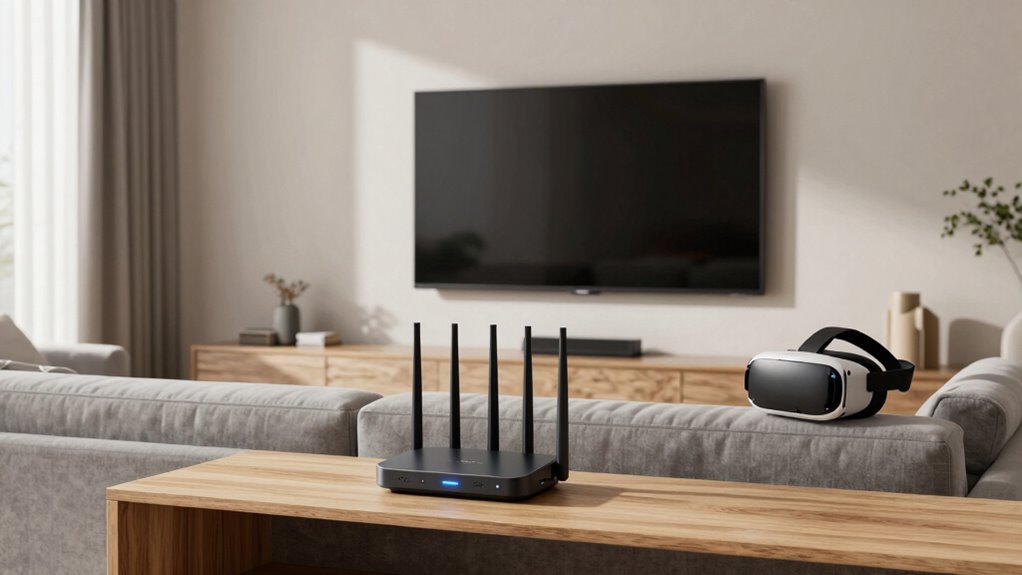

Wi-Fi 6E improves your wireless VR experience by reducing interference from other household devices and overlapping networks, thanks to the less congested 6 GHz band. It offers faster, more stable connections with lower latency, ensuring smoother visuals and more accurate tracking. This means fewer disruptions, lag, or disconnections during your VR sessions. If you want to see how Wi-Fi 6E can elevate your virtual adventures, keep exploring the benefits it brings to home setups.

Get VR and gaming gear delivered free — and shop member deals
- Fast, free delivery on millions of items
- Access to Prime Big Deal Days deals on October 6–7
- Prime Video, Amazon Music and more included
Key Takeaways
- Reduces interference from other Wi-Fi networks and household devices, ensuring a more stable VR connection.
- Provides higher bandwidth for smooth streaming and high-resolution VR content without lag.
- Uses OFDMA and MU-MIMO to allow multiple devices to connect efficiently, minimizing congestion.
- Offers a more reliable, low-latency connection, enhancing responsiveness and immersion in wireless VR.
- Supports higher frame rates and complex environments, enabling more realistic and immersive VR experiences.
With the advent of Wi‑Fi 6E, wireless virtual reality (VR) experiences are becoming more seamless and immersive than ever before. This new standard tackles some of the biggest challenges in home VR setups, particularly interference mitigation and bandwidth expansion. As you try to enjoy a smooth, lag-free VR session, you’ve likely faced interruptions caused by overlapping signals from other Wi-Fi networks, smart devices, or household electronics. Wi‑Fi 6E operates on the 6 GHz band, which is less congested than the traditional 2.4 GHz and 5 GHz bands. This means fewer devices compete for the same frequencies, considerably reducing interference that can cause lag, jitter, or disconnections during your VR experience. The result is a more stable connection that maintains high fidelity, even in crowded households with multiple Wi-Fi networks and connected gadgets.
In addition to interference mitigation, Wi‑Fi 6E enables bandwidth expansion. VR content demands large data transfers to deliver high-resolution visuals, low latency, and real-time responsiveness. Previous Wi-Fi standards often struggled to keep up, especially when multiple devices shared the network. Wi‑Fi 6E dramatically increases available bandwidth, allowing you to stream or download large VR files, software updates, or multiplayer sessions without slowdown. This expansion ensures your headset receives consistent data flow, minimizing latency and buffering issues that can break immersion. With higher bandwidth, your VR system can support more complex environments, richer textures, and higher frame rates, making your virtual worlds feel more realistic and responsive.
Furthermore, Wi‑Fi 6E’s improvements aren’t just about raw speed; they also enhance overall network efficiency. Technologies like OFDMA and MU-MIMO, which are integral to Wi‑Fi 6E, enable multiple devices to communicate simultaneously without hogging bandwidth or causing congestion. This means your VR headset gets prioritized data transmission, reducing delay and jitter. As a result, you’ll experience smoother movement and more accurate tracking, critical for immersion and reducing motion sickness. Additionally, these advancements contribute to network sustainability by enabling more efficient use of spectrum and energy, aligning with the goals of sustainable technology development.
In your home, implementing Wi‑Fi 6E can transform your wireless VR experience. You won’t have to worry as much about interference from neighboring networks or household devices, and you’ll gain ample bandwidth to handle demanding VR content. This combination of interference mitigation and bandwidth expansion ensures your virtual adventures are more fluid, responsive, and immersive. As Wi‑Fi 6E becomes more widespread, you’ll find that wireless VR no longer requires cumbersome cables or compromises in quality—just a reliable, fast, and interference-resilient connection that elevates your virtual reality experience to new heights.
As an affiliate, we earn on qualifying purchases.
Frequently Asked Questions
How Does Wi‑Fi 6E Improve Latency for VR?
Wi-Fi 6E improves latency for VR by reducing network congestion and enhancing signal stability. With its expanded spectrum, it offers more channels, so your device experiences less interference and lag. This means smoother, more responsive gameplay, even when multiple devices are connected. The improved signal stability guarantees your VR experience is seamless, allowing you to move freely without worrying about delays or disconnections caused by crowded networks.
Can Wi‑Fi 6E Reduce Interference in Crowded Homes?
Yes, Wi-Fi 6E can reduce interference in crowded environments through interference mitigation techniques. Its expanded 6 GHz band minimizes congestion from other devices, providing cleaner signals and fewer interruptions. You’ll notice smoother VR experiences because Wi-Fi 6E handles multiple devices more efficiently, reducing latency and lag. This makes it ideal for crowded homes where interference from smartphones, smart home gadgets, and neighbors can otherwise degrade your wireless performance.
Is Wi‑Fi 6E Compatible With Existing VR Headsets?
Wi-Fi 6E can be compatible with your existing VR headset, but compatibility concerns may arise depending on your device’s firmware and hardware. You might need firmware updates to guarantee peak performance and compatibility. Check your headset manufacturer’s instructions or support site for updates. If your device supports Wi-Fi 6E or can be upgraded, you’ll experience improved connectivity and reduced lag, making wireless VR more seamless in your home environment.
What’s the Real-World Speed Increase With Wi‑Fi 6E?
With Wi‑Fi 6E, you’ll notice real-world speed increases of up to 3x compared to older Wi‑Fi standards. This boost helps you overcome bandwidth bottlenecks, ensuring your VR streams smoothly without lag. Plus, Wi‑Fi 6E improves signal stability by using the 6 GHz band, reducing interference from other devices. As a result, your wireless VR experience becomes more responsive, immersive, and reliable, even in busy home environments.
How Does Wi‑Fi 6E Affect Battery Life in VR Devices?
Wi‑Fi 6E actually improves battery life in VR devices because it’s more power-efficient, despite offering faster speeds. You’ll find that the enhanced power efficiency extends your battery longevity, allowing longer VR sessions without frequent recharging. While the device uses less power for data transmission, it still maintains a strong connection, so you benefit from both better performance and longer-lasting batteries, making your VR experience more seamless and enjoyable.
wireless VR headset with low latency
As an affiliate, we earn on qualifying purchases.
As an affiliate, we earn on qualifying purchases.
Conclusion
So, while Wi-Fi 6E brings some subtle improvements to wireless VR, it’s not exactly a game-changer overnight. Think of it as a gentle nudge toward a smoother experience, easing some of the usual bumps in your virtual adventures. With a bit of patience, these quiet upgrades might just make your home VR sessions feel a little more seamless and a lot more enjoyable—hinting at a future where virtual worlds become even more inviting.
As an affiliate, we earn on qualifying purchases.
As an affiliate, we earn on qualifying purchases.
Fall Picks
fall essentials
As an affiliate, we earn on qualifying purchases.