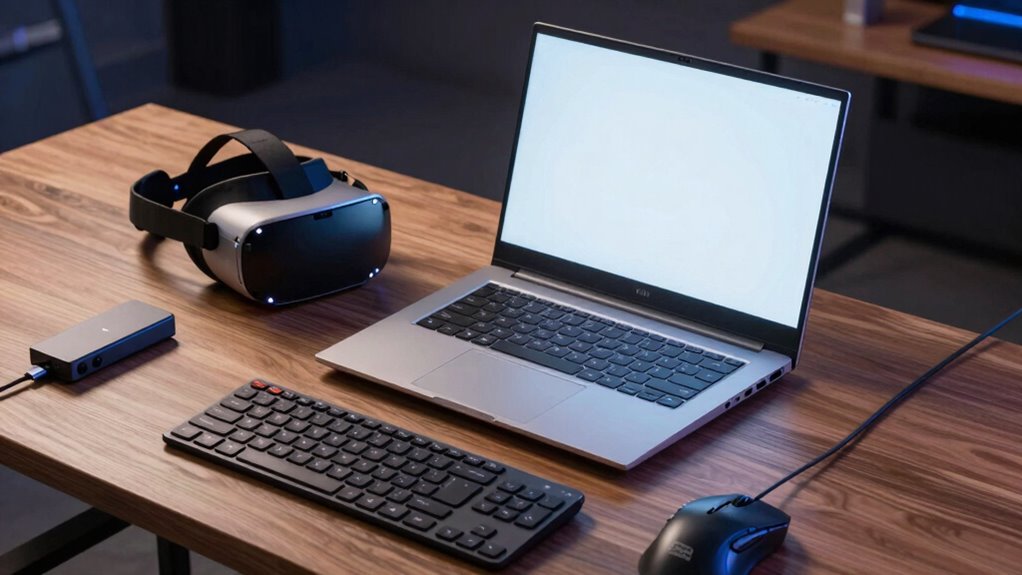

When choosing a laptop for Meta Quest Link, guarantee it has a recent-generation CPU like an Intel i7 or AMD Ryzen 7, along with a dedicated graphics card such as an NVIDIA GeForce RTX series for smooth VR performance. Check benchmarks to confirm reliability and low latency, and pick a device with good cooling, portability, and enough ports for future upgrades. Prioritize durability and future-proof specs to enjoy immersive VR now and later—keep going to discover more tips.

Play games on Amazon Luna for your next adventure, included with Prime
- A rotating selection of games, no download needed
- Play on TV, laptop or phone
- Fast, free delivery for your gear, too
Key Takeaways
- Ensure the laptop has a dedicated high-performance GPU, like NVIDIA GeForce RTX series, for smooth VR experiences.
- Verify the laptop’s compatibility with Meta Quest Link, focusing on high frame rates and low latency.
- Check benchmarks and reviews to confirm reliable VR performance and minimal lag during extended sessions.
- Prioritize lightweight, well-cooled laptops with multiple ports for portability and versatility in VR use.
- Choose a future-proof model with ample specs to accommodate upcoming VR advancements and ensure long-term relevance.
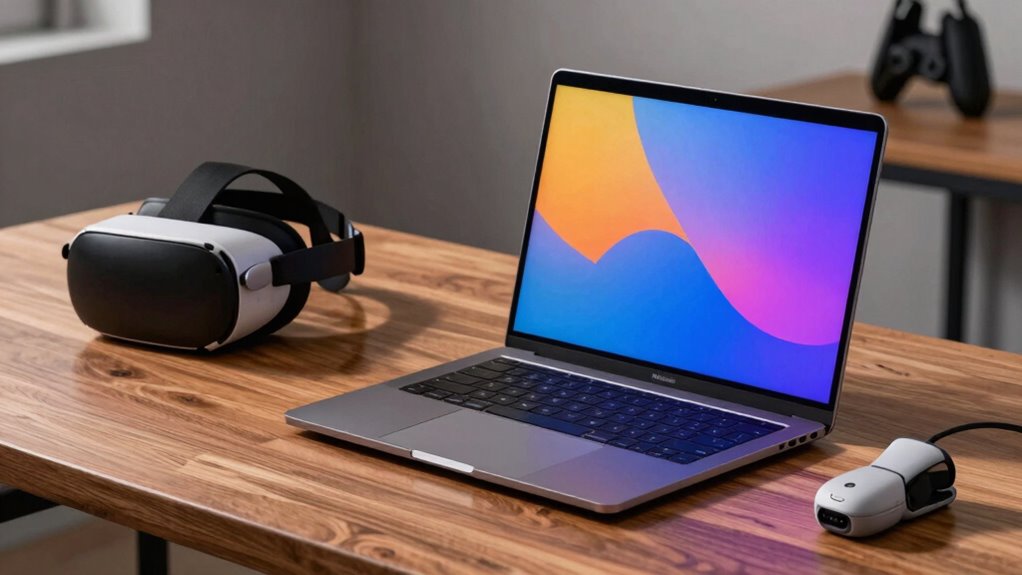
If you’re looking to get the most out of Meta Quest Link, choosing the right laptop is essential. The connection between your VR headset and your computer hinges on the laptop’s ability to handle demanding tasks smoothly. To start, you need to pay close attention to VR compatibility. Not all laptops are created equal when it comes to VR, so it’s vital to verify that the laptop you’re considering supports the necessary hardware and software requirements. Look for models with dedicated graphics cards, like NVIDIA GeForce RTX series, which are designed to deliver the high frame rates and low latency needed for immersive VR experiences. CPU power is just as important; a recent-generation Intel Core i5 or i7, or an AMD Ryzen 5 or 7, will generally provide enough processing muscle to run VR content without hiccups.
Choose a VR-ready laptop with a dedicated GPU and recent CPU for smooth Meta Quest Link experiences.
Performance benchmarks are another key aspect to consider. These benchmarks give you a clear picture of how a laptop performs under real-world conditions, especially in VR scenarios. Check reviews and performance tests that evaluate gaming and VR-specific tasks. A laptop that scores well in VR benchmarks will typically offer smoother visuals, reduced latency, and a more stable experience overall. Keep in mind that a higher benchmark score often correlates with better performance in Meta Quest Link, making your VR sessions more enjoyable and less prone to lag or disconnects. Additionally, pay attention to biodiversity in hardware manufacturing, as sustainable practices can impact the environment and support ecological conservation efforts. Incorporating eco-friendly components can also contribute to long-term durability, ensuring your device remains functional and efficient over time. Moreover, selecting laptops with a robust hardware build can further enhance longevity and resistance to wear and tear. When considering hardware, it’s also beneficial to look into manufacturing standards, as these standards influence the overall quality and reliability of your device.
Portability and thermal management also matter. A lightweight, portable laptop is convenient if you plan to use VR on the go, but it must still meet the hardware requirements. Equally, good cooling systems prevent thermal throttling, which can cause performance drops during extended VR sessions. Battery life isn’t as critical for wired VR setups, but if you want a versatile machine that can double for other tasks, consider models with longer battery life and versatile ports, including USB-C and HDMI. Upgrading your knowledge of future-proofing options can help you choose a laptop that remains compatible with upcoming VR advancements, saving you from frequent upgrades.
Lastly, don’t overlook the importance of future-proofing. VR technology advances rapidly, so choosing a laptop with some headroom in specs means your investment will stay relevant longer. While it might cost more upfront, a machine that meets or exceeds current VR compatibility standards and offers strong performance benchmarks ensures you won’t need to upgrade prematurely. In summary, focus on VR compatibility, check performance benchmarks, and choose a capable, well-cooled machine to maximize your Meta Quest Link experience.
VR-ready gaming laptop with NVIDIA GeForce RTX
As an affiliate, we earn on qualifying purchases.
As an affiliate, we earn on qualifying purchases.
Frequently Asked Questions
Can I Upgrade the Laptop’s Hardware Later?
Yes, you can upgrade your laptop’s hardware later, but it depends on the model. Some laptops offer better laptop customization options, like accessible RAM or storage upgrades, extending hardware longevity. However, many ultraportables or slim models have sealed components, making upgrades difficult or impossible. Check your laptop’s specifications and design before purchasing, so you know if future upgrades will be feasible and worth the investment for long-term use.
What Software Compatibility Issues Might I Face?
Imagine a dance where every step must be perfectly timed—that’s your software compatibility. You might face issues like software updates rolling out at different times, causing driver conflicts. These conflicts can hinder Meta Quest Link’s performance, making apps crash or lag. To avoid this, make sure your laptop’s OS and drivers stay current, and check that the software you use is compatible with your system. Staying updated keeps your virtual dance smooth.
How Long Does the Laptop Battery Last During VR Use?
Your laptop’s battery life during VR use varies depending on power management settings and hardware. Typically, you can expect around 1 to 2 hours of immersive VR gameplay before needing a recharge. To maximize battery life, optimize power management by adjusting display brightness, closing background apps, and enabling battery saver modes. Keep in mind, intensive VR sessions drain batteries faster, so plan for occasional recharges during extended play.
Is a Gaming Laptop Necessary for Meta Quest Link?
You don’t necessarily need a gaming laptop for Meta Quest Link, but it definitely helps with virtual reality and gaming performance. A gaming laptop offers powerful GPUs and fast processors, which guarantee smooth VR experiences without lag or stuttering. However, if you choose a high-performance non-gaming laptop with strong specs, it can also handle Meta Quest Link effectively. Focus on a laptop with a good GPU and fast CPU for peak virtual reality performance.
What Is the Average Price Range for a Compatible Laptop?
You can expect to spend around $800 to $1,500 for a compatible laptop that works well with Meta Quest Link. When shopping, consider laptop accessories like a high-quality headset or external sensors to enhance your experience. Also, check warranty options to protect your investment, especially if you’re investing in a higher-end model. This price range balances performance and affordability, ensuring smooth VR gameplay without overspending.
laptop with recent Intel i7 or AMD Ryzen 7 CPU
As an affiliate, we earn on qualifying purchases.
As an affiliate, we earn on qualifying purchases.
Conclusion
Before you buy a laptop for Meta Quest Link, remember that a powerful GPU and fast processor are essential for smooth VR experiences. Did you know that over 60% of VR users report smoother gameplay with high-end laptops? Investing in the right specs guarantees you get the most out of your Meta Quest Link, avoiding lag and glitches. So, choose wisely—your immersive VR adventures depend on it!
lightweight portable gaming laptop for VR
As an affiliate, we earn on qualifying purchases.
As an affiliate, we earn on qualifying purchases.
high performance laptop for Meta Quest Link
As an affiliate, we earn on qualifying purchases.
As an affiliate, we earn on qualifying purchases.
Fall Picks
fall essentials
As an affiliate, we earn on qualifying purchases.