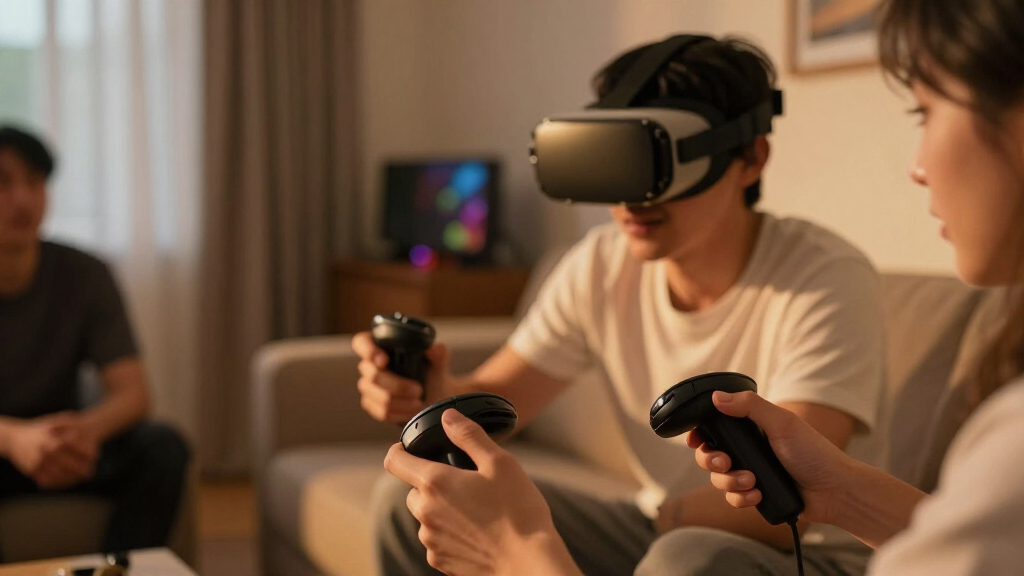

For VR horror, the accessory decision is not just whether to add haptics. It is whether you want a substantial wearable that can make impacts and environmental cues feel more present, or a simpler set of straps that adds vibration with less bulk and expense. A haptic vest covers more of the torso and can provide more varied, localized feedback when supported by the game or companion software. Wearable haptic straps are generally easier to wear and store, but their sensations are more limited by their smaller number and placement of motors.

Get VR and gaming gear delivered free — and shop member deals
- Fast, free delivery on millions of items
- Access to Prime Big Deal Days deals on October 6–7
- Prime Video, Amazon Music and more included
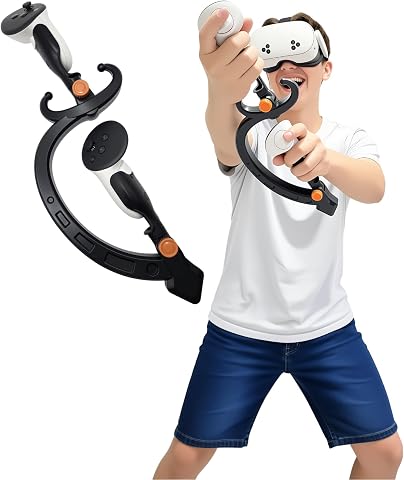
VR Two-Handed Sword for Meta Quest 2, Quest 3 & Quest 3S – Black
- ✔ Compatible headsets: Meta Quest 2, Quest 3, Quest 3S, and Quest Pro
- ✔ Accessory type: Two-handed sword hilt
- ✔ Release design: Quick-release half-shell

Apexinno VR Gun Stock Cover for Meta Quest 3 & Quest 3S Controllers
- ✔ Compatible headsets: Meta Quest 3 and Quest 3S
- ✔ Accessory type: VR gun stock cover
- ✔ Material: High-strength ABS
The vest is the better fit for players who value immersion and expect to use haptics often; the straps suit people testing the idea, playing in shorter sessions, or watching their budget. Game support matters: neither accessory automatically translates every in-game sound or event into convincing physical feedback. The comparison below focuses on the shared decision criteria that affect comfort, setup, compatibility, immersion, and value.
At a Glance
| Criteria | Haptic vest | Wearable haptic straps | Winner |
|---|---|---|---|
| Immersion and feedback coverage | Broader torso coverage and more potential feedback zones; results depend on the model and supported content. | Focused vibration from a smaller wearable area; less spatially detailed than a vest. | A |
| Comfort and freedom of movement | More weight and coverage; can feel restrictive during long or physically active sessions. | Typically lighter and less bulky, though fit and strap placement still matter. | B |
| Setup and software | Often requires fitting, charging, and app or game-profile setup. | Usually simpler to wear and put away, with device-specific setup. | B |
| Game compatibility | Can rely on supported games, profiles, or audio-based features; effects vary. | Support varies; some products depend on companion software or audio input rather than native game integration. | Depends |
| Session practicality | More involved to put on and store, but rewarding for planned horror sessions. | Easier to add to shorter sessions and more convenient to store. | B |
| Cost and value | Usually the larger investment; makes sense when frequent use and stronger immersion justify it. | Usually the lower-cost entry into wearable haptics; better value for experimentation or occasional play. | Depends |
VR Two-Handed Sword for Meta Quest 2, Quest 3 & Quest 3S – Black
When a horror game puts us in close quarters, a bare controller can feel unlike a sword handle. This modular hilt is designed to add weight and leverage, giving sword movements a more substantial physical grip. Its adjustable angle and rotation are especially useful for players who want to align the controller with different weapon styles rather than accept one fixed orientation. That makes it our best overall choice in this two-product comparison, particularly for melee-focused Quest play.The defining advantage over the Apexinno gun stock is configuration flexibility. A half-shell quick-release design can make it easier to detach or rearrange the controller setup for dual-wielding or shield use, while the modular build is described as fully ambidextrous. It also works with existing silicone controller grips, which may matter if we already use a grip cover. By comparison, Apexinno has a simpler snap-in approach, but its main purpose is a stable shooting hold rather than changing between sword-like configurations.That flexibility has limits. The sword accessory is for Meta Quest controllers only, and it may add a physical component that we need to account for when swinging in a confined play area. Its specialized shape makes little sense for a horror game centered on firearms or exploration rather than melee. Buyers should also check that their controller grip arrangement leaves room for the accessory, even though compatibility with existing silicone grips is listed.Choose this model if a convincing, adjustable melee grip is more important than a minimal setup. If the main challenge in our horror games is aiming a weapon, Apexinno is the more relevant design; if we want broader Quest model coverage and multiple sword-handling options, the modular hilt is the stronger fit.
Pros:
- Adds weight and leverage for a more substantial melee grip.
- Adjustable angle and rotation can suit different sword styles.
- Quick-release half-shell supports changing configurations, including dual-wielding or shield use.
- Ambidextrous modular design and compatibility with existing silicone grips add setup flexibility.
Cons:
- Limited to Meta Quest controllers rather than a cross-platform accessory.
- Its specialized hilt and added hardware may be inconvenient in tight play spaces or for non-melee games.
- More adjustable components may require more setup decisions than Apexinno’s snap-in stock cover.
Best for: Quest players who spend much of their VR horror time using swords or other melee weapons and want adjustable, ambidextrous handling.
Not ideal for: Players focused on firearm-based horror, anyone using a non-Meta headset, or those who prefer the least bulky controller setup.
Bottom line: For Quest melee horror, we favor this adjustable, quick-release hilt over Apexinno because it supports more grip configurations, provided we can accommodate its added hardware.
“For Quest melee horror, we favor this adjustable, quick-release hilt over Apexinno because it supports more grip configurations, provided we can accommodate its added hardware.”
Apexinno VR Gun Stock Cover for Meta Quest 3 & Quest 3S Controllers
For horror games built around aiming and shooting, Apexinno takes a more direct approach than the sword hilt: it wraps the Quest 3 or Quest 3S controller in a stock-style cover intended to add weight and balance. The textured ABS grip aims to provide a more secure hold and reduce hand fatigue, while precision cutouts are designed to avoid interfering with controller tracking. Those details make it the most purpose-built choice here for firearm-focused encounters.Its strongest practical difference from the sword accessory is its simple snap-in installation. No tools are required, so setup is less involved than choosing an angle and configuration for a modular hilt. That simplicity comes with a narrower mission: the cover is about a shooting grip, not adapting to sword styles, dual-wielding, or shield use. If our horror library leans toward guns, the focused design is a reasonable trade; if melee is central, the sword is the more relevant pick.We should weigh the comfort claim against the listed drawback of extra bulk. A more substantial grip may feel useful for aiming, but a larger controller can be less appealing during quick movement or games that rely on frequent changes in hand position. Compatibility is also limited to Quest 3 and Quest 3S, making the sword the better option for Quest 2 or Quest Pro owners. The product description says the cutouts avoid tracking interference, but buyers should still install it as intended and make sure the controllers remain unobstructed.Apexinno is best when we want a straightforward, shooting-oriented accessory for a compatible headset. It ranks behind the sword overall because it has fewer supported headsets and a more specialized handling role—not because its focused design is a poor match for firearm-led horror.
Pros:
- Adds weight and balance intended to support steadier aiming.
- Textured, ergonomic ABS grip is designed to reduce slipping and hand fatigue.
- Precision cutouts are designed to preserve controller tracking.
- Snap-in installation requires no tools.
Cons:
- Adds bulk, which may feel cumbersome during movement or frequent grip changes.
- Compatible only with Quest 3 and Quest 3S controllers.
- Its shooting-specific shape offers less versatility than the modular sword hilt for melee play.
Best for: Quest 3 and Quest 3S owners who play firearm-focused VR horror and want a textured, stock-style controller grip with tool-free installation.
Not ideal for: Quest 2 or Quest Pro owners, melee-focused players, and anyone trying to keep the controller as compact as possible.
Bottom line: For firearm-led horror on Quest 3 or Quest 3S, Apexinno offers the simpler shooting grip, but its added bulk and limited headset fit make it less versatile than the sword accessory.
“For firearm-led horror on Quest 3 or Quest 3S, Apexinno offers the simpler shooting grip, but its added bulk and limited headset fit make it less versatile than the sword accessory.”
As an Amazon Associate we earn from qualifying purchases.
Key Differences
The biggest difference is how much of the body the accessory involves. A vest can spread feedback over the torso and may distinguish more kinds of sensations, giving supported horror games more room to communicate a hit, nearby movement, or another event. Straps provide a narrower set of vibrations. That can still add a physical cue, but it is less likely to feel like an event is happening around or across the body. The gap is meaningful for immersion, not a guarantee of better scares: software support and the quality of the haptic effects remain decisive.
The tradeoff is everyday practicality. A vest takes more effort to put on, may feel warm or restrictive, and costs more in most product comparisons. Straps are easier to wear, remove, and store, and are a safer starting point if you are unsure that haptics will improve your sessions. Pay extra for a vest when you expect to use it regularly and its supported features match the games you play. For occasional horror sessions, the lighter option is usually the more sensible buy.
Detailed Comparison
Immersion and feedback coverage (Haptic vest wins — major)
Winner: A, with a moderate-to-major gap. A vest can cover more of the torso and place feedback in multiple zones, which gives supported games more scope to make impacts and other cues feel physically distinct. Straps can still add a noticeable vibration, but the sensation is more concentrated and less varied. In practice, the vest has the advantage when the game and accessory profile are designed to work together; unsupported or poorly mapped effects can shrink that advantage.
Comfort and freedom of movement (Wearable haptic straps wins — moderate)
Winner: B, usually by a moderate margin. Straps generally cover less of the body and are lighter to wear, which can matter when a horror game involves turning, reaching, or longer sessions. A vest adds coverage and weight, so fit, heat, and movement become more noticeable. Comfort depends on the specific product and the player, but if you dislike extra gear against your torso, straps are the safer choice.
Setup and software (Wearable haptic straps wins — moderate)
Winner: B, by a minor-to-moderate margin. A smaller wearable is generally quicker to put on and put away. Both types may need charging, pairing, configuration, or companion software, so neither should be treated as plug-and-play across every headset and game. A vest can involve more fitting and feature setup. Check the exact device requirements before buying, especially if you want to avoid troubleshooting before a session.
Game compatibility (major difference)
Winner: Depends; the difference can be major for a particular game. Compatibility is determined by the accessory, the game, and any profile or audio-based software—not simply by whether the wearable is a vest or straps. A vest may have richer feedback where native support or a well-made profile exists, while straps may offer a simpler experience on some systems. Look up support for the exact titles and hardware you use. Do not pay a premium based on a general promise of compatibility.
Session practicality (Wearable haptic straps wins — moderate)
Winner: B, by a moderate margin for casual use. Straps are typically easier to keep near the headset and add to a short session. A vest is more of a deliberate setup: put it on, adjust it, and store it afterward. For a planned horror night, that extra effort may be worth it. For quick play or frequent breaks, the lighter accessory is more likely to get used rather than left on the shelf.
Cost and value (moderate difference)
Winner: Depends on how often you will use it. Straps are usually the lower-cost way to try wearable haptics, so they offer stronger value for curious or occasional players. A vest costs more, but can justify the premium for a frequent player who wants broader coverage and has compatible games. The price gap is only worthwhile if the additional feedback is available in your actual library and you are comfortable wearing the device.
Haptic vest: Pros and Cons
Pros:
- Broader torso coverage can make supported events feel more present.
- More potential feedback zones than a smaller strap-based wearable.
- A stronger choice for players who prioritize immersion and play often.
Cons:
- Usually costs more than straps.
- More bulk, weight, and effort to put on and store.
- Benefits depend heavily on supported games, profiles, and software.
Wearable haptic straps: Pros and Cons
Pros:
- Typically lighter, less bulky, and easier to store.
- Usually a lower-cost way to try wearable haptics.
- A practical fit for shorter or occasional horror sessions.
Cons:
- Feedback covers less of the body and may feel less spatially detailed.
- Still requires checking device compatibility and setup needs.
- May not satisfy players seeking a substantial, full-torso sensation.
Who Should Choose What
Choose Haptic vest if:
- You play VR horror regularly and want broader, more immersive torso feedback.
- Your favorite games have confirmed support or useful profiles for the vest you are considering.
- You are comfortable with added cost, weight, and setup in exchange for a richer haptic experience.
Choose Wearable haptic straps if:
- You want to try haptics without committing to a larger purchase.
- You prefer a lighter wearable for shorter sessions or easier storage.
- Convenience matters more to you than maximum coverage and varied sensations.
Skip both if: Skip both if you dislike wearing extra gear, your games lack useful support, or you mainly want improved visuals or audio rather than physical feedback.
Value for Money
Straps are generally the better value for a first purchase because they cost less and make it easier to find out whether wearable feedback improves your play. That does not make them the best value for every player: if their limited coverage feels too subtle, a cheaper accessory you rarely use is poor value. A vest is worth paying more for when you play often, want more extensive feedback, and have confirmed that your preferred titles support the features you are paying for. If those conditions are uncertain, start with straps or wait until you can verify compatibility.
Final Verdict
Choose a haptic vest if VR horror is a regular hobby and your priority is a more immersive, broader set of physical cues. Its advantages are meaningful for supported games, but the higher cost and extra bulk are hard to justify for occasional play. Choose wearable haptic straps if you want an easier, lower-cost entry point or value comfort and quick setup above maximum coverage. For most first-time buyers, straps are the safer purchase; frequent players with verified game support should choose the vest. The deciding factor is not the accessory label—it is whether your games can use its feedback well enough to justify wearing and paying for it.
Frequently Asked Questions
Do haptic accessories make VR horror games scarier?
They can make impacts and other supported events feel more physical, which may increase immersion. They do not change a game’s visuals or story, and poorly matched or repetitive vibration may add little. The effect depends on the game, accessory, and your comfort with haptics.
Are haptic vests compatible with every VR horror game?
No. Support varies by game, wearable, headset, and companion software. Some devices use game-specific integration or profiles; others may use audio-driven effects. Check compatibility for the exact titles you plan to play before paying more for a vest.
Are wearable haptic straps a good alternative to a vest?
Yes, if you want a lighter and usually less expensive way to add vibration. They are not a one-for-one substitute for a vest’s broader coverage, so players who want more varied torso feedback may find straps limited.
Which option is better for long VR sessions?
Straps often have an advantage because they cover less of the body and can be easier to wear for extended play. Individual fit matters, and a well-fitting vest may still suit some players. Take comfort and heat into account, not only haptic strength.
Fall Picks
fall essentials
As an affiliate, we earn on qualifying purchases.