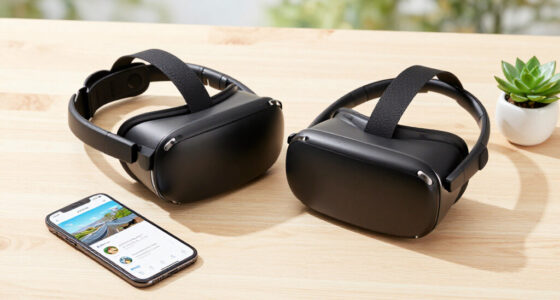
Wireless PCVR promises freedom: no cables, no tugging, no immersion breaks.
But it also raises a practical question many VR users struggle to answer:

Play games on Amazon Luna for your next adventure, included with Prime
- A rotating selection of games, no download needed
- Play on TV, laptop or phone
- Fast, free delivery for your gear, too
How much wireless bandwidth do I actually need for smooth PCVR?
That’s exactly why we built the VR Wireless Bandwidth Calculator.
This tool helps you estimate the real-world Mbps required for streaming PCVR over Wi-Fi—based on resolution, refresh rate, codec, and scene complexity—so you can make informed decisions about Wi-Fi 6 vs 6E vs Wi-Fi 7.
Why Wireless Bandwidth Matters for VR
Unlike flat gaming or video streaming, PCVR wireless streaming has unique demands:
- Two high-resolution displays (one per eye)
- High refresh rates (90–144 Hz)
- Extremely low tolerance for latency and packet loss
- Rapid scene changes that create bitrate spikes
If your wireless link can’t keep up, the result is familiar:
- Compression artifacts
- Micro-stutters
- Latency spikes
- Motion sickness for some users
Marketing specs like “AX5400” or “BE11000” don’t tell you whether a setup will actually work for your headset and settings.
That’s where a bandwidth-first view becomes useful.
As an affiliate, we earn on qualifying purchases.
What the VR Wireless Bandwidth Calculator Does
The calculator estimates the sustained video bitrate required for wireless PCVR streaming (e.g. Air Link or Virtual Desktop), not raw uncompressed video.
It takes into account:
- Resolution per eye
- Refresh rate (Hz)
- Video codec (H.264, HEVC, AV1)
- Quality target (from “low” to “near-wired”)
- Scene complexity (static vs fast motion)
- Stability margin for real-world Wi-Fi conditions
Based on these inputs, it outputs:
- Estimated sustained Mbps
- Estimated peak burst Mbps
- A practical Wi-Fi recommendation (Wi-Fi 6, 6E, or 7)
- Setup tips to improve stability
As an affiliate, we earn on qualifying purchases.
Use the VR Wireless Bandwidth Calculator
👉 Interactive Tool Below
VR Wireless Bandwidth Calculator
Estimate the wireless streaming bitrate you’ll need for Air Link / Virtual Desktop style PCVR. Results are approximate but useful for choosing Wi-Fi 6 vs 6E vs 7.
As an affiliate, we earn on qualifying purchases.
How to Interpret the Results
Sustained Bitrate
This is the bandwidth your network must deliver consistently during gameplay.
If your Wi-Fi can’t maintain this level, quality drops or stutter becomes likely.
Peak Bursts
Short spikes caused by:
- Scene changes
- High motion
- I-frames in video encoding
These bursts explain why “average speed” alone is not enough for VR.
Suggested Wi-Fi Tier
The recommendation accounts for real-world interference, not lab conditions:
- Wi-Fi 6 – Can work at lower bitrates, but sensitive to congestion
- Wi-Fi 6E – Much more stable thanks to the clean 6 GHz band
- Wi-Fi 7 – Designed for very high bitrates and ultra-low latency
high bandwidth Wi-Fi router for VR
As an affiliate, we earn on qualifying purchases.
As an affiliate, we earn on qualifying purchases.
Why Wi-Fi 6E Often Feels Like a Bigger Upgrade Than Wi-Fi 6
Many users assume Wi-Fi 6 and 6E are similar because the standard name is almost the same.
For VR, the difference is substantial.
Wi-Fi 6E adds access to the 6 GHz band, which:
- Has no legacy devices
- Has far less interference
- Supports wide channels more reliably
For PCVR streaming, this often matters more than raw speed.
A Note on Accuracy and Real-World Variability
This calculator provides estimates, not guarantees.
Actual performance depends on:
- Router quality
- Channel width and congestion
- Distance and line-of-sight
- Whether your router is also handling other devices
- Headset decoder efficiency
That’s why the tool includes a stability margin—to reflect real homes, not ideal test labs.
Who This Tool Is For
The VR Wireless Bandwidth Calculator is especially useful if you:
- Use PCVR over Air Link or Virtual Desktop
- Are deciding between Wi-Fi 6, 6E, or 7
- Want to reduce stutter without blindly upgrading hardware
- Build or tune VR setups for sim racing or flight simulation
- Live in an apartment with dense Wi-Fi traffic
Bottom Line
Wireless PCVR quality is limited less by “headline Wi-Fi speed” and more by consistent, low-latency bandwidth delivery.
This calculator helps translate your VR settings into actionable network requirements, so you can:
- Avoid unnecessary upgrades
- Identify real bottlenecks
- Build a wireless setup that actually feels smooth
If you’re exploring wireless PCVR seriously, understanding bandwidth is no longer optional—it’s foundational.
Evergreen bestsellers Picks
bestsellers
As an affiliate, we earn on qualifying purchases.