TL;DR

Play games on Amazon Luna for your next adventure, included with Prime
- A rotating selection of games, no download needed
- Play on TV, laptop or phone
- Fast, free delivery for your gear, too
IdeaClyst acts as a private, AI-powered war room for your ideas, combining structured debates, research grounding, and local storage. It helps founders cut through guesswork and move from concept to action faster, without risking data leaks or expensive mistakes.
Ever stared at three tabs, each with a different idea, feeling that familiar knot tighten in your stomach? That’s the founder’s dilemma: which idea deserves your time — really deserves it? The build part is easy now. The decision-making? That’s where most stumble. A War Room for Your Next Idea: Inside IdeaClyst
Enter IdeaClyst. It’s not just a tool; it’s a war room in your pocket. Designed to simulate a boardroom of diverse advisors, it forces ideas into the light, exposes weaknesses, and helps you decide what’s worth building — all on your own machine. No cloud, no subscriptions, just you, your ideas, and a structured way to sharpen your conviction.
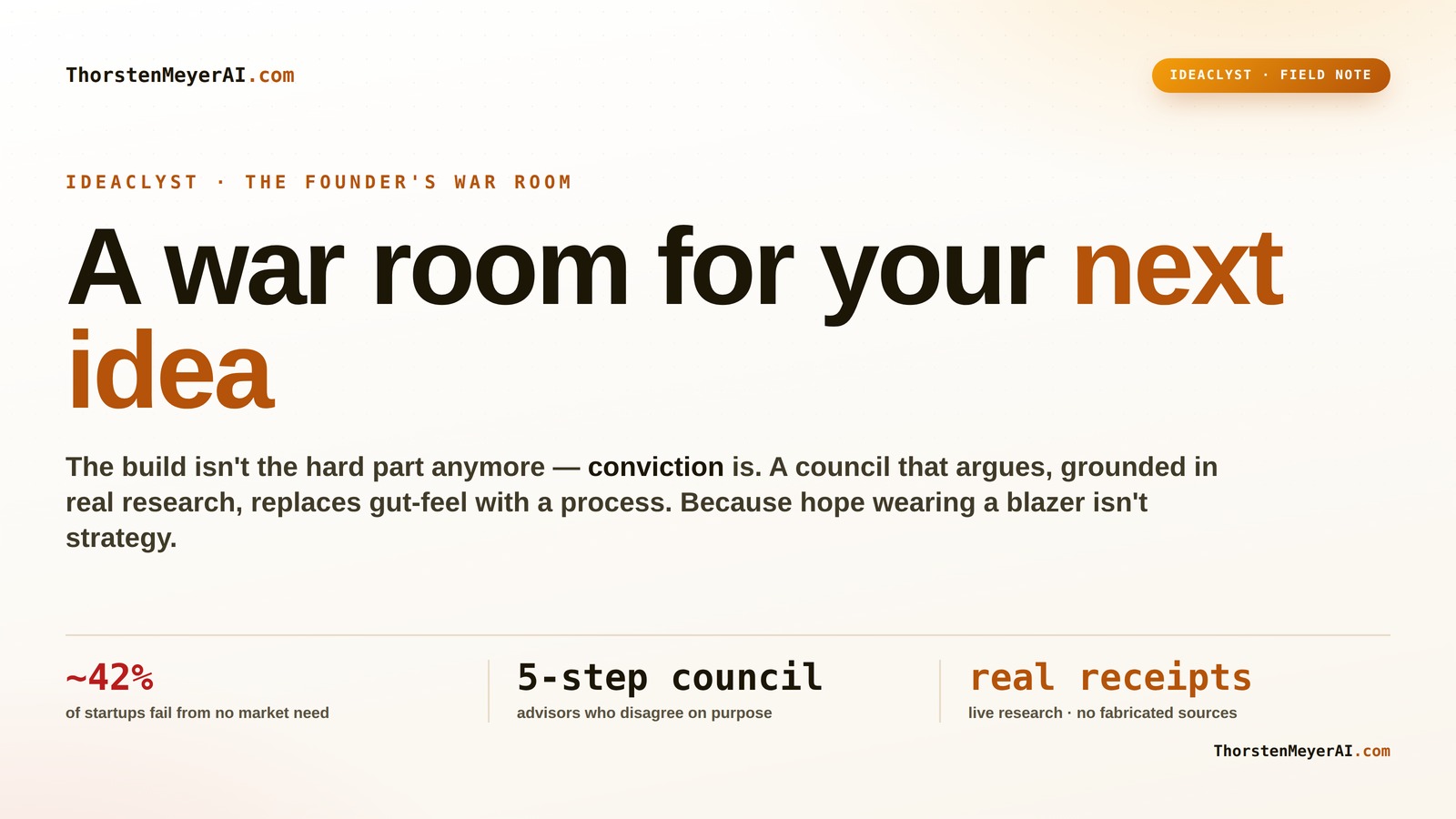
A war room for your next idea
The build isn’t the hard part anymore — conviction is. Knowing which idea deserves the next six months, and being able to defend it. Most founders answer with gut feel and optimistic math. That’s hope wearing a blazer. IdeaClyst replaces it with a process.
The most expensive decision is what to build
The single most valuable thing a tool can do is talk you out of the wrong six months. The numbers make the case better than any pitch.
Three tools in one — on your own machine
Strip away the framing and IdeaClyst is three things at once, all running locally with nothing leaving your laptop.
An AI council
Pressure-tests an idea you bring it — advisors who argue on purpose.
A discovery engine
Finds ideas you didn’t know to look for by hunting real demand signals.
A founder’s workspace
Carries winners from “interesting” all the way to “ready to build.”
Advisors who disagree on purpose
Not one confident, agreeable answer — a structured five-step deliberation where models play different roles and turn on their own work. The disagreement is the feature.
The five-step deliberation
A council that leads with the bad news surfaces the objections you’d otherwise find the expensive way, on month five.
Product strategy
Who’s it for, what’s the wedge, why now, what’s the business model.
Technical architecture
What would it actually take to build — and where’s the risk.
Critique pass
The council turns on its own work. Where’s the hand-waving? What kills this?
Second, independent critique
A different voice, a different angle — so blind spots don’t survive.
Final synthesis
Everything into one coherent founder packet: strategy, architecture, validation, plan.
When IdeaClyst cites a source, it actually fetched it
The hard departure from “ask an AI what it thinks of my startup.” It runs in a strict, real-data-only mode — if it can’t gather genuine evidence, it says so plainly rather than inventing a plausible paragraph.
Confidence with receipts
No fabricated statistics, no imaginary competitors, no made-up citations. The packet survives a skeptical co-founder or a sharp investor because the reasoning has receipts.
Market research first
Scouts the landscape before the council reasons about anything.
Competitor read
Real positioning, pricing signals, feature claims — differentiation vs. reality.
Validation with links
Not “talk to customers” — concrete signals & sources you can click.
From the blank page to build-ready
Evaluation is half the problem; the blank page is the other half. And a plan is worthless if it dies in a tab you never reopen.
Bring a space, not an idea
“AI for accountants,” “tools for indie game studios” — plus your goal and real capacity. It hunts demand signals across HN, Reddit, Product Hunt, GitHub, pricing pages.
- An honest market read — leads with the bad news when a space is hard
- An opportunity map — high pain, thin competition
- Ranked candidates — wedge, who pays, effort, risk, confidence
- each with KILL CRITERIA — when to walk away
A home and a forward path
Every promising idea gets carried forward, with every artifact in plain files on your disk.
- Validation tooling — sprint board, interview list, evidence browser
- Founder profile — a personal-fit lens; same discovery, different advice
- Build workspaces — funnel, personas, landing draft, version history
- “Build this idea” → a PRD + task queue, ready for a coding agent
Key Takeaways
- IdeaClyst combines a structured AI debate with live web research, grounding your ideas in facts rather than assumptions.
- The local-first design keeps all your data private, owned, and easily integrable into your workflow.
- Its multi-model council surfaces objections you might miss, reducing costly mistakes before building.
- It’s suitable for solo founders, impact teams, and small startups needing a rigorous, private decision space.
- Using IdeaClyst can cut validation time from months to hours, saving thousands in unnecessary development.
private AI idea validation software
As an affiliate, we earn on qualifying purchases.
As an affiliate, we earn on qualifying purchases.
Why a War Room? It’s the Secret Weapon for Better Decisions
Imagine a war room where every move is debated, every risk laid bare. That’s what IdeaClyst offers — a dedicated space for founders to challenge their ideas from multiple angles. Instead of a gut feeling or a hunch, you get a structured, multi-perspective debate.
Why does this matter? Because human intuition is inherently biased and limited. Relying solely on your gut can lead to overlooking critical flaws or overestimating an idea’s potential. The war room approach forces you to confront uncomfortable truths and consider alternative viewpoints, which ultimately results in more robust decisions. It’s a tradeoff: you invest time upfront in rigorous validation, but this can save you from costly failures down the line. For startups, this disciplined process can be the difference between pivoting early or wasting resources on a flawed concept.
As an affiliate, we earn on qualifying purchases.
How IdeaClyst’s AI Council Sparks Better Ideas and Smarter Choices
IdeaClyst isn’t just another brainstorming app. It’s an AI council that stages a five-step debate, with each model playing a different role. It starts with strategy, then technical feasibility, critique, second critique, and finally, a synthesis.
This staged disagreement isn’t just for fun; it’s a deliberate design to surface blind spots and challenge assumptions. For example, when exploring a new nonprofit initiative, one model might focus on the target demographic, questioning whether the proposed approach truly meets their needs. Another might scrutinize the technical feasibility, highlighting potential hurdles. The critique models push back on assumptions, forcing you to defend or refine your ideas. The synthesis then consolidates these perspectives into a cohesive plan.
The key here is the tradeoff: more thorough validation requires time and mental effort upfront, but it drastically reduces the risk of overlooking critical flaws. This process helps you identify weaknesses early, saving you from expensive mistakes and guiding your focus toward the most promising paths. The final output isn’t just a plan; it’s a well-vetted, resilient strategy that considers multiple angles.
team research collaboration software
As an affiliate, we earn on qualifying purchases.
As an affiliate, we earn on qualifying purchases.
Grounded in Real Research — Not Just Model Vibes
Many AI tools talk a big game but rely on outdated or surface-level info. IdeaClyst breaks that mold by grounding its critiques in live web research. It pulls in fresh data, relevant to today’s market, giving you validation rooted in facts, not guesses.
Why is this important? Because market conditions, user preferences, and technology landscapes change rapidly. Relying on static or outdated data can lead you astray, causing you to pursue ideas that no longer hold value or miss emerging opportunities. By integrating live research, IdeaClyst ensures your validation is based on current realities, making your decisions more accurate and timely. This reduces the risk of building products or strategies that are irrelevant or obsolete by the time you launch. Essentially, grounding your ideas in real-time data enhances your confidence and agility, giving you a competitive edge in fast-moving markets.
For instance, if you’re exploring a new app, it scans recent articles, market reports, and user trends, providing evidence-backed insights. This approach minimizes the guesswork and helps you prioritize ideas with the highest real-world potential.
As an affiliate, we earn on qualifying purchases.
Frequently Asked Questions
Is IdeaClyst suitable for solo founders or small teams?
Absolutely. Its design is perfect for solo entrepreneurs and small teams that need a private, structured space to challenge and develop ideas without relying on external cloud services.Can I trust IdeaClyst to ground my ideas in real data?
Yes. It pulls live web research into its debates, ensuring your validation is based on current, relevant facts. This helps avoid the common trap of relying on outdated or biased info.Is it difficult to set up and use?
Not really. Since it runs locally, setup is straightforward. The debate process may take some getting used to, but it’s designed to be intuitive and worth the effort for serious decision-making. A War Room for Your Next Idea: Inside IdeaClystDoes it integrate with other tools or platforms?
Because everything is stored as plain files on your disk, you can easily integrate IdeaClyst with your existing workflows, version control, or other local tools.Is IdeaClyst free or paid?
It’s open source under the MIT license, so you can run it for free on your own machine. No recurring subscription fees or cloud costs.Conclusion
Imagine a war room where every decision is challenged from multiple angles, with your data safely stored on your own machine. That’s what IdeaClyst offers — a private, argument-driven space to sharpen your conviction and accelerate your path from concept to action.
If you’re serious about turning ideas into impactful realities, this tool could be the secret weapon you’ve been missing. Your next big breakthrough might just start with a single, well-argued debate.
Halloween Picks
halloween
As an affiliate, we earn on qualifying purchases.