TL;DR

Get VR and gaming gear delivered free — and shop member deals
- Fast, free delivery on millions of items
- Access to Prime Big Deal Days deals on October 6–7
- Prime Video, Amazon Music and more included
Meta has announced Brain2Qwerty v2, an upgraded AI system capable of decoding full sentences from brain activity with higher accuracy. This development marks a step toward non-invasive, thought-to-text communication, especially for those with speech impairments.
Meta has introduced Brain2Qwerty v2, an advanced non-invasive brain-computer interface (BCI) system designed to decode neural activity into full sentences with significantly higher accuracy. This breakthrough, announced in a recent publication, moves the technology closer to enabling direct thought-to-text communication without surgical implants, which could benefit individuals with speech impairments.
Building on last year’s Brain2Qwerty v1, Meta’s latest iteration employs an end-to-end deep learning architecture, large language models (LLMs), and real-time decoding capabilities. The system was trained on approximately 22,000 sentences from nine volunteers who wore magnetoencephalography (MEG) devices while actively typing. The researchers report that Brain2Qwerty v2 can decode sentences with a word accuracy rate of 61%, a substantial improvement over the 8% accuracy achieved by previous non-invasive methods. The most successful participant achieved a 78% word accuracy, with more than half of all sentences decoded with one word error or less.
Meta states that decoding accuracy improves with increased data volume, indicating potential for further performance gains through data scaling. The system’s goal is to aid people with neurological injuries or diseases that impair speech, without the risks associated with invasive implants. While invasive methods like Neuralink are more efficient, they carry risks such as hemorrhage and infection, limiting their scalability. MEG devices, however, remain large and require magnetic shielding, posing challenges for consumer use. Nonetheless, ongoing advancements in smaller, room-temperature MEG sensors, such as Cerca’s optically-pumped magnetometers, suggest future possibilities for portable, non-invasive brain interfaces.
Implications for Non-Invasive Thought Communication
This development is significant because it demonstrates that non-invasive brain decoding can approach practical levels of accuracy for full sentences, potentially enabling communication for individuals with speech impairments. It also highlights a path toward less risky brain-computer interfaces, which could eventually replace invasive implants. The progress suggests that, with further data and technological refinement, non-invasive thought-to-text systems could become viable for everyday use, transforming how humans interact with technology and each other.
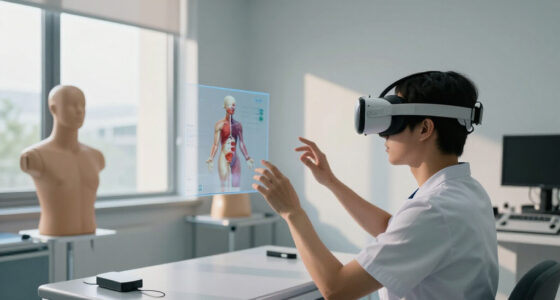
non-invasive brain-computer interface MEG device
As an affiliate, we earn on qualifying purchases.
As an affiliate, we earn on qualifying purchases.
Progress and Challenges in Brain-Computer Interfaces
Meta’s work builds on prior research into brain-computer interfaces, with earlier versions of Brain2Qwerty showing promise but limited to character-level decoding. Invasive methods like Neuralink have demonstrated higher accuracy but pose significant health risks and long-term stability issues. Non-invasive approaches, primarily using EEG and MEG, have historically struggled with low accuracy and limited decoding scope. Recent advances in machine learning and sensor miniaturization are gradually overcoming these barriers, but practical, consumer-ready devices remain years away due to technical and environmental challenges, such as magnetic interference and device size.
“The improvements in decoding full sentences with non-invasive methods mark a pivotal step toward practical telepathy-like communication.”
— an anonymous researcher
portable magnetoencephalography (MEG) sensor
As an affiliate, we earn on qualifying purchases.
As an affiliate, we earn on qualifying purchases.
Remaining Technical and Practical Challenges
It is still unclear how close this technology is to real-world, consumer-grade applications. The current system requires MEG devices, which are large and sensitive to magnetic interference, limiting portability. Although smaller sensors are emerging, widespread adoption will depend on overcoming environmental noise, device miniaturization, and ensuring consistent long-term performance. The accuracy, while promising, still falls short of the reliability needed for everyday communication without errors or misunderstandings. Further research is needed to validate these results across diverse populations and real-world scenarios.
thought-to-text communication device
As an affiliate, we earn on qualifying purchases.
As an affiliate, we earn on qualifying purchases.
Next Steps Toward Practical Non-Invasive Brain-Text Systems
Meta plans to continue refining Brain2Qwerty v2 by increasing data collection, improving decoding algorithms, and developing more portable MEG sensors. Future research will focus on reducing errors, enhancing real-time processing, and testing in more naturalistic settings. The company also aims to collaborate with clinical partners to evaluate the system’s effectiveness for individuals with speech impairments. Commercial deployment remains years away, but ongoing technological advances suggest a gradual transition from laboratory prototypes to practical devices.
As an affiliate, we earn on qualifying purchases.
Key Questions
How does Brain2Qwerty v2 differ from previous versions?
It uses an end-to-end deep learning architecture, incorporates large language models, and can decode full sentences in real-time, significantly improving accuracy over earlier character-level systems.
Can this technology be used outside laboratory settings?
Currently, it requires MEG devices, which are large and sensitive to magnetic interference, making widespread use impractical. Future miniaturization and environmental solutions are needed for consumer use.
What are the main challenges before this becomes a commercial product?
Overcoming device size, environmental interference, achieving higher accuracy, and ensuring long-term stability are key hurdles before practical, everyday applications can be realized.
How might this technology impact people with speech impairments?
It could provide a non-invasive means of communication, offering improved quality of life without surgical implants, once technical challenges are addressed.
Source: Road to VR
Halloween Picks
halloween
As an affiliate, we earn on qualifying purchases.