TL;DR

Play games on Amazon Luna for your next adventure, included with Prime
- A rotating selection of games, no download needed
- Play on TV, laptop or phone
- Fast, free delivery for your gear, too
A headline-only report says a University of Maryland study found brain waves can reveal cybersickness in real time. The available information does not include the study methods, participant numbers, results, or details about how well the approach performed.
A University of Maryland study has been reported to find that brain-wave activity can reveal cybersickness in real time, a result that could help researchers track discomfort during virtual-reality experiences as it occurs. The available report provides only a headline, so the study’s methods, findings and limits cannot yet be independently described in detail.
The reported development concerns the use of brain-wave signals to detect cybersickness while a person is experiencing it, rather than relying only on a later account of symptoms. The headline does not specify which brain signals were measured, what equipment was used, or how researchers distinguished cybersickness from other responses.
No information is available about the number or characteristics of participants, the virtual environments they experienced, or the symptoms assessed. The report also does not provide performance measures, such as detection accuracy, response time, or how often the method might mistake other forms of discomfort for cybersickness.
The finding is attributed broadly to a University of Maryland (UMD) study. Without the article text or a study citation, the researchers involved, publication venue, date, and whether the work has undergone peer review are not established here. The headline reports a finding, but it does not provide evidence sufficient to assess its strength or practical readiness.
Brain Waves Reveal Cybersickness in Real Time, UMD Study Finds
A University of Maryland study is reported to find that brain-wave activity can reveal cybersickness as it occurs. The headline points to a possible way to track discomfort during VR experiences, while the study details needed to judge the finding are not available in the report provided.
From symptoms to brain signals
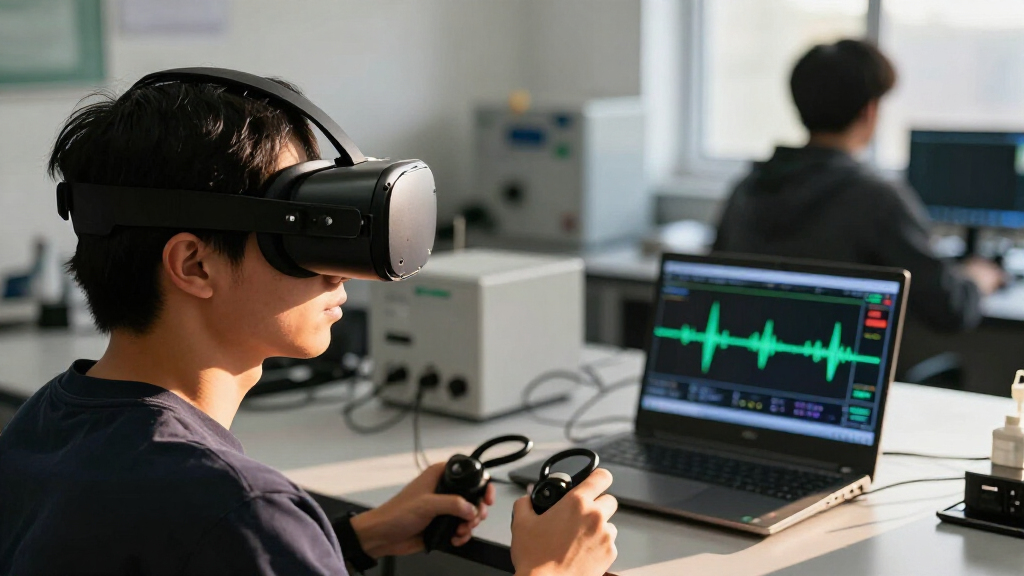
Cybersickness is discomfort associated with virtual or simulated environments. The report frames brain-wave measurement as a way to observe discomfort during exposure.
Brain activity
The headline attributes real-time detection to brain-wave activity, but does not identify the signals or equipment used.
Virtual exposure
The VR environments or activities participants experienced are not described in the available account.
Discomfort signal
It is not clear how researchers defined cybersickness or distinguished it from other responses.
Why real-time tracking could matter
A reliable measure could help researchers study when discomfort begins and compare reactions across VR experiences. That potential has not been established as a user benefit.
What remains unknown
The headline alone does not provide enough information to assess how strong the finding is, how broadly it applies, or whether it is ready for practical use.
What can be assessed now?
The distinctions below separate what the provided headline reports from questions that still need the full study or article.
| Question | In the report | Needed to assess |
|---|---|---|
| Can brain waves reveal cybersickness? | Reported finding | Methods and measured results |
| How accurate is detection? | Not stated | Accuracy and error rates |
| Does it work across VR settings? | Not stated | Testing across people and environments |
| Can consumers use it now? | Not established | Validated product or warning-system evidence |
| Has it been peer reviewed? | Unknown | Study paper and publication record |
A finding, not yet a readiness claim
A brain-wave pattern detected in a study would not by itself show that the method identifies cybersickness reliably across people, devices, and environments.
These bars describe the information supplied in the headline-only account, not the quality or completeness of the underlying study.
Quick answers
What did the UMD study reportedly find?
The headline says brain-wave activity can reveal cybersickness in real time. Detailed results and methods are not available in the report provided.
What is cybersickness?
It is discomfort associated with virtual or simulated environments. The account does not specify which symptoms the study examined.
How accurate was the detection?
No accuracy figures or other performance measures are included, so reliability cannot be assessed from the available details.
Can VR users use this technology now?
The report describes a study finding. It does not confirm a consumer product or real-time warning system.
Has the study been peer reviewed?
The publication venue and review status are not provided. A paper or full report would be needed to confirm them.
What would clarify the finding?
The study paper or full report, including methods, participant details, measured results, and validation across settings.
Potential for Real-Time VR Safety
If the reported approach can reliably identify cybersickness as it develops, it could give researchers a way to track participants’ reactions during virtual-reality sessions. That may help studies compare how different experiences affect users, and could inform investigations into when discomfort begins rather than depending only on a participant’s memory afterward.
For people using VR, the possible longer-term relevance is whether such monitoring could help systems or researchers respond to signs of discomfort sooner. But the report does not say that a commercial headset or application currently uses this method, or that it has been tested as a real-time warning system. Any benefit to users remains a potential application, not an established outcome of the headline finding.
The distinction matters because detecting a brain-wave pattern in a study is not by itself proof that the pattern can identify cybersickness accurately across people, devices and settings. Before it could support practical decisions, researchers would need to show how consistent the signal is and how it performs alongside direct reports of symptoms.
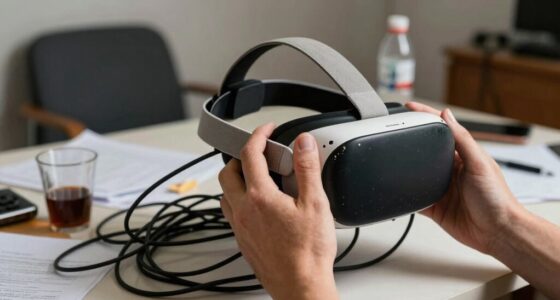
virtual reality headset with adjustable interpupillary distance
As an affiliate, we earn on qualifying purchases.
As an affiliate, we earn on qualifying purchases.
From Symptoms to Brain Signals
Cybersickness refers to discomfort associated with virtual or simulated environments. The reported study’s focus, as conveyed by its headline, is whether brain-wave measurements can indicate that discomfort in real time. The provided information does not describe the particular virtual-reality activity or the symptoms researchers examined.
People can report how they feel, but such reports may be collected after an experience or at intervals during it. A real-time biological measure could offer another way to study changes during exposure. However, the headline does not establish that brain-wave monitoring replaces symptom reports, nor does it identify a specific device or measurement technique.
The story is therefore best understood as a reported research finding, not evidence that a finished product is available. Important details needed to place the result in the research timeline—including a paper, conference presentation or study announcement—are absent from the information provided.
VR motion sickness relief wristbands
As an affiliate, we earn on qualifying purchases.
As an affiliate, we earn on qualifying purchases.
Study Details Still Missing
The available account does not identify the researchers or provide a direct quotation from them. It also leaves open how the study was conducted, how cybersickness was defined, and whether brain-wave signals were compared with participants’ reported symptoms or another measure.
There is no reported sample size, accuracy figure, comparison group, or information about the environments tested. Without those details, it is not possible to judge whether the reported real-time detection worked consistently, whether it applies beyond the study conditions, or whether the result has been independently replicated.
It also remains unclear whether the finding appears in a peer-reviewed publication and whether the researchers envision any specific use beyond research. The headline alone does not support claims that the method is ready for consumer use, can prevent cybersickness, or works across VR systems.
EEG headband brainwave monitoring device
As an affiliate, we earn on qualifying purchases.
As an affiliate, we earn on qualifying purchases.
Publication and Validation Needed
The next step for readers seeking to evaluate the finding is access to the study paper or full report, including its methods, participant details and measured results. Those materials would clarify what the researchers mean by real-time detection and how they tested the relationship between brain activity and cybersickness.
Further research would need to test whether the approach holds across different participants and virtual experiences, and report how often it correctly identifies discomfort. Until those details are available, the finding should be treated as a reported research result whose practical implications remain unsettled. No follow-up study, publication date or product development plan is specified in the available account.
Source: rss
VR facial interface replacement foam for comfort
As an affiliate, we earn on qualifying purchases.
As an affiliate, we earn on qualifying purchases.
Key Questions
What did the UMD study reportedly find?
The headline says brain-wave activity can reveal cybersickness in real time. Detailed results and methods are not available in the report provided.
What is cybersickness?
Cybersickness is discomfort associated with virtual or simulated environments. The available account does not specify which symptoms the study examined.
How accurate was the brain-wave detection?
No accuracy figures or other performance measures are included, so the method’s reliability cannot be assessed from the available details.
Can VR users use this technology now?
The report does not say that the method is available in consumer products. It describes a study finding, not a confirmed commercial feature or warning system.
Has the study been peer reviewed?
The publication venue and review status are not provided. A study paper or full report would be needed to confirm those details.
Source: rss
Halloween Picks
halloween
As an affiliate, we earn on qualifying purchases.