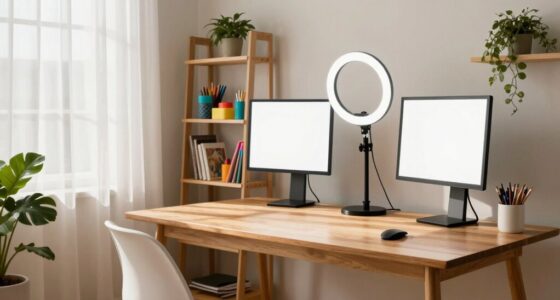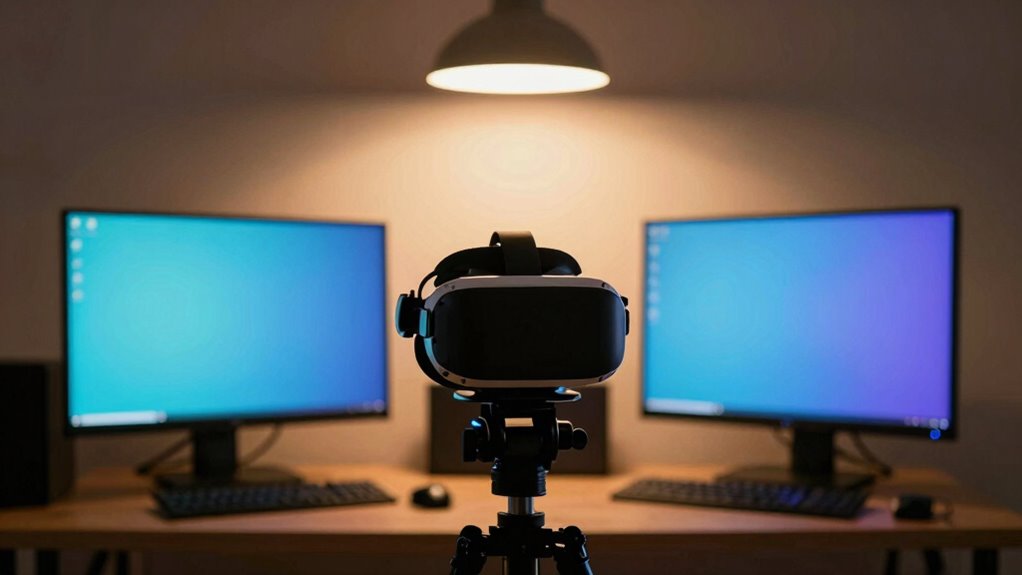
Lighting greatly enhances your VR experience by creating realistic environments and deepening immersion. Unlike cameras with fixed settings, dynamic VR lighting responds to your movements and scene changes in real time, adding depth, shadows, and natural effects. This makes objects feel grounded and environments more believable, boosting your sense of presence. Proper lighting influences mood and perception far more than static camera setups. If you keep exploring, you’ll discover even more how lighting elevates VR content beyond typical visuals.

Play games on Amazon Luna for your next adventure, included with Prime
- A rotating selection of games, no download needed
- Play on TV, laptop or phone
- Fast, free delivery for your gear, too
Key Takeaways
- Dynamic lighting creates realistic shadows and depth, enhancing immersion more effectively than static camera settings.
- Real-time light adjustments respond to user movements, making virtual environments feel authentic and alive.
- Advanced VR lighting simulates complex light interactions, such as bounce and gradation, which static cameras cannot replicate.
- Proper ambient shadows and highlights improve object perception and spatial awareness, grounding scenes convincingly.
- Lighting principles and techniques significantly influence mood and realism, surpassing the capabilities of fixed camera exposures.

Lighting plays an essential role in shaping the quality of VR content, affecting both immersion and visual clarity. When done right, lighting creates a believable environment that draws you in and makes virtual worlds feel real. One of the key elements here is ambient shadows, which add depth and dimension to your scene. Instead of flat, lifeless visuals, ambient shadows mimic how light interacts with objects, casting soft, natural shadows that help you perceive spatial relationships. This subtle detail prevents environments from looking artificial or cartoonish, making the experience more convincing.
Dynamic illumination takes this a step further by allowing light sources within the scene to change in real time. Think about how sunlight shifts as the day progresses or how a flickering fire casts moving shadows across a room. When VR content employs dynamic illumination, it responds to user movements or scene changes, enhancing realism. It’s like having a virtual stage where lighting adjusts seamlessly, so you don’t feel like you’re stuck in a static environment. This fluidity heightens immersion, because your brain interprets the scene as more authentic, reacting naturally to the changing light and shadows.
Compared to many cameras that capture static images or fixed lighting conditions, lighting in VR is interactive and adaptable. Cameras often rely on preset exposure and fixed lighting setups, which can limit the sense of depth and realism. VR, however, can simulate complex lighting interactions—like how light bounces off surfaces or creates subtle gradations—that cameras might miss or oversimplify. This ability to manipulate ambient shadows and dynamic illumination makes virtual worlds more vivid and believable. It’s not just about seeing a scene; it’s about feeling like you’re truly present within it. Recognizing lighting interactions is crucial to understanding how a scene appears more lifelike and engaging.
Your experience hinges on how well the lighting is integrated into the virtual environment. When ambient shadows are thoughtfully implemented, objects don’t appear to float or seem disconnected from their surroundings. Instead, they feel anchored, grounded in a realistic space. Dynamic illumination ensures that these shadows and lighting effects shift naturally with your movement, preventing the environment from feeling static or staged. This interplay between shadow and light guides your focus, highlights important objects, and enhances spatial awareness—all essential for high-quality VR content. Additionally, understanding how lighting interacts with surfaces can significantly improve the realism and aesthetic appeal of virtual worlds. Recognizing the importance of lighting design principles can lead to more immersive and visually compelling experiences. Furthermore, advancements in rendering techniques enable more accurate and natural lighting effects, elevating the overall quality of VR environments. Incorporating real-time rendering allows for even greater responsiveness and realism in dynamic lighting scenarios, making virtual worlds feel more alive.
In essence, lighting influences how immersive and crisp your VR experience feels more profoundly than many camera techniques can achieve. It shapes the environment’s mood, guides your perception, and creates a believable world where every shadow and glow contributes to a seamless, engaging experience. When lighting is executed well—through ambient shadows and dynamic illumination—it elevates virtual content from simple visuals to truly engaging environments.
As an affiliate, we earn on qualifying purchases.
Frequently Asked Questions
How Does Lighting Impact User Immersion in VR Environments?
Lighting profoundly impacts your immersion in VR environments by shaping ambient brightness and color temperature. Proper lighting makes scenes feel more realistic, so you can easily forget you’re in a virtual world. Adjusting ambient brightness prevents eye strain and enhances clarity, while matching color temperature creates natural-looking scenes. When lighting feels authentic, you stay engaged and immersed, making the VR experience more compelling and believable.
Can Adjustable Lighting Improve VR Content for Different User Preferences?
Yes, adjustable lighting can considerably improve VR content for different user preferences. You can tweak ambient brightness and color contrast to enhance comfort and immersion. If you prefer a more vibrant or subdued environment, these settings let you customize your experience, reducing eye strain and increasing realism. By actively managing lighting, you make the VR environment more adaptable, ensuring it feels just right for your personal viewing comfort and engagement.
What Lighting Techniques Are Most Effective for Realistic VR Scenes?
You should use lighting techniques that emphasize color contrast and shadow depth to create realistic VR scenes. High contrast lighting highlights details, making objects feel more tangible, while deep shadows add depth and dimension. Position your light sources thoughtfully to mimic natural lighting, ensuring shadows fall naturally. This combination immerses users, enhancing realism and making the virtual environment more convincing and engaging.
How Does Lighting Influence Motion Sickness in VR Experiences?
You might find that proper lighting, especially with balanced color temperature and appropriate shadow depth, subtly guides your perception and reduces discomfort. When lighting mimics real-world conditions, it helps your brain stay grounded, decreasing the chances of motion sickness. Harsh or inconsistent lighting can create visual dissonance, making you feel uneasy. So, paying attention to these lighting details guarantees a more comfortable and immersive VR experience.
Are There Specific Lighting Setups Recommended for VR Content Creators?
You should use balanced ambient illumination with soft, diffuse lighting to reduce harsh shadows and glare in your VR content. Set the color temperature to a neutral or slightly warm tone, around 3000K to 4000K, to create a comfortable, natural environment. Consistent lighting helps maintain immersion and minimizes motion sickness, making your VR experience more comfortable and visually appealing for users.
As an affiliate, we earn on qualifying purchases.
Conclusion
Remember, lighting isn’t just a detail—it’s the master artist shaping your VR experience. It transforms flat images into immersive worlds, much like a lighthouse guides ships safely to shore. Without proper lighting, even the best cameras can’t save your content from looking dull or unrealistic. So, next time you craft VR content, focus on lighting first; it’s the secret ingredient that turns good into unforgettable. After all, in the domain of VR, light is your most powerful brush.
As an affiliate, we earn on qualifying purchases.
virtual reality environment lighting
As an affiliate, we earn on qualifying purchases.
As an affiliate, we earn on qualifying purchases.
Fall Picks
fall essentials
As an affiliate, we earn on qualifying purchases.