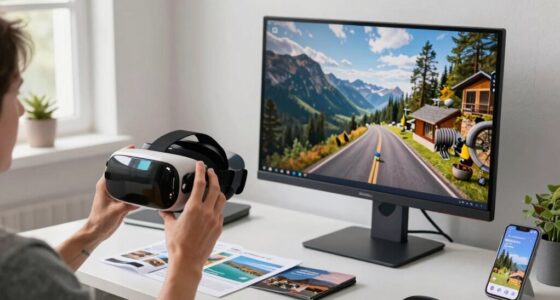
To avoid falling for exaggerated VR marketing claims, you should stay skeptical and focus on what’s realistically deliverable. Look beyond buzzwords and hype, and check for details on actual performance, such as latency, comfort, and content availability. Seek independent reviews and user experiences to gain a clear picture. Remember, not all claims hold up in real-world use—if you keep exploring, you’ll discover how to spot genuine features versus marketing tricks.
Key Takeaways
- Scrutinize what “full immersion” entails and recognize that it varies by product and user experience.
- Verify claims with independent reviews and real user feedback instead of relying solely on marketing materials.
- Be cautious of hardware capabilities highlighted under ideal conditions, not real-world performance.
- Look for specific features and specifications rather than vague or exaggerated marketing language.
- Maintain skepticism about promises of “seamless,” “instant,” or “zero latency” experiences; validate with multiple sources.

Virtual reality marketing claims can be confusing, especially when companies boast about features that sound impressive but may not deliver in practice. You’ve probably seen ads promising “full virtual immersion” or “life-like experiences,” but it’s essential to approach these claims with a healthy dose of skepticism. Not all features are created equal, and understanding what’s realistic helps you avoid being misled or disappointed. When evaluating VR products or services, look beyond the hype and focus on what truly matters: the quality of the experience and whether it meets your needs.
Virtual immersion is often the centerpiece of VR marketing, with companies emphasizing how their system makes you feel like you’re truly somewhere else. But ask yourself: what does “full virtual immersion” really mean? Some companies may simply use the term to describe high-resolution visuals or a wide field of view, while others might be referring to haptic feedback or spatial audio. It’s important to scrutinize the specifics and see if they align with your expectations. Remember, consumer skepticism is healthy here. Just because a product claims to deliver “total immersion” doesn’t mean it will do so for everyone, especially if you’re sensitive to motion sickness or require more refined hardware.
Full immersion claims vary—clarify if it’s about visuals, sound, or feedback to set realistic expectations.
You should also be wary of marketing that overhypes the capabilities of VR technology. Often, claims focus on what the hardware *can* do in perfect conditions, not how it performs in real-world settings. For example, a headset might advertise “seamless VR experiences,” but in reality, you might encounter latency, discomfort, or limited content that hampers immersion. Recognize that many advertising statements are designed to impress rather than inform, so dig deeper. Ask for user reviews and expert opinions to get a clearer picture of actual performance. Additionally, VR performance factors such as hardware limitations and environmental conditions significantly impact the overall experience. Understanding the limitations of VR helps set realistic expectations and avoid overestimating what the technology can achieve. Being aware of technological constraints allows consumers to make more informed decisions and prevents disappointment from unmet expectations.
Your skepticism is your best tool in evaluating VR marketing claims. Don’t accept bold promises at face value; instead, compare features across different products and consider the context in which they’re used. If an ad claims “instant setup” or “zero latency,” seek out demonstrations or independent reviews that verify these claims. Remember, technology still has its limits, and marketing often glosses over the nuances. By remaining critical and doing your homework, you can avoid falling for exaggerated promises and find a VR experience that genuinely meets your expectations.

Meta Quest 3 512GB | VR Headset — Thirty Percent Sharper Resolution — 2X Graphical Processing Power — Virtual Reality Without Wires — Access to 40+ Games with a 3-Month Trial of Meta Horizon+ Included
NEARLY 30% LEAP IN RESOLUTION — Experience every thrill in breathtaking detail with sharp graphics and stunning 4K…
As an affiliate, we earn on qualifying purchases.
As an affiliate, we earn on qualifying purchases.
Frequently Asked Questions
Are VR Marketing Claims Regulated by Any Authority?
Virtual Reality marketing claims aren’t heavily regulated by a specific authority. However, marketing regulations in general, like those from the Federal Trade Commission (FTC), do apply to VR advertising. You should stay cautious and scrutinize VR marketing claims carefully, since some marketers might exaggerate benefits. Being aware of existing marketing regulations helps you identify false or misleading claims, ensuring you make informed decisions when exploring Virtual Reality products.
How Can I Verify the Credibility of VR Claims?
To verify the credibility of Virtual Reality (VR) claims, you should look for independent reviews and user testimonials that reflect real experiences. Check if the company provides transparent specifications and proof of technology. Trustworthy brands often collaborate with reputable organizations and have a solid online presence. Building consumer trust relies on clear, honest information—so always cross-reference claims with credible sources before making decisions about VR products.
Do VR Claims Differ Between Industries?
Yes, VR claims differ between industries because each has unique industry-specific terminology and user experience variations. For example, in healthcare, claims focus on simulation accuracy and safety, while gaming emphasizes immersion and graphics quality. You should compare these claims carefully, considering how industry standards shape expectations. Recognize that marketing language may highlight features relevant to that sector, so always evaluate whether the claims align with your specific needs and industry benchmarks.
What Common Tactics Do VR Marketers Use to Exaggerate?
VR marketers often use virtual illusions to create an impressive experience, making their claims seem more impactful than they truly are. They also rely heavily on persuasive language, emphasizing potential benefits and emotional appeal while downplaying limitations. You should watch out for these tactics, as they can make a product seem better than reality. Always question exaggerated claims and look for concrete evidence to verify the authenticity of the marketing message.
Are There Any Red Flags Indicating False VR Claims?
You can spot virtual hype and potential user deception by watching for overly broad claims, such as “unmatched immersion” or “perfect experience,” that sound too good to be true. Be cautious of vague or inconsistent specifications, and check for independent reviews. If a claim seems exaggerated or lacks supporting evidence, it’s a red flag. Staying skeptical helps you enjoy VR without falling for unwarranted promises.

KIWI design K4 Head Strap, VR Headset Accessories for Meta Oculus Quest 3/3S, Non-Battery & Enhanced Support & Adjustable & Comfort Strap Gift for Kids and Adults
Compatible with Meta Quest 3/3S: The KIWI design K4 is a budget-friendly head strap for Meta Quest 3/3S,…
As an affiliate, we earn on qualifying purchases.
As an affiliate, we earn on qualifying purchases.
Conclusion
By sharpening your eyes and questioning every bold claim, you become a savvy VR consumer who’s immune to marketing tricks. Remember, not every “revolutionary” feature is a game-changer, and some claims are as inflated as a balloon ready to burst. Stay skeptical, do your research, and trust your own experience over hype. With this mindset, you’ll navigate the VR world unscathed and truly discover the innovations that genuinely elevate your immersive adventures—because, in this game, knowledge is your ultimate superpower.
Meta Quest 3 512GB | VR Headset — Thirty Percent Sharper Resolution — 2X Graphical Processing Power — Virtual Reality Without Wires — Access to 40+ Games with a 3-Month Trial of Meta Horizon+ Included
NEARLY 30% LEAP IN RESOLUTION — Experience every thrill in breathtaking detail with sharp graphics and stunning 4K…
As an affiliate, we earn on qualifying purchases.
As an affiliate, we earn on qualifying purchases.

PC Adapter Kit for VR2 Headset — PC Connection Solution for VR2 Gaming, Compatible with SteamVR on Windows, Smooth Signal Processing, Expand VR Game Library, High-End Thermal Design
Optimized PC Connection for VR2:This V2 headset PC adapter is purpose-built to link your VR2 headset with a…
As an affiliate, we earn on qualifying purchases.
As an affiliate, we earn on qualifying purchases.