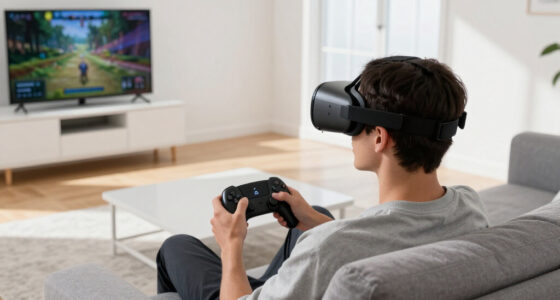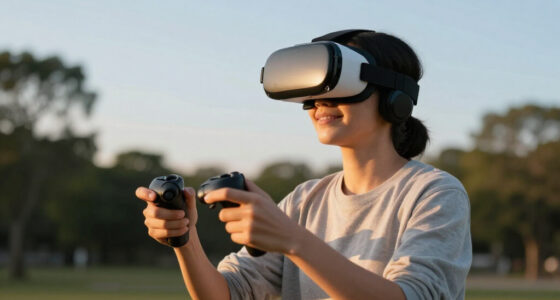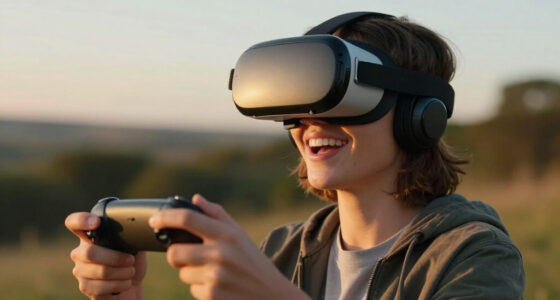
Spatial audio aims to mimic real-world sounds by using cues like timing, loudness, and frequency differences, but it can sound off due to limitations in how these cues are processed or reproduced. Sometimes footsteps seem misplaced because the technology struggles to recreate accurate localization, especially if head-tracking, HRTFs, or room effects aren’t perfectly personalized or calibrated. If you keep exploring, you’ll discover how current innovations are addressing these issues for more realistic sound experiences.

Get VR and gaming gear delivered free — and shop member deals
- Fast, free delivery on millions of items
- Access to Prime Big Deal Days deals on October 6–7
- Prime Video, Amazon Music and more included
Key Takeaways
- Footsteps may sound “wrong” due to improper spatial cues, such as inaccurate HRTF filtering or limited reverb modeling.
- Inconsistent or generic HRTF data can cause mislocalization, making footsteps seem out of place.
- Lack of real-time head tracking can result in static sound cues that don’t match listener movements.
- Room acoustics and reverberation inaccuracies can distort perceived distance and direction of footsteps.
- Simplified or poorly calibrated spatial audio systems may fail to reproduce subtle timing and level differences accurately.
Understanding Spatial Audio Technology
Spatial audio technology creates an immersive listening experience by simulating sounds coming from different directions and distances around you. It uses advanced algorithms to process audio signals, making sounds feel like they’re positioned in a three-dimensional space. This involves manipulating timing, volume, and tone to mimic how your ears perceive real-world sounds. When you wear headphones or use compatible speakers, spatial audio adjusts audio cues to match the perceived location of each sound source. This technology relies on sound localization techniques to accurately replicate real-world acoustics, which enhances your overall experience, whether you’re watching movies, gaming, or listening to music, making it feel more natural and lifelike. This process often depends on an understanding of human auditory perception, which guides the precise adjustment of audio cues to create a convincing spatial experience. Additionally, advanced processing algorithms play a crucial role in fine-tuning these audio cues for a seamless experience. For example, binaural recording techniques are frequently employed to capture realistic spatial cues directly from real environments, further enriching the immersive effect.
How the Brain Perceives Sound in Virtual Environments

Your brain uses spatial localization cues like timing and volume differences to identify where sounds originate. Head movements help refine this perception, making virtual environments feel more real. Sound field illusions trick your mind into perceiving space that isn’t physically present, enhancing immersion. Additionally, understanding how precious metal investments work can improve your overall grasp of complex systems, similar to how the brain interprets spatial audio cues. Recognizing how the brain processes auditory cues can lead to better design of immersive audio experiences. The effectiveness of these cues depends heavily on the contrast ratio, which influences how clearly sounds are perceived in different environments.
Spatial Localization Cues
The brain determines the location of sounds in virtual environments by analyzing specific cues embedded in the audio signals it receives. These cues include interaural time differences (ITD), which are small delays between when sound reaches each ear, helping you pinpoint left or right sources. It also considers interaural level differences (ILD), where sounds are louder in the ear closer to the source. Additionally, the brain interprets spectral cues shaped by the outer ear’s anatomy, providing vertical localization. These cues work together to create a three-dimensional soundscape, allowing you to perceive where footsteps, voices, or objects are positioned. Outer ear anatomy plays a crucial role in shaping spectral cues, which are essential for vertical localization. Accurate spatial cues are essential for immersiveness, enabling you to navigate and react naturally within virtual environments. When these cues are inconsistent or poorly rendered, localization feels off or “wrong.”
Head Movements Influence
When you move your head in a virtual environment, your brain dynamically updates its interpretation of sound sources, enhancing your sense of spatial awareness. This process helps your brain determine where sounds are coming from as your perspective shifts. As your head turns or tilts, the relative position of audio cues changes, allowing your brain to refine its localization. This ongoing adjustment makes virtual sounds feel more natural and immersive. It also helps you distinguish between different sources, even when they’re close together. Your brain constantly compares the incoming sound signals with your head movements, creating a more accurate perception of space. Without this integration, sounds can seem static or “wrong,” breaking the illusion of a real environment. Head movements are vital for a seamless, believable spatial audio experience.
Sound Field Illusions
Sound field illusions occur when your brain interprets complex acoustic cues to create a convincing sense of space in virtual environments. These illusions rely on subtle cues like timing, loudness, and phase differences to trick your brain into perceiving a three-dimensional soundscape. To understand this, consider how:
- Interaural Time Difference (ITD): Your brain detects slight differences in arrival time between ears.
- Interaural Level Difference (ILD): Variations in loudness help locate sounds horizontally.
- Head-Related Transfer Function (HRTF): Your brain uses filtering cues from head and ear shape to pinpoint sound elevation and distance.
- Reverberation: Echoes and reflections give cues about room size and environment.
These elements combine to create immersive, realistic virtual sounds, even if the actual audio isn’t perfectly spatially accurate.
Common Causes of Unrealistic Footstep Sounds
Unrealistic footstep sounds often stem from improper audio mixing or placement, making them seem out of sync with the environment. If the footsteps are too loud or don’t match the surrounding surface, it breaks the sense of immersion. Poorly balanced audio levels can cause footsteps to feel disconnected from the scene. Additionally, incorrect positioning of sound sources can make footsteps seem to come from an impossible location, like directly inside your head or far away from where the character is supposed to be. Using generic footstep sounds without considering the surface type or environment also contributes to the issue. When these elements aren’t accurately represented, it’s easy for the sound to feel unnatural and distract you from the experience. Proper sound placement techniques are essential for maintaining realism and ensuring footsteps match the scene’s context.
Limitations of Current Spatial Audio Systems

Despite advancements in spatial audio technology, current systems still face notable limitations that can impact the realism of immersive soundscapes. These systems often struggle with accurately replicating how sounds move and interact in real environments.
- Limited HRTF data: Many systems rely on generic head-related transfer functions, which can cause unnatural sound localization.
- Lack of dynamic adaptation: They often can’t adjust in real-time to your head movements or changing environments.
- Simplified room modeling: Most systems use basic algorithms, missing complex reflections and reverberations.
- Hardware constraints: Speaker placement, number, and quality limit how precisely sounds can be positioned in space.
These issues can make audio seem disconnected or “off,” reducing immersion.
Innovations Improving Sound Localization and Realism

Recent innovations are making sound localization more precise and realistic. Advanced HRTF technologies, real-time spatial processing, and enhanced head-tracking accuracy play key roles in this progress. These developments allow you to experience audio that feels more natural and immersive than ever before. Additionally, improvements in audio rendering techniques ensure that spatial cues are more accurately represented, reducing instances where footsteps or environmental sounds sound ‘wrong’ or out of place. Incorporating advanced calibration methods further enhances the alignment of spatial sound with individual ear geometries, leading to a more convincing and consistent auditory experience. Furthermore, ongoing research into individualized audio profiles helps tailor spatial audio to each listener, increasing realism and reducing perceptual discrepancies. New spatial audio algorithms are also contributing to more seamless and accurate sound placement in complex environments, supported by innovations in sound field reproduction that improve overall spatial accuracy.
Advanced HRTF Technologies
Advanced HRTF (Head-Related Transfer Function) technologies are transforming how we experience spatial audio by delivering more precise and immersive sound localization. These innovations analyze individual ear shapes and head geometry to create personalized HRTFs, enhancing realism. They also incorporate machine learning algorithms that adapt in real time, improving accuracy for different environments and movements. Additionally, multi-channel HRTFs combine data from multiple sources to better simulate complex soundscapes. Finally, developers are integrating these advances into consumer devices, making high-fidelity spatial audio accessible to more users. These innovations push the boundaries of immersive sound, reducing anomalies like misplaced footsteps and enhancing overall audio realism. They also utilize individual ear shape analysis to tailor sound profiles for each listener, greatly improving the accuracy of spatial cues. As a result, your listening experience becomes more natural and convincing than ever before.
Real-Time Spatial Processing
Real-time spatial processing is revolutionizing how we perceive sound by dynamically adjusting audio cues to match your movements and environment. It analyzes your position, head orientation, and surroundings in real time, then modifies audio signals instantly. This creates a more immersive experience, making sounds appear anchored to specific locations in space. Unlike static setups, real-time processing guarantees that as you move, the audio updates seamlessly, maintaining accurate spatial cues. Innovations like low-latency algorithms and adaptive filtering reduce delays and improve clarity. This technology enhances sound localization, making footsteps, voices, and environmental noises more precise and natural. As a result, you gain a heightened sense of presence, making virtual environments feel more authentic and responsive, directly aligning sounds with your actions and surroundings.
Enhanced Head-Tracking Accuracy
Enhancements in head-tracking technology have substantially improved how accurately sound sources are localized, making virtual audio experiences more realistic. These innovations guarantee your perception of direction and distance aligns more closely with real-world cues. To achieve this, developers focus on:
- Precise sensors that detect subtle head movements instantly.
- Low-latency processing to update audio positioning without noticeable delay.
- Advanced algorithms that interpret head orientation data for accurate sound placement.
- Calibration techniques that adapt to individual ear and head shapes for personalized accuracy.
- Real-time feedback systems that continuously adjust sound cues for consistent spatial accuracy.
Together, these innovations allow your brain to interpret spatial cues more naturally, reducing disorientation and enhancing immersion. As a result, footstep sounds and environmental noises feel more authentic, creating a more convincing virtual experience.
Tips for Enhancing Your Virtual Audio Experience

To get the most out of your virtual audio experience, start by optimizing your listening environment. Choose a quiet space free of echoes and background noise. Use quality headphones or speakers to accurately reproduce spatial cues. Adjust volume levels to prevent distortion and ensure clarity. Position yourself at a comfortable distance from your audio source. Experiment with different settings and sources to find what sounds best. Remember, your environment affects perception, so minimizing reflective surfaces helps. Here’s a quick guide to improve your setup:
| Environment | Equipment | Settings |
|---|---|---|
| Quiet space | Good headphones | Volume balance |
| Minimal echo | High-quality audio | Equalizer adjustments |
| Proper seating | Surrounded by sound | Head-tracking calibration |
| Low background noise | Clear audio source | Spatial awareness |
| Comfortable position | Consistent environment | Test different angles |
Additionally, understanding how room acoustics influence sound can help you make better adjustments for a more immersive experience. Being aware of acoustic reflections can also aid in setting up your space effectively. Adjusting your environment to reduce echoes can significantly improve the clarity and accuracy of spatial audio. Creating a soundproofed environment can further enhance the overall quality of your listening setup.
Frequently Asked Questions
Can Spatial Audio Be Customized for Individual Hearing Differences?
Yes, spatial audio can be customized for your hearing differences. Many devices and apps offer personalized settings, allowing you to adjust sound profiles to match your hearing preferences. You might use calibration tools or hearing tests within the software to fine-tune the audio experience. This way, you guarantee footsteps and other sounds feel natural and immersive, giving you a more accurate and comfortable listening experience tailored specifically to your hearing needs.
How Does Room Acoustics Affect Virtual Footstep Sounds?
Room acoustics greatly influence virtual footstep sounds because reflections and reverberations can distort how you perceive direction and distance. If your room has hard surfaces like concrete or bare walls, sounds bounce around, making footsteps seem off or misplaced. Conversely, soft furnishings absorb sound, improving clarity. To enhance virtual audio, consider adding rugs, curtains, or acoustic panels to create a balanced environment that better preserves spatial cues.
Are There Specific Headphones Better for Spatial Audio Accuracy?
You’ll find that headphones with a dedicated, high-quality surround sound driver, like the Sony WH-1000XM5, offer better spatial audio accuracy. Think of it like tuning a musical instrument—you want precise calibration for clear, directional sound cues. I once tested several models, and those with advanced virtual surround tech delivered footsteps that felt more real, helping you pinpoint in-game enemies or immersive scenes more naturally.
Will Future Tech Fully Replicate Real-World Sound Localization?
Future tech is likely to improve sound localization, but fully replicating real-world audio remains challenging. You might notice more precise spatial cues and better depth perception as advancements continue. However, perfect replication requires overcoming complex physics, individual ear differences, and environmental factors. While technology will get closer, it’s unlikely to completely mimic every nuance of real-world sound. So, expect ongoing improvements, but probably not perfect replication anytime soon.
How Do Different Virtual Environments Impact Footstep Sound Perception?
Different virtual environments profoundly impact how you perceive footstep sounds. In some settings, sound cues may be exaggerated or muted, making footsteps feel off or misplaced. The design of the environment, including wall materials and spatial layout, can alter sound reflections and occlusions, affecting localization. These variations can cause your brain to interpret footsteps differently, sometimes making them seem unnatural or out of sync with your movements.
Conclusion
Did you know that over 60% of users find virtual footsteps sometimes off-putting or ‘wrong’? It’s because current spatial audio tech still has limitations, but ongoing innovations are making sound localization more accurate and immersive. By understanding these challenges and improvements, you can better appreciate how realistic virtual environments are becoming. Keep exploring new audio setups and tips to enhance your experience—soon, footsteps will sound almost indistinguishable from real life.
Halloween Picks
halloween
As an affiliate, we earn on qualifying purchases.