
TL;DR
Extended Reality (XR) technologies are increasingly used to improve scientific demonstrations and education. This development offers new ways for scientists and educators to visualize complex concepts, making science more accessible and engaging.
Extended Reality (XR) technologies are being adopted more widely in scientific show-and-tell, providing immersive and interactive experiences that enhance understanding of complex scientific concepts. This trend is gaining momentum among educators, researchers, and science communicators, offering new opportunities to engage audiences and facilitate learning.
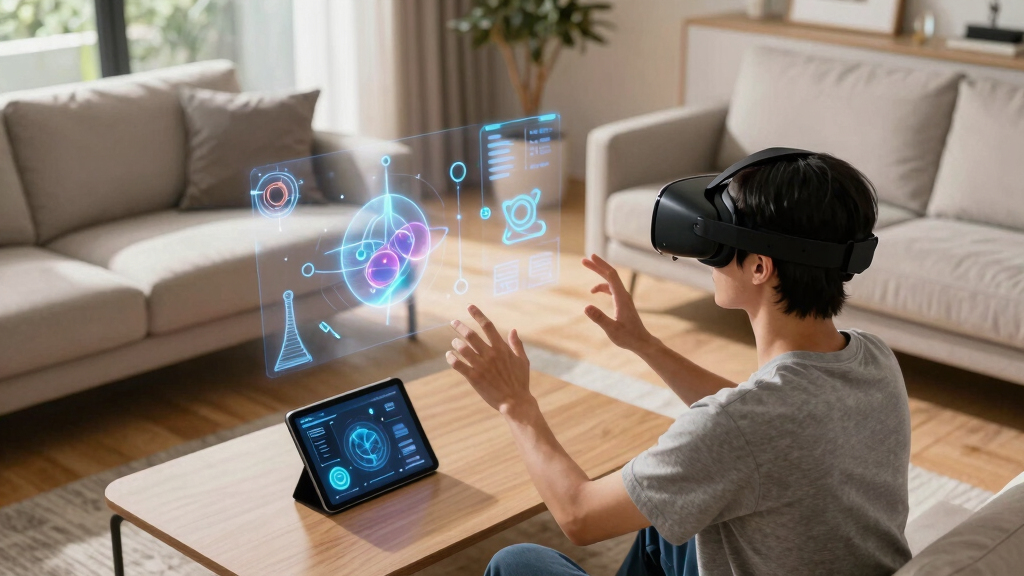
Recent demonstrations and pilot programs have showcased XR’s potential to transform scientific education. Institutions are integrating virtual and augmented reality tools to visualize phenomena such as molecular structures, astronomical objects, and biological processes. John Deere has created an extended reality training system to enhance learning. According to researchers involved in these projects, XR allows users to explore three-dimensional data sets in ways that traditional methods cannot match. Companies specializing in XR hardware and software report increased interest from educational institutions and research labs seeking innovative ways to communicate science. To learn more about XR in education, see our article on how XR is transforming scientific education.While many applications remain in experimental or pilot phases, early feedback indicates that XR can improve comprehension and retention, especially among younger audiences. Educators note that students are more motivated and engaged when interacting with virtual models that they can manipulate and explore from different angles. Researchers emphasize that XR can also facilitate remote collaboration, allowing scientists from different locations to work together within shared virtual environments.
How XR Could Revolutionize Scientific Education and Communication
The adoption of XR for scientific show-and-tell could significantly improve public understanding of complex scientific topics, making science more accessible and engaging. It also offers new tools for researchers to visualize data and collaborate remotely, potentially accelerating discovery and innovation. As XR becomes more affordable and widespread, its integration into educational and research settings may reshape how science is taught, learned, and communicated, impacting both academia and public outreach efforts.virtual reality science education kits
As an affiliate, we earn on qualifying purchases.
As an affiliate, we earn on qualifying purchases.
Growing Adoption of XR in Science Education and Research
Over the past few years, XR technologies have evolved from niche tools to more mainstream educational and research aids. Early experiments focused on virtual labs and simulations, but recent developments include full-scale virtual environments for scientific visualization. Universities, museums, and research institutes have begun incorporating XR into curricula and exhibits, driven by advancements in hardware and software. Industry reports indicate a rising demand for XR solutions tailored to science communication, with some projects receiving funding from government and private sources. However, the extent of XR’s integration into standard scientific practice remains limited, with ongoing assessments of its effectiveness and accessibility.“XR allows students to see and manipulate molecules and planetary systems in ways that textbooks simply can’t provide.”
— Dr. Lisa Chen, Science Educator

Practical Data Analytics for Innovation in Medicine: Building Real Predictive and Prescriptive Models in Personalized Healthcare and Medical Research … (The Elsevier Science & Technology Books)
As an affiliate, we earn on qualifying purchases.
As an affiliate, we earn on qualifying purchases.
Unanswered Questions About XR’s Long-Term Impact in Science
It is not yet clear how widely XR will be adopted across different scientific disciplines or how cost-effective it will remain for large-scale implementation. While pilot programs show promise, comprehensive studies on long-term educational outcomes and research productivity are still underway. Additionally, questions remain about accessibility for underserved communities and the standardization of XR tools for scientific use.VR biological process visualization tools
As an affiliate, we earn on qualifying purchases.
As an affiliate, we earn on qualifying purchases.
Future Steps for Integrating XR into Scientific Practice
Researchers and educators plan to expand pilot programs and conduct systematic studies to evaluate XR’s effectiveness in teaching and research. Industry players are developing more affordable and user-friendly XR solutions tailored for science. Additionally, collaborations between technology providers and scientific institutions are expected to increase, aiming to establish best practices and expand XR’s reach within the scientific community. Monitoring these developments over the next year will clarify XR’s potential to become a staple in scientific show-and-tell.XR scientific data visualization software
As an affiliate, we earn on qualifying purchases.
As an affiliate, we earn on qualifying purchases.
Key Questions
How is XR currently being used in science education?
XR is being used to create immersive visualizations of molecules, planets, biological processes, and more, allowing students to interact with complex data in three dimensions.
What advantages does XR offer over traditional teaching methods?
XR provides interactive, engaging experiences that can improve understanding and retention of complex scientific concepts, especially for visual and kinesthetic learners.
Are there limitations or challenges to using XR in science?
Yes, challenges include high costs, technical barriers, limited accessibility in some regions, and the need for further research to validate long-term educational benefits.
Will XR replace traditional science teaching methods?
It is unlikely to replace traditional methods entirely but is expected to complement them, offering new ways to visualize and explore scientific data.
What is the outlook for XR in scientific research?
XR is anticipated to enhance remote collaboration, data visualization, and simulation capabilities, potentially accelerating scientific discovery in various fields.
Source: rss