
TL;DR
Xreal announced it will ship the Aura mixed reality device this fall, powered by Qualcomm’s Snapdragon Reality Elite chipset in its puck. Preorders are open, but pricing has not been disclosed. The device aims to offer a lightweight, see-through AR experience with a wide field of view.
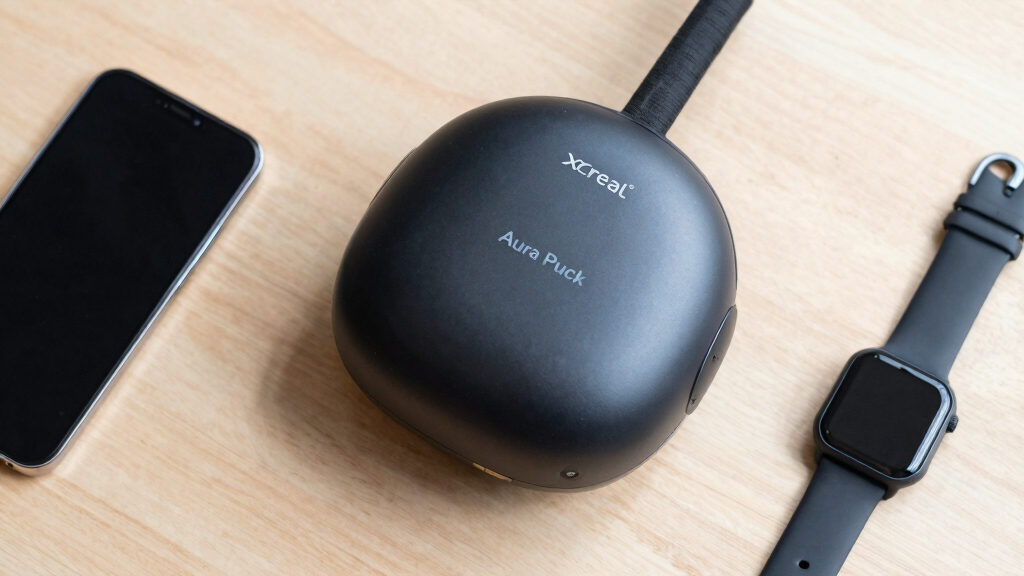
Xreal has announced that its Aura mixed reality device will begin shipping this fall, with preorders now open. The device features Qualcomm’s new Snapdragon Reality Elite chipset in its tethered compute puck, marking a significant hardware update. The company has not yet disclosed the final retail price, only stating it will not exceed $1,500.
The Xreal Aura is a lightweight, see-through AR device designed to resemble sunglasses, with a form factor that emphasizes sleekness over the larger, bulkier AR glasses. It features a 70-degree diagonal field of view, which is the widest yet for Xreal’s lineup, and includes built-in head and hand tracking. Unlike previous tethered devices, Aura uses a dedicated compute puck powered by Qualcomm’s Snapdragon Reality Elite chipset, which is also paired with Xreal’s own X1S chip in the headset for core computer vision tasks.
Preorders for Aura are available now, with two options: a $299 “Founder Priority Pass” that guarantees early delivery and an exclusive limited-edition number, and a $99 “Launch Credit” that offers earlier shipping and a discount. The company has not announced the device’s final price but has indicated it will not exceed $1,500. The preorders are fully refundable before the final sale, according to Xreal.
Despite the open preorders, many key specifications remain undisclosed, including the exact price and full feature set. The device runs Google’s Android XR operating system and will support most features and apps available on Samsung Galaxy XR, with some exceptions such as face-tracked avatars, as Aura lacks face tracking capabilities.
Impact of the Snapdragon Reality Elite in Aura
The inclusion of Qualcomm’s Snapdragon Reality Elite chipset in the Aura puck marks a notable hardware upgrade, potentially improving performance and power efficiency for mixed reality experiences. This development positions Xreal as a key player in the lightweight AR device market, offering an alternative to more expensive, true AR glasses. The device’s broad compatibility with existing XR apps and features could expand its appeal, especially among users seeking a portable, tethered AR solution.
However, the lack of full specifications and the absence of a confirmed retail price mean that the device’s market impact remains uncertain. Its success will depend on how well it balances performance, price, and user experience in a competitive landscape that includes both tethered and standalone XR devices.

XREAL 1S AR Glasses, 500" Virtual Screen, Powered by X1 Chip, Native 3DoF
- Giant Virtual Screen: Up to 500-inch immersive display
- High-Quality Display: 120Hz refresh rate, true-to-life colors
- Enhanced Clarity: 9% sharper optical engine
As an affiliate, we earn on qualifying purchases.
As an affiliate, we earn on qualifying purchases.
Background on Xreal Aura and Qualcomm XR Chips
First teased over a year ago as “Project Aura,” the device represents Xreal’s second attempt to deliver a lightweight, see-through AR experience running on Google’s Android XR operating system. Previously, Xreal’s products primarily functioned as tethered virtual monitors, but Aura introduces a dedicated compute puck powered by Qualcomm’s Snapdragon Reality Elite, the company’s latest flagship XR chipset. Qualcomm announced the Reality Elite earlier this year, emphasizing its focus on high-performance, power-efficient XR applications.
While initial reports suggested the puck might use the XR2+ Gen 2 chip, recent disclosures indicate the Reality Elite will be used instead, signaling a hardware refresh. The device’s design, resembling sunglasses but sitting farther from the eyes than true AR glasses, positions it as a lightweight alternative to larger mixed reality headsets. The device’s form factor and features aim to appeal to users seeking portability over full AR immersion, with a focus on tethered experiences.
“The Aura device combines sleek design with powerful Qualcomm Snapdragon Reality Elite performance, offering a new level of lightweight AR experience.”
— an anonymous Xreal spokesperson

Tifosi Optics Sanctum SL Sunglasses (Crystal Clear (Purple Mirror AR))
- Lens Color: Purple mirror finish for bright sun
- Fit: Medium-large sport fit for stability
- Lens Technology: Impact-resistant polycarbonate with UV protection
As an affiliate, we earn on qualifying purchases.
As an affiliate, we earn on qualifying purchases.
Remaining Unknowns About Xreal Aura
It is not yet clear what the final retail price of the Aura will be, nor the complete list of specifications and supported features. The exact availability in different regions and the full app ecosystem compatibility remain to be confirmed. Additionally, the impact of the device’s limited face tracking and the actual user experience in real-world scenarios are still unknown.

RayNeo Air 4 Pro AR/XR Glasses, HDR10 201" Virtual Display, 120Hz 3D Movie & Gaming Video Display, USB-C Plug & Play for iPhone 17/16/15, Android, Switch 2, PS5, Steam Deck
- HDR10 Virtual Display: 201-inch ultra-wide virtual screen with 10B colors
- AI SDR-to-HDR Upscaling: Enhances color, sharpness, and motion clarity
- 120Hz 3D Video Playback: Smooth 3D movies and gaming visuals
As an affiliate, we earn on qualifying purchases.
As an affiliate, we earn on qualifying purchases.
Upcoming Details and Release Timeline
Xreal is expected to reveal the final pricing and full specifications closer to the device’s launch later this year. The company may also provide more details on regional availability and software support during upcoming announcements or product demos. Consumers and industry watchers will be watching for how Aura performs in real-world testing and whether it lives up to its promises of lightweight, portable mixed reality.
tethered AR device with Snapdragon chipset
As an affiliate, we earn on qualifying purchases.
As an affiliate, we earn on qualifying purchases.
Key Questions
When can I preorder the Xreal Aura?
Preorders are currently open, with options to reserve via the Founder Priority Pass or Launch Credit system. The device is scheduled to ship later this year.
What is the expected price of the Xreal Aura?
The final retail price has not been announced, but Xreal states it will not exceed $1,500. The preorder system offers refundable reservations and early shipping options.
What are the main features of the Aura device?
It features a 70-degree field of view, built-in head and hand tracking, a lightweight design resembling sunglasses, and runs on Google’s Android XR OS powered by Qualcomm’s Snapdragon Reality Elite chipset.
Will the Aura support face tracking or avatars?
No, Aura does not have face tracking capabilities, so features like face-tracked avatars will not be available on this device.
How does Aura compare to other AR glasses?
Aura is designed as a lightweight, tethered device with a wider field of view than previous Xreal products, but it is not a true AR glasses device like Snap’s Spectacles, which use waveguide technology for a more compact form factor.
Source: UploadVR