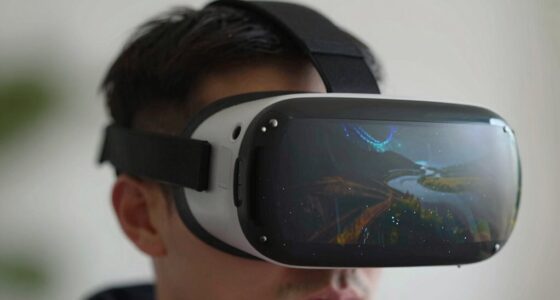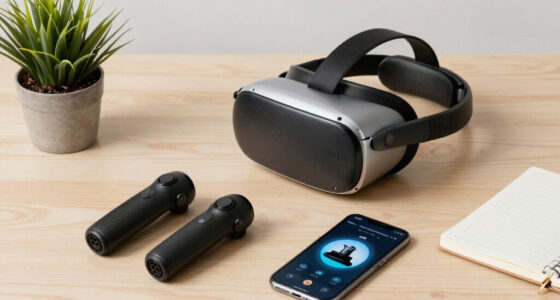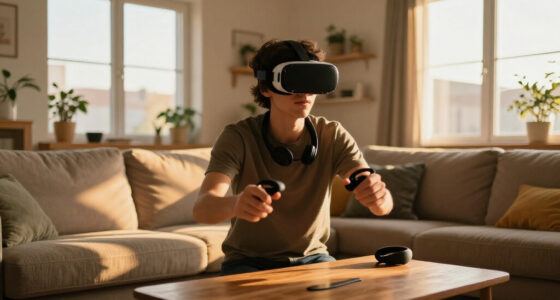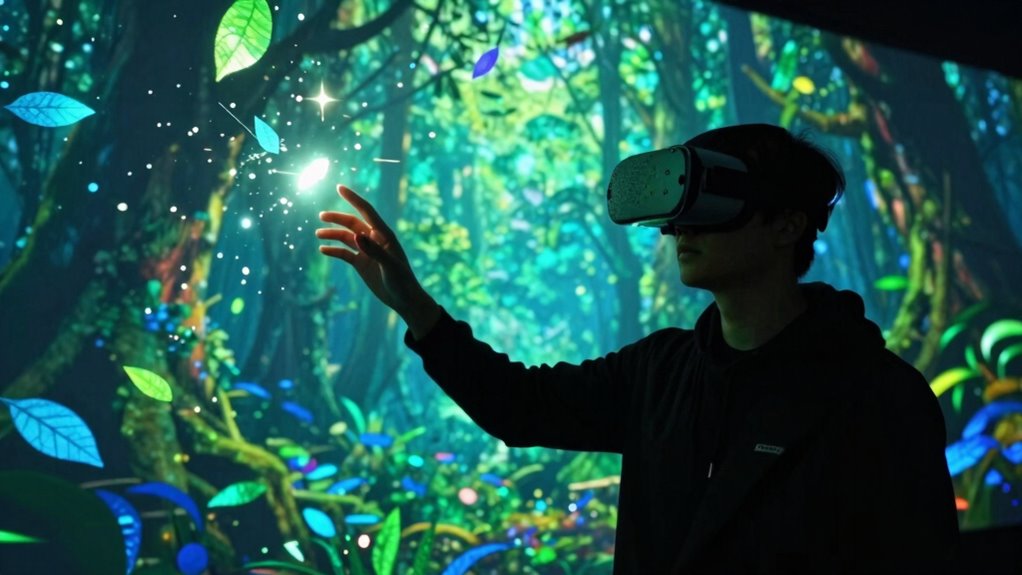

Presence in VR is the feeling that you’re truly inside a digital world, making the experience seem just as real as your physical environment. It happens when your senses, movement, and virtual body align seamlessly, creating a sense of immersion. High-quality visuals, sounds, and tactile feedback help trick your brain into accepting the virtual space as real. If you want to understand how this powerful sense is achieved and enhanced, keep exploring how VR creates such convincing experiences.

Play games on Amazon Luna for your next adventure, included with Prime
- A rotating selection of games, no download needed
- Play on TV, laptop or phone
- Fast, free delivery for your gear, too
Key Takeaways
- Presence in VR is the sensation of being genuinely immersed and “inside” the virtual environment.
- It depends on virtual embodiment, making users feel their virtual avatar is part of themselves.
- Sensory immersion, through visuals, sound, and haptics, enhances the feeling of a real, tangible world.
- High-quality hardware and responsive environment cues strengthen the perception of realism.
- Overall, presence makes virtual experiences feel authentic, convincing, and memorable.

Whether you’re exploring a digital universe or collaborating with others, feeling truly immersed in VR hinges on a concept known as presence. Presence is that feeling that makes you forget you’re wearing a headset and that what you see and hear is just a simulation. It’s what turns a digital experience into something that feels real. At its core, presence relies heavily on virtual embodiment and sensory immersion. Virtual embodiment is about feeling that your virtual body or avatar is an extension of yourself. When you see your hands moving in VR and they respond accurately, you start to believe those hands are yours. This connection deepens as your brain accepts the virtual body as part of your own. Sensory immersion, on the other hand, involves engaging your senses in a way that makes the virtual environment feel tangible. When the visuals are crisp, the sounds are spatially accurate, and even haptic feedback provides physical sensations, your brain receives a consistent stream of sensory data. This consistency helps bridge the gap between the virtual and real worlds, making the scene feel authentic.
You might notice that when your virtual embodiment matches your real movements, your sense of presence increases markedly. If you reach out to grab an object and your avatar’s hand moves precisely as yours does, your brain accepts that virtual hand as your own. The more seamlessly your actions are reflected in the environment, the stronger your feeling of being truly there. Sensory immersion plays an essential role as well. Imagine walking through a virtual forest where every sound is spatially accurate, every breeze can be felt subtly through a haptic device, and the visuals are so detailed that the environment seems to extend beyond your headset. These elements work together to trick your brain into accepting the virtual scene as part of your physical reality. When both virtual embodiment and sensory immersion are optimized, you’re more likely to experience a profound sense of presence. Additionally, achieving a high level of sensory immersion often depends on the quality of the hardware used, such as high-resolution displays and precise tracking systems. The hardware quality significantly influences how convincingly these elements can be integrated to enhance the experience. Moreover, sensory cues such as tactile feedback and spatial audio are crucial in creating a cohesive and believable environment.
Creating a convincing VR experience also involves considering how the environment responds to user interactions, further enhancing virtual realism. Ultimately, presence in VR isn’t just about looking around or hearing sounds; it’s about creating a believable, convincing experience that your mind accepts as real. It’s the magic that transforms a good VR session into a compelling, unforgettable experience. Achieving this sense of presence requires a carefully crafted blend of virtual embodiment and sensory immersion, which together turn digital worlds into immersive domains that feel just as real as the physical world around you.
As an affiliate, we earn on qualifying purchases.
Frequently Asked Questions
How Does Presence Differ From Immersion in VR?
Presence differs from immersion in VR because it’s about your feeling of truly being there, influenced by virtual realism and sensory fidelity. While immersion involves being absorbed in the experience, presence focuses on how real and convincing the environment feels to you. High sensory fidelity and realistic visuals enhance your sense of presence, making you forget you’re in a virtual world and genuinely experience being part of it.
Can Presence Be Measured Objectively or Only Subjectively?
Presence can be measured both objectively and subjectively. You can use quantitative metrics like tracking data, response times, and physiological responses to gather objective evidence of presence. However, user feedback remains essential for capturing the personal, subjective experience of feeling “there.” Combining these methods provides an all-encompassing understanding of presence in VR, helping developers enhance immersion and create more convincing virtual environments.
Does Presence Vary Between Different VR Platforms or Devices?
You’ll notice presence varies considerably across VR platforms. For instance, high-end headsets with advanced visual fidelity and haptic feedback often boost your sense of immersion. A study shows users feel 30% more present with better visual clarity and tactile sensations. Lower-end devices might lack these features, reducing your feeling of being truly there. So, the quality of visuals and tactile feedback directly influences how immersed and present you feel in different VR systems.
How Do Social Interactions Influence Presence in VR?
Social interactions markedly boost your sense of presence in VR by making the experience feel more authentic. When you see realistic avatars and experience environmental realism, you’re more immersed and engaged. Developing detailed avatars helps you connect better with others, while immersive environments make interactions feel genuine. These elements work together to heighten your feeling of actually being part of the virtual world, enhancing overall presence during social VR experiences.
Is Presence in VR Affected by User Personality or Mood?
Your personality traits and emotional states subtly shape your sense of presence in VR. If you’re naturally outgoing or enthusiastic, you might find it easier to immerse yourself, while mood swings can either enhance or diminish your engagement. These personal qualities act like a gentle current, guiding your experience. Embracing your unique traits can make virtual worlds feel more real, deepening your connection and making the journey more memorable.
As an affiliate, we earn on qualifying purchases.
Conclusion
Understanding presence in VR isn’t just about immersion; it’s about feeling truly there. Studies show that users who experience higher levels of presence report greater emotional engagement and satisfaction. For example, a recent survey found that 78% of VR users felt more connected to virtual environments when their sense of presence was heightened. So, if you want your VR experiences to resonate, focus on creating that convincing sense of ‘being there’—it makes all the difference.
As an affiliate, we earn on qualifying purchases.
As an affiliate, we earn on qualifying purchases.
Halloween Picks
halloween
As an affiliate, we earn on qualifying purchases.