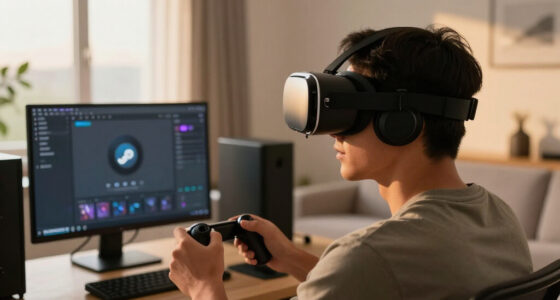
Switching from base-station to inside-out tracking means you’ll rely on your device’s onboard sensors instead of external stations, making setup quicker and more portable. Inside-out tracking offers easier installation and flexibility but may be less precise in larger or obstructed environments. With base-station systems, you’ll get higher accuracy but need fixed hardware setups. To understand how these changes impact your experience and what future tech might bring, keep exploring the details ahead.
Key Takeaways
- Inside-out tracking uses onboard sensors, offering greater portability and easier setup compared to the external infrastructure needed for base-station systems.
- Base-station tracking provides more consistent and higher accuracy over larger areas, unaffected by environmental obstructions.
- Inside-out systems are more flexible and suitable for dynamic environments, while base-station setups are ideal for fixed, high-precision spaces.
- Transitioning to inside-out reduces installation time and costs, simplifying deployment and maintenance.
- Future industry trends favor inside-out systems for streamlined, portable, and adaptable tracking solutions.

Pimax Crystal Super VR Headset, 3840×3840 per Eye, Ultrawide, 140° FOV, Eye- Tracking, Ultra-Sharp for Flight & Racing Simulators & Gaming, DP Connection with PC
- High-Resolution Per Eye: 3840×3840 pixels with local dimming
- Exceptional Visual Clarity: 50 PPD with aspherical lenses
- Ultra-Wide Field of View: 140° for immersive experience
As an affiliate, we earn on qualifying purchases.
As an affiliate, we earn on qualifying purchases.
How Inside‑Out Tracking Works

Inside‑Out tracking works by placing sensors or cameras on the tracked device itself, which then detect signals or features from the environment. As you move, these sensors scan the surroundings, capturing spatial data in real-time. The system processes this data instantly, creating a map of your position relative to nearby objects. Unlike external systems, it relies solely on onboard hardware, so there’s no need for external sensors or base stations. This setup allows for more freedom of movement and easier setup, as you don’t have to install additional equipment around your play area. The device constantly updates its understanding of your location, ensuring smooth and accurate tracking during your activities. Incorporating high-quality tracking technology ensures better precision and responsiveness during use. Additionally, advancements in sensor accuracy contribute to more reliable and immersive experiences, enabling seamless integration with smart home automation features. Moreover, the elimination of external base stations simplifies the overall setup process, making it more accessible for users. Furthermore, the development of compact hardware has made inside-out tracking systems increasingly portable and user-friendly.

HTC Vive SteamVR Base Station 2.0 (Single) – Precision Room-Scale Tracking for PC VR, Black
- Includes Base Station and Power Adapter: One base station with power adapter
- Standard Threaded Mounting Compatibility: Fits standard threaded mounts
- 8'2" Long Power Cord: Includes 8'2" power cord
As an affiliate, we earn on qualifying purchases.
As an affiliate, we earn on qualifying purchases.
The Mechanics of Base‑Station Systems

Understanding how base-station systems work starts with their placement strategies, which determine coverage and accuracy. You also need to take into account how signals are transmitted and received to maintain reliable communication. Additionally, proper system calibration ensures all components work together seamlessly for precise tracking. A thorough understanding of navigation and mapping principles helps optimize the overall system performance. Recognizing common slang terms used in the field can also improve communication among team members and users. Maintaining system health through regular checks is essential to prevent errors and ensure continuous operation, especially considering the importance of signal quality in reliable system functioning. Regularly monitoring gelato flavors and customer feedback can also help improve service quality and user satisfaction.
Base-Station Placement Strategies
Effective base-station placement is vital for ensuring accurate tracking and reliable data transmission. You need to consider the environment, obstacles, and coverage area to optimize performance. Position stations high enough to minimize obstructions and maximize line-of-sight. Avoid placing stations near interference sources like metal structures or electronic devices. Spread them evenly to prevent coverage gaps and ensure seamless data flow. Adjust placement based on the specific layout of your space, whether indoors or outdoors, to enhance signal strength. Regularly evaluate and reposition stations if you notice dead zones or weak signals. Proper placement reduces latency, improves accuracy, and keeps your system running smoothly. Incorporating precise placement techniques can further enhance system reliability and performance. Additionally, understanding home energy considerations can help you optimize your system’s integration with your overall energy setup. In outdoor environments, consider the electric dirt bike capabilities to ensure your tracking system can withstand different terrains and conditions. Moreover, implementing environmental assessments can identify potential challenges before finalizing station locations, ensuring consistent coverage across diverse settings. Considering essential oils for signal enhancement might also be beneficial for specialized environments where signal interference is common, helping maintain optimal system operation.
Signal Transmission and Reception
Have you ever wondered how base stations transmit and receive signals to keep tracking systems accurate? It all starts with radio waves sent out through antennas, which broadcast signals over specific frequencies. When a device, like a phone or tracker, responds, the base station captures the reflected signals. This exchange allows the system to measure distance and direction. The signals travel through the air, facing obstacles and interference that can affect accuracy. Base stations use multiple antennas to improve reception and reduce errors, ensuring a clear, stable connection. The quality of transmission depends on factors like signal strength, frequency, and environmental conditions. By continuously sending and receiving these signals, the system maintains real-time tracking, allowing precise location data to be delivered to you.
System Calibration Processes
Once signals are exchanged between devices and base stations, the system needs to be fine-tuned to guarantee accurate tracking. Calibration aligns the system’s components, ensuring measurements are precise. You’ll typically start by verifying the base station’s position and orientation, then adjust signal timings and power levels. During calibration, you might also need to account for environmental factors like obstacles or reflective surfaces that could interfere with signals. Proper calibration involves iterative testing and adjustments to optimize accuracy. This process ensures the system’s calculations match real-world distances and angles. Regular calibration maintains performance over time, especially if the environment or hardware changes. Calibration accuracy is essential for reliable location data and a seamless tracking experience. Ultimately, system calibration minimizes errors, giving you reliable location data and a seamless tracking experience.

Wireless Full Body Tracking Kit, BNO085 IMU Motion Trackers, Rechargeable Wearable VR Motion Sensors for PC VR Applications and Motion Tracking Setup(2 BNO085 trackers)
- Sensor Type: BNO085 IMU motion sensor
- Tracking Capability: Supports full body movement tracking
- Design: Lightweight and wearable for comfort
As an affiliate, we earn on qualifying purchases.
As an affiliate, we earn on qualifying purchases.
Setup and Installation Differences
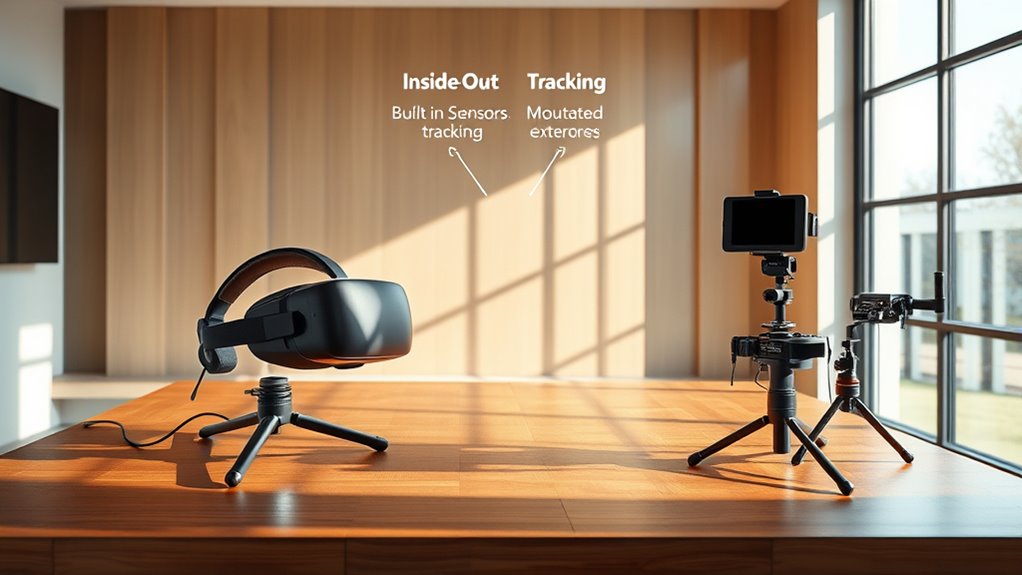
When setting up inside-out and base-station tracking systems, you’ll notice differences in hardware needs and installation steps. Inside-out setups often require fewer components and are simpler to install, while base-station systems demand more equipment and careful calibration. Understanding these differences helps you plan for the complexity and calibration processes involved in each setup. Additionally, precision and automation features play a significant role in how these systems perform and influence your overall kitchen technology experience. Incorporating cookie management options can enhance user experience by allowing customization of system settings and data collection preferences. Being aware of the installation complexity can help you allocate sufficient time and resources for a successful setup. Moreover, understanding hardware requirements can ensure compatibility and optimal performance of your tracking system. Considering ventilation considerations is also important, especially in enclosed spaces, to maintain safety and system longevity.
Hardware Requirements
Inside-out tracking systems typically require minimal hardware setup, as they rely on sensors embedded within the device itself, reducing the need for external equipment. You mainly need to guarantee the device’s internal sensors are unobstructed and calibrated for peak performance. Unlike base-station tracking, which demands external sensors or lasers, inside-out systems eliminate the need for additional hardware in your space. Proper piercing care and hygiene is also essential to maintain optimal sensor function and prevent infections that could interfere with tracking. This simplicity means fewer components to install, less room for setup errors, and quicker deployment. Your focus shifts to proper device positioning and ensuring internal sensors are clean and unobstructed for a seamless experience. Additionally, understanding the home environment can help optimize sensor effectiveness and overall device performance.
Setup Complexity
Setup complexity varies substantially between inside-out and base-station tracking systems. Inside-out systems are generally easier to install because they rely on built-in sensors on the headset, requiring minimal external setup. You simply put on the headset, calibrate it briefly, and you’re ready to go. In contrast, base-station tracking demands more planning and effort. You need to position external base stations in ideal locations, ensuring they have clear lines of sight to cover your play area. Mounting the stations securely and configuring their orientation can take additional time. The process is more involved but offers greater flexibility once set up. Overall, inside-out setups are quicker and more straightforward for most users, while base-station systems require a more deliberate installation process but can provide more expansive tracking space.
Calibration Process
Calibration processes differ substantially between inside-out and base-station tracking systems. With inside-out, you typically calibrate by moving sensors around your space to map your environment, confirming the system recognizes room geometry and surfaces. For base-station setups, calibration involves aligning and syncing the stationary base stations, often requiring precise positioning and sometimes room scans.
- Inside-out calibration focuses on sensor placement and environment mapping
- Base-station calibration involves station positioning and synchronization
- Inside-out requires movement to complete environment scans
- Base-station setup calls for accurate base placement and signal alignment
While inside-out calibration is more dynamic and user-friendly, base-station calibration demands more precision during installation to ensure accurate tracking. Both methods ultimately aim for seamless, reliable tracking performance.

Upgraded VR Wireless Receiver SteamVR Games USB Dongle Receiver for Valve Index Controller Portable Mini HTC Vive Tracker Receiver
- Universal Compatibility: Supports Valve Index, HTC Vive, and more
- Pre-Flashed Firmware: Ready for Steam and HTC Vive tracking
- Reliable Performance: Tested for durability and seamless use
As an affiliate, we earn on qualifying purchases.
As an affiliate, we earn on qualifying purchases.
Accuracy and Precision in Tracking

Understanding the accuracy and precision of tracking systems is essential because they determine how reliably a device can pinpoint your position. Higher accuracy means your location is closer to the true position, while better precision indicates consistent results over multiple measurements. Inside-out tracking often offers good accuracy in small areas but can drift over larger spaces. Base-station tracking typically provides higher accuracy due to fixed reference points, maintaining precision across larger zones. To clarify, consider this comparison:
| Feature | Inside-Out Tracking | Base-Station Tracking |
|---|---|---|
| Accuracy | Moderate to high | Very high |
| Precision | Consistent locally | Consistent overall |
| Ideal Use Case | Personal devices | Large spaces |
Choosing the right system depends on your accuracy needs.
Flexibility and Portability Considerations

When choosing a tracking system, flexibility and portability often influence how easily you can deploy and move the technology. You want a setup that adapts to different environments without hassle. Inside-out systems typically offer lightweight hardware, making them easier to relocate and set up in various spaces. Conversely, base-station systems might require more infrastructure, limiting quick mobility. Consider how often you’ll need to move the system or adjust its placement. Portability can save time and reduce setup complexity. Think about power sources, mounting options, and space requirements. Ensuring the system can adapt to your changing needs keeps your workflow smooth. Ultimately, your choice depends on how much flexibility and portability matter for your specific environment and use case.
- Ease of relocation
- Setup complexity
- Power and mounting options
- Adaptability to different spaces
Compatibility With Different Devices

Compatibility with different devices is crucial to guarantee your tracking system integrates seamlessly into your existing workflow. Ensuring your hardware works across various devices prevents disruptions and simplifies setup. Some systems support VR headsets, motion controllers, and sensors from multiple brands, while others are more limited. Check compatibility before investing to avoid frustration.
| Device Type | Compatibility Notes |
|---|---|
| VR Headsets | Many support popular brands like Oculus, HTC Vive, and Valve Index |
| Motion Controllers | Compatibility varies; verify with your system |
| Tracking Sensors | Some systems only work with specific sensor models |
Impact on User Experience and Immersion
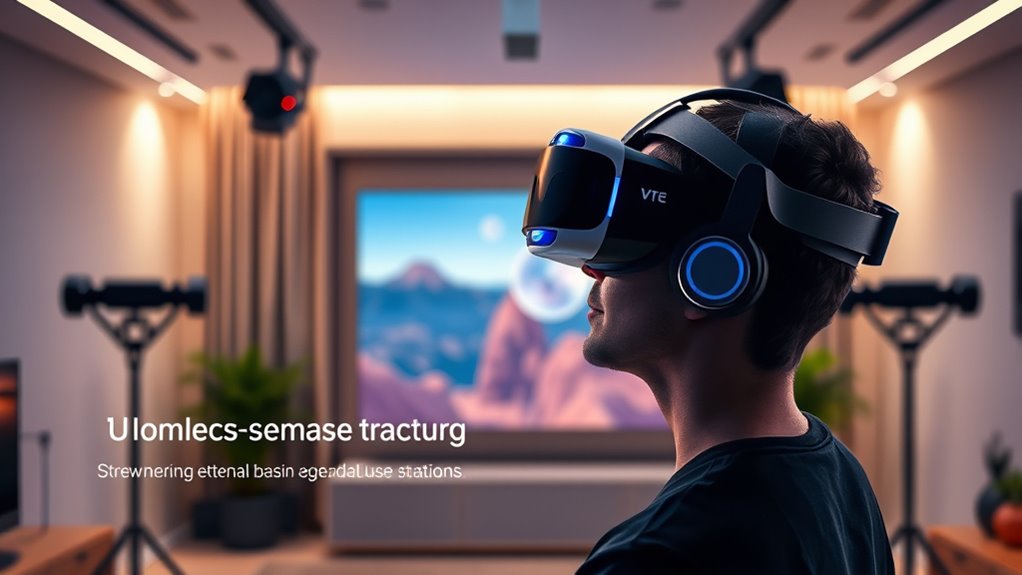
The choice between Inside-Out and Base-Station tracking considerably influences your overall user experience and immersion levels. With Inside-Out, you benefit from a more seamless, cable-free setup that lets you move freely without worrying about external sensors. This often results in a more natural, immersive environment where you feel truly present. On the other hand, Base-Station tracking offers precise positional data, enhancing realism during fast-paced or room-scale experiences. Your immersion depends on how accurately your movements are captured.
Inside-Out tracking offers seamless, cable-free movement, while Base-Station provides precise, immersive accuracy for intense VR experiences.
- Inside-Out provides freedom of movement with fewer wires
- Base-Station offers higher tracking precision for intense gameplay
- Inside-Out can have tracking gaps in complex environments
- Base-Station enhances immersion with consistent accuracy
Future Trends and Innovations in Tracking Technology
Advancements in tracking technology are rapidly shaping the future of virtual reality experiences, promising greater accuracy, ease of use, and immersion. Innovations like hybrid tracking combine inside-out and outside-in methods for seamless precision, while AI-driven algorithms enhance responsiveness. Expect lighter hardware with longer battery life and faster setup times, making VR more accessible. Spatial awareness will improve, enabling more natural interactions and realistic environments. The table below highlights upcoming trends:
| Trend | Description | Impact on Users |
|---|---|---|
| Hybrid Tracking | Combines multiple tracking methods for accuracy | Smoother experiences |
| AI Integration | Enhances responsiveness and environment mapping | More natural interactions |
| Lightweight Hardware | Reduces bulk and increases comfort | Longer usability, less fatigue |
| Enhanced Spatial Awareness | Improves environmental understanding | More immersive, realistic VR |
Frequently Asked Questions
How Do Tracking Methods Affect Overall VR Gameplay Experiences?
Tracking methods directly impact your VR gameplay by influencing accuracy, responsiveness, and immersion. Inside-out tracking offers more freedom and ease of setup, making movement feel natural and seamless. Base-station tracking provides higher precision, ideal for fast-paced or complex games. Your experience depends on your preferences; inside-out feels more intuitive, while base-station enhances control in demanding scenarios. Choose based on how you like to play and the level of detail you need.
What Are the Cost Differences Between Inside-Out and Base-Station Systems?
Imagine choosing between a sleek, portable bicycle and a sturdy motorcycle. Inside-out systems are like bikes—more affordable, easier to set up, but less precise, costing around $300 to $500. Base-station setups are your motorcycles—more expensive, around $500 to $1,000, but offering superior accuracy and stability. Your choice depends on your budget and how much precision you want to enhance your VR adventures.
Can Existing VR Setups Be Upgraded From One Tracking Type to Another?
Yes, you can upgrade your existing VR setup from one tracking type to another, but it depends on your hardware. If your headset supports both tracking methods or if you can replace key components, the upgrade is feasible. However, some systems may require new hardware or adapters. Check your device specifications and manufacturer guidance to ensure compatibility before proceeding with the upgrade.
How Do Tracking Technologies Impact Device Maintenance and Longevity?
Tracking technologies are the backbone of your VR device’s health, like the steady heartbeat keeping it alive. Inside-out tracking usually requires less maintenance because it’s more integrated and less prone to misalignment. Base-station setups, on the other hand, demand regular calibration and occasional repairs. Your device’s longevity depends on proper care—clean lenses, firmware updates, and careful handling—ensuring your VR experience remains smooth and reliable over time.
Are There Privacy Concerns Associated With Different Tracking Systems?
Yes, there are privacy concerns with different tracking systems. You might worry about how your location data is collected, stored, and shared, especially if it’s used without your consent. Inside-out tracking may feel less invasive since it uses onboard sensors, but it still tracks your movements. Base-station systems could raise more privacy issues because they often involve more centralized data collection. Always check privacy policies and control your data sharing options.
Conclusion
Whether you prefer the seamless simplicity of inside-out tracking or the robust reliability of base-station setups, understanding their differences helps you decide what’s right. As technology advances, expect exciting evolutions that enhance immersion, improve accuracy, and expand flexibility. Embrace these innovations, and you’ll gain access to a world where virtual adventures feel vivid, vibrant, and virtually limitless. So, stay savvy, stay connected, and step confidently into the future of tracking technology.