
In simple terms, 3DOF tracks only your head’s rotational movements, like turning or tilting, so you can look around but can’t move in space. 6DOF, on the other hand, detects both rotation and your actual position—like stepping forward or leaning—to give a more immersive experience. Understanding these differences helps you pick the right VR system for your activity. Keep going if you want to learn more about how each setup works!

Get VR and gaming gear delivered free — and shop member deals
- Fast, free delivery on millions of items
- Access to Prime Big Deal Days deals on October 6–7
- Prime Video, Amazon Music and more included
Key Takeaways
- 3DOF tracks only head rotation (looking around), while 6DOF tracks both rotation and position (moving around).
- 3DOF uses sensors like gyroscopes for orientation; 6DOF adds motion sensors for full movement tracking.
- 3DOF is suitable for watching videos and virtual tours; 6DOF enables active exploration and object interaction.
- 6DOF offers more immersive experiences by allowing users to lean, step, and reach within virtual environments.
- Choosing between them depends on activity needs, with 3DOF being simpler and cheaper, and 6DOF providing greater realism.
As an affiliate, we earn on qualifying purchases.
What Are Degrees of Freedom in VR?
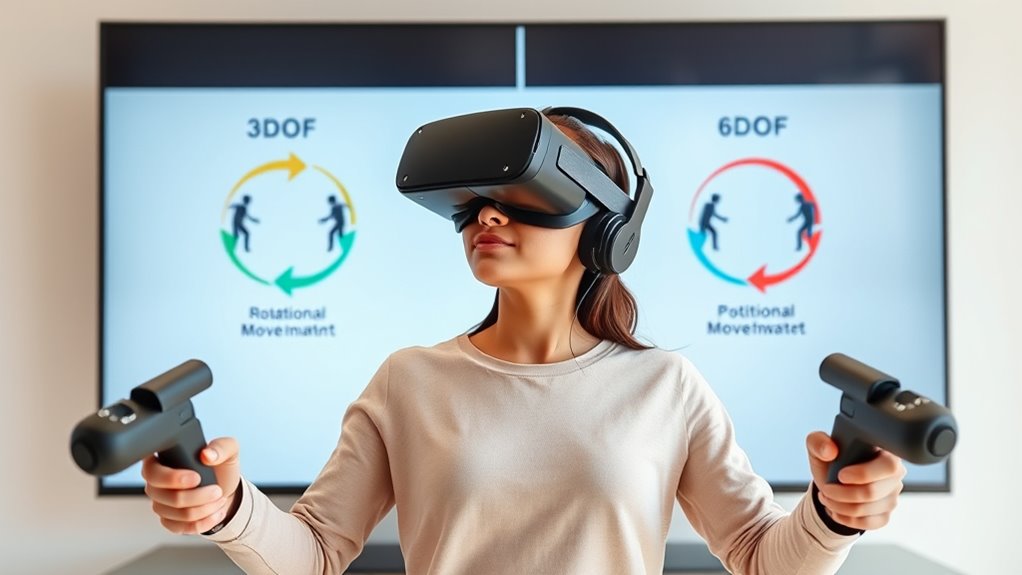
Have you ever wondered how virtual reality systems track your movements? Degrees of freedom, or DOF, refer to the number of ways your device can detect your motion. In VR, this means how many directions and types of movement the system can follow. For example, 3DOF tracks rotational movements like turning your head left or right, up or down. It doesn’t track your position in space, only how you’re looking. On the other hand, 6DOF captures both rotational and positional movements, so it knows when you move forward, backward, or sidestep. Basically, DOF determines how immersive your VR experience can be. The more degrees of freedom your system has, the more natural and realistic your movements feel within the virtual environment. Additionally, the contrast ratio plays a significant role in how vivid and detailed the virtual scenes appear, further enhancing the overall experience. A higher tracking accuracy ensures smoother and more precise motion detection, making the experience even more convincing. This is especially important in immersive environments, where realistic tracking heightens the sense of presence. Moreover, the body tracking capabilities can further improve the realism of virtual interactions by accurately mimicking your full body movements. Incorporating water-based tracking techniques can also enhance realism, especially in applications like hydrotherapy or aquatic exercise, by providing more accurate movement detection in water environments.
As an affiliate, we earn on qualifying purchases.
How 3DOF Devices Track Your Head Movements
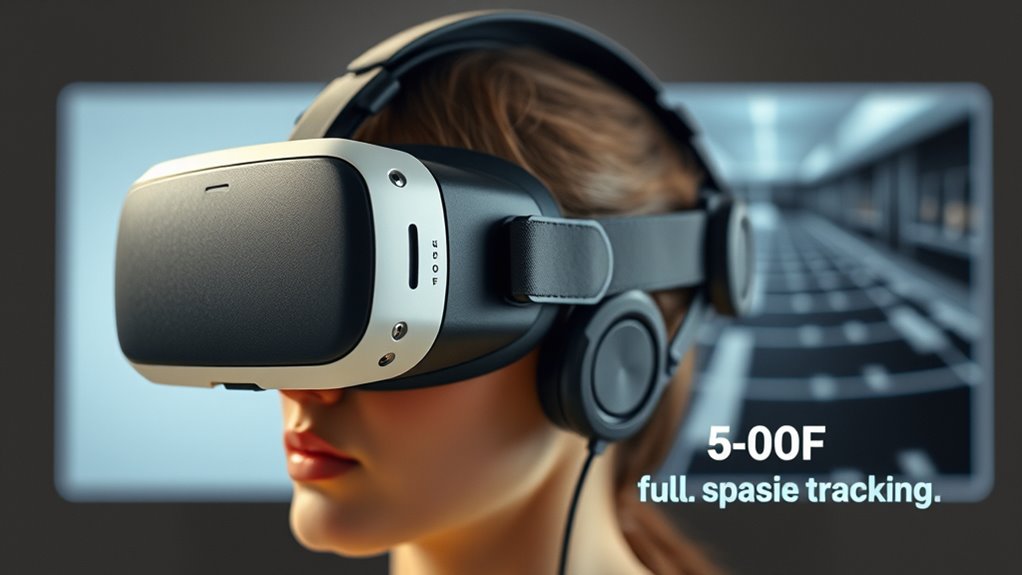
3DOF devices mainly track your head rotation, so they detect when you look left, right, up, or down. Your movement range is limited to these rotational changes, meaning they can’t follow forward or backward movements. They typically use sensors like gyroscopes and magnetometers to capture your head’s orientation accurately.
Head Rotation Detection
Head rotation detection in 3DOF devices works by tracking the angular movements of your head, such as looking left or right, up or down, and tilting side to side. The device uses sensors to measure how your head rotates around a fixed point, capturing these movements in real time. This lets you look around in a virtual environment as long as your head turns within the device’s limited range.
Here’s how it works:
- Sensors detect rotational angles from your head movements.
- The device translates these angles into corresponding changes in the virtual view.
- It updates your perspective based on these rotations, giving a sense of looking around.
This system is simple but effective for basic head rotation tracking.
Limited Movement Range
While sensors in 3DOF devices effectively track your rotational head movements, their ability to capture motion is limited to a specific range. They can detect when you turn, tilt, or nod your head, but only within a certain distance from your starting position. If you move too far or quickly, the device won’t register those movements accurately. This means your experience is confined to looking around within a fixed space, making it less versatile for dynamic interactions. You won’t be able to lean forward, step sideways, or move in space beyond the initial tracking zone. As a result, your movement feels restricted, and the device doesn’t adapt to broader physical motions. This limitation impacts the feeling of immersion and the scope of interaction in virtual environments.
Sensor Technologies Used
Sensors in 3DOF devices primarily rely on gyroscopes and accelerometers to track your head movements. These sensors detect rotational and linear motions, allowing the device to interpret your head orientation. Here’s how they work:
- Gyroscopes measure rotational movement, so when you tilt or turn your head, it detects the change in angle.
- Accelerometers capture linear acceleration, helping identify movements like nodding or shaking your head.
- Sensor Fusion Algorithms combine data from both sensors to improve accuracy and reduce noise, providing a smooth tracking experience.
These technologies work together to determine your head’s position and orientation within a limited range, enabling simple 3DOF interactions like looking around or tilting your head.
best VR systems for immersive experience
As an affiliate, we earn on qualifying purchases.
As an affiliate, we earn on qualifying purchases.
The Capabilities of 6DOF Systems
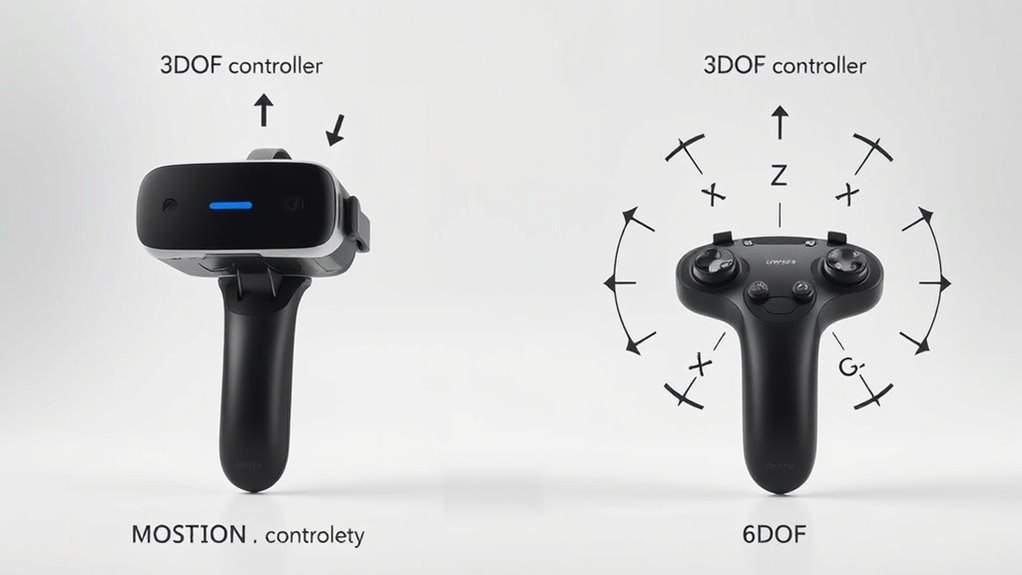
With 6DOF systems, you get precise movement tracking that captures your full range of motion. This leads to a more immersive experience, making virtual environments feel incredibly real. Plus, their complex interaction capabilities let you manipulate objects and navigate with natural ease.
Precise Movement Tracking
Six Degrees of Freedom (6DOF) systems excel at tracking precise movements by capturing all three axes of translation—forward/backward, up/down, and left/right—as well as rotations around those axes. This allows you to move naturally and accurately within virtual environments. With 6DOF, you can expect your device to detect subtle shifts and rotations, making interactions smooth and responsive. You won’t feel limited or disconnected from your virtual surroundings. Additionally, local automation enhances the responsiveness of 6DOF systems by integrating with smart home devices for a more seamless experience. The high level of motion sensing accuracy provided by 6DOF systems ensures a more immersive and realistic virtual experience. Here’s what makes 6DOF movement tracking so effective: 1. Tracks all translational movements for realistic positioning. 2. Detects rotations, enabling natural head and hand movements. 3. Offers high precision, reducing lag and improving immersion.
This ensures your virtual experience feels seamless and lifelike.
Enhanced Immersive Experience
By accurately capturing both translational and rotational movements, 6DOF systems create a more convincing and engaging virtual environment. This allows you to look around, lean, and move naturally within the digital space, enhancing your sense of presence. Unlike 3DOF setups, which limit you to head orientation, 6DOF immerses you fully, making interactions feel real. You can explore environments more freely, notice small details, and respond intuitively to virtual objects. This heightened immersion reduces the disconnect often felt in simpler systems, making experiences feel more authentic. As a result, 6DOF technology delivers a richer, more compelling virtual world that responds seamlessly to your every move, drawing you deeper into the digital environment. Modern VR technology continues to evolve, offering even more realistic and immersive experiences.
Complex Interaction Capabilities
The enhanced movement tracking of 6DOF systems unlocks a wide range of complex interactions that go beyond simple head orientation. With 6DOF, you can interact more naturally within virtual environments, making your experience feel more real. You can reach out, grab objects, and manipulate tools, creating a sense of presence and control. This level of interaction enables connected cooking experiences where virtual tools can be operated as if they were real. This allows for more immersive gameplay, training simulations, or design work. Additionally, the precise motion tracking offered by 6DOF systems enables smoother and more accurate control, further enhancing the realism of virtual interactions.
Some key capabilities include:
- Picking up and moving objects as if you’re physically handling them.
- Interacting with menus or interfaces through natural gestures.
- *Steering* environments by leaning or leaning around obstacles.
These features make your virtual experience more intuitive and lifelike, elevating the potential of VR beyond basic viewing.
As an affiliate, we earn on qualifying purchases.
Practical Examples of 3DOF and 6DOF Use
Have you ever wondered how different degrees of freedom are applied in real-world situations? 3DOF is commonly used in simple head-tracking systems for VR, where only rotational movements matter. For example, when you turn your head side to side or tilt it up and down, a 3DOF system captures these motions to adjust the view. It’s perfect for experiences like watching 360-degree videos or basic virtual tours. On the other hand, 6DOF is used in more advanced applications like flight simulators, robotics, or immersive gaming. It tracks both rotational and positional movements, so you can lean forward, step aside, or duck under objects. This allows for a more realistic and interactive experience, making you feel truly present within the virtual environment. Understanding the degrees of freedom helps you choose the right technology for your needs, especially as different VR tracking systems offer varying levels of immersion.
Which Setup Is Better for Different Activities?
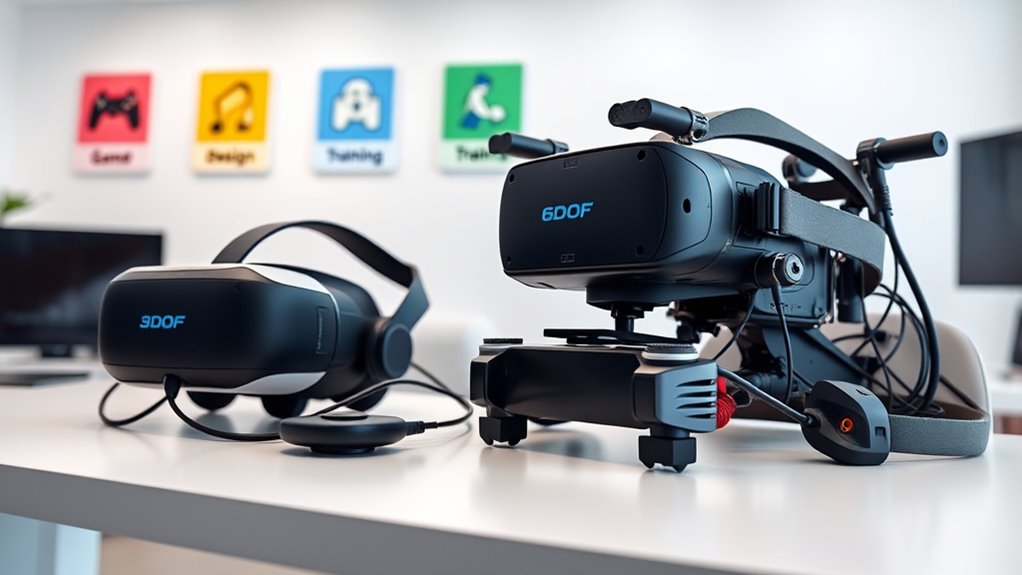
Choosing between 3DOF and 6DOF setups depends on what activities you want to enjoy. If you’re into simple experiences like viewing virtual tours or watching videos, a 3DOF setup works fine because it tracks head rotation only. For more interactive activities, such as playing immersive video games or designing in 3D, a 6DOF setup is better since it tracks both position and rotation.
Consider these options:
- Watching movies or virtual tours – 3DOF is sufficient.
- Playing fast-paced, movement-intensive games – 6DOF offers a more realistic experience.
- Creating or editing 3D models – 6DOF helps you move within the virtual space easily.
Your choice should match how actively you want to engage with the virtual environment. Additionally, if you plan to use your setup for extended periods, understanding toilet maintenance and comfort can help you stay comfortable during long sessions.
Limitations of 3DOF Compared to 6DOF
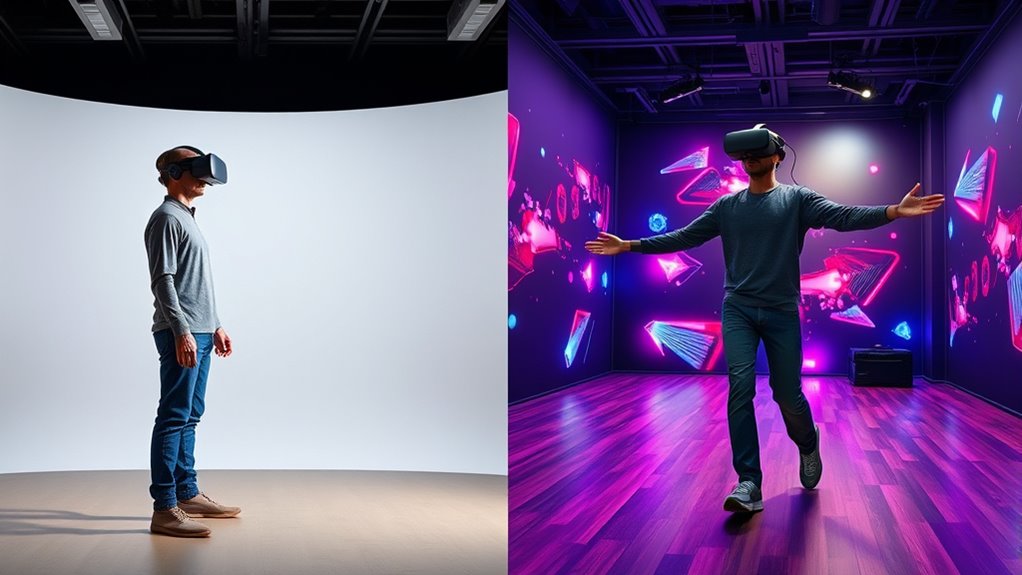
While 3DOF setups are simpler and more affordable, they come with notable limitations that can affect your virtual experience. With 3DOF, you can only move your head up and down, side to side, and tilt, which means you can’t look around objects or explore your environment naturally. This restricts immersion, making interactions feel less realistic. You also can’t lean or duck, which reduces your ability to navigate complex scenes or dodge obstacles. If you want a more dynamic experience that reacts to your full range of movement, 3DOF falls short. It’s best suited for seated experiences like watching videos or simple VR apps. For more immersive gameplay or realistic simulations, 6DOF offers the freedom to move in all directions and enhances the overall experience.
Choosing the Right VR System for You
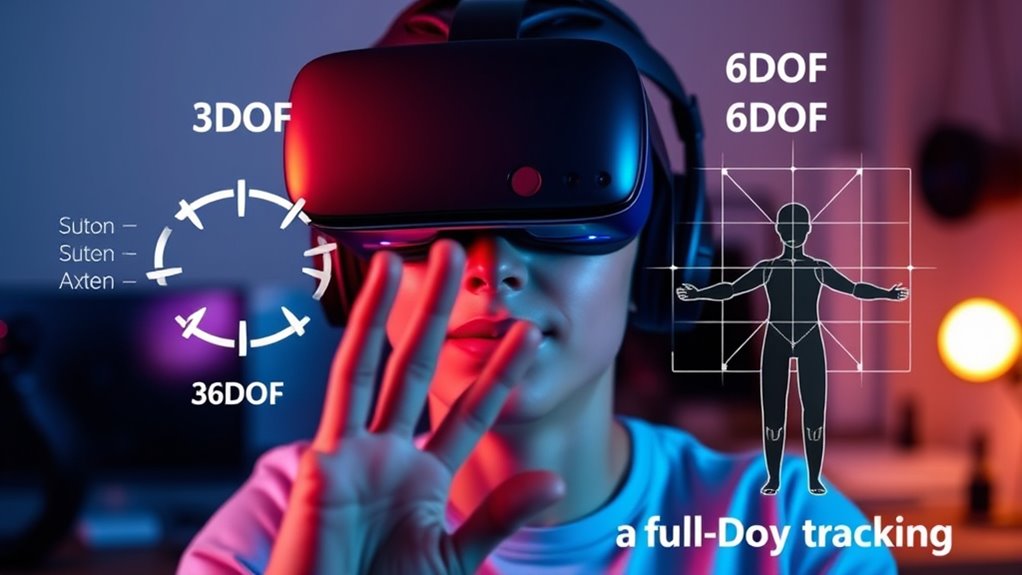
Selecting the right VR system depends on your specific needs, budget, and how you plan to use it. To make an informed choice, consider these factors:
Choosing the right VR system depends on your needs, budget, and intended use to ensure the best experience.
- Purpose: If you want immersive gaming, a 6DOF system offers full movement tracking. For casual experiences or watching videos, a 3DOF headset might suffice. Understanding tracking capabilities can help clarify how well each system meets your activity requirements. Ensuring the reliability and safety of your setup is also important for long-term use and peace of mind. Additionally, consider how the Free Floating feature impacts your VR experience, especially in terms of ease of setup and flexibility. Being aware of the tracking system used can help you choose a device that aligns with your activity level and safety preferences.
- Budget: 3DOF systems are usually cheaper and easier to set up, while 6DOF options can be more costly but provide a richer experience.
- Space & Comfort: If you have limited space, a lightweight 3DOF headset might be better. For more active use, ensure your setup allows for comfortable movement.
- Safety & Maintenance: Regular safety checks, such as ensuring proper cord management and ventilation, are crucial for a safe and enjoyable VR experience.
Evaluate your priorities to find a system that fits your lifestyle without overspending.
Frequently Asked Questions
How Do 3DOF and 6DOF Impact VR Immersion?
You’ll notice that 6DOF substantially enhances your VR immersion by allowing full movement in all directions, making experiences feel more real and natural. In contrast, 3DOF tracks only head rotation, limiting your interaction and making environments feel less immersive. With 6DOF, you can walk, lean, and look around freely, which pulls you deeper into the virtual world. So, if immersion matters, 6DOF offers a much richer, more engaging experience.
Can You Upgrade From 3DOF to 6DOF Later?
Yes, you can upgrade from 3DOF to 6DOF later, but it depends on your VR headset. Some headsets or controllers are designed with modular components, allowing upgrades or replacements. For others, you’ll need to purchase a new device that offers 6DOF tracking. Before upgrading, check if your current hardware supports expansion or if a full replacement is necessary to enjoy full positional tracking and enhanced immersion.
Are There Cost Differences Between 3DOF and 6DOF Systems?
Yes, there are cost differences between 3DOF and 6DOF systems. Generally, 6DOF setups cost more because they offer greater complexity, advanced sensors, and more precise tracking. You pay for the added features, improved experience, and higher technology. If you’re on a budget, a 3DOF system might suit you better. But if you want full motion, better immersion, and flexibility, investing in a 6DOF system is worth the extra cost.
Which VR Systems Are Best for Professional Use?
For professional use, you should consider VR systems like Oculus Quest Pro, HTC Vive Pro, or Varjo VR-3. These offer high-resolution displays, precise tracking, and comfortable designs suited for extended sessions. They’re ideal for industries like training, design, and simulation. You’ll benefit from their advanced features, ensuring immersive experiences and accurate data collection, helping you boost productivity and achieve your professional goals efficiently.
How Do Tracking Technologies Differ in 3DOF and 6DOF?
Ever wonder how tracking technologies differ in 3DOF and 6DOF? In 3DOF, your head’s rotation is tracked, meaning you can look around but not move in space. With 6DOF, both rotation and position are tracked, so you can lean, duck, or step forward. This makes 6DOF more immersive, perfect for detailed simulations, while 3DOF is simpler, ideal for passive experiences like watching videos.
Conclusion
Imagine you’re exploring a new city with a map. A 3DOF headset is like having only a compass—great for directions, but you miss the street views. A 6DOF system is like walking the streets yourself, seeing everything up close. If you want full immersion and freedom, go for 6DOF. Otherwise, 3DOF might be enough for casual sightseeing. Choose what fits your adventure, and plunge into VR with confidence!
Halloween Picks
halloween
As an affiliate, we earn on qualifying purchases.