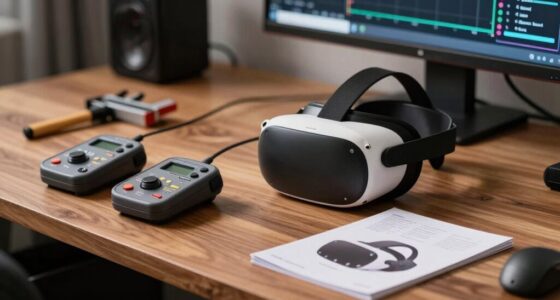
A maintainable VR setup is one you can keep using without turning every session into a cable, tracking, or compatibility project. I rank the Meta Quest 3 as the easiest fit for a simple standalone space, while the VIVE Focus Vision suits buyers who want more PC flexibility and replaceable-session power. The Valve Index Full Kit offers a complete PC VR package, but its renewed status and room-tracking hardware ask for more care. The HTC base station is different: it is a replacement or expansion component, not a complete headset setup.

Play games on Amazon Luna for your next adventure, included with Prime
- A rotating selection of games, no download needed
- Play on TV, laptop or phone
- Fast, free delivery for your gear, too
The main choice is between simple standalone use and a more involved PC room-scale system. A cordless headset reduces setup clutter, but still needs charging and storage. Base-station tracking can support a dedicated play area, yet depends on compatible equipment and mounting. I focus on the upkeep buyers will face after the initial setup, not just headline display features.
Complete the kit

Key Takeaways
- Meta Quest 3 is the simplest option here to maintain as a standalone headset, though its stated battery life is about 2.2 hours and its renewed condition merits inspection.
- VIVE Focus Vision is the most adaptable headset in this group: standalone or DisplayPort PC VR, with a hot-swappable battery, but PC streaming has a specific Ethernet setup requirement.
- Valve Index Full Kit is the clearest all-in-one choice for buyers committed to PC VR and room-scale base stations; renewed condition and a more involved tracking area add upkeep.
- HTC Vive SteamVR Base Station 2.0 is only one tracking component, so it makes sense as a compatible system replacement or expansion, not as a first VR purchase.
- Before choosing, match the headset to your room, computer, tracking hardware, and tolerance for charging, cables, mounting, and refurbished-product checks.
| Meta Quest 3 512GB VR Headset (Renewed) |  | Best Overall for Low-Fuss Standalone VR | Platform: Standalone | Storage: 512 GB | Memory: 8 GB RAM | VIEW ON AMAZON | See Our Full Breakdown |
| HTC VIVE Focus Vision Wired VR Headset Bundle with Facial Tracker |  | Best for Flexible PC and Standalone Use | Display resolution: 2448 × 2448 pixels per eye | Refresh rate: 90 Hz | Field of view: Up to 120 degrees | VIEW ON AMAZON | See Our Full Breakdown |
| Valve Index VR Full Kit (Renewed) |  | Best Complete Kit for Dedicated PC VR | Included components: Headset, controllers, base stations | Controller type: Knuckles | Resolution: 1440 × 1600 per eye | VIEW ON AMAZON | See Our Full Breakdown |
| HTC Vive SteamVR Base Station 2.0, Single |  | Best Replacement or Expansion Tracking Component | Model number: 99H12160-00 | Included: One base station and one power adapter | Compatibility: VIVE Pro, VIVE Pro Eye, VIVE Pro 2, VIVE Cosmos Elite | VIEW ON AMAZON | See Our Full Breakdown |
| vr setup is maintainable | Refresh rate | Field of view | Condition | Warranty |
|---|---|---|---|---|
| Meta Quest 3 512GB VR Headset | 120 Hz | 110 degrees | Renewed | — |
| HTC VIVE Focus Vision Wired VR | 90 Hz | Up to 120 degrees | — | — |
| Valve Index VR Full Kit | — | — | Renewed; professionally inspected and tested | 90-day limited warranty |
| HTC Vive SteamVR Base Station | — | — | — | 1 year |
More Details on Our Top Picks
Meta Quest 3 512GB VR Headset (Renewed)
I rank the Meta Quest 3 first because its standalone design removes the PC and external tracking stations from the basic setup. That means fewer cables across the room and fewer pieces of hardware to position or troubleshoot than the Valve Index kit. For a buyer who wants VR ready in a shared room, that simplicity is a meaningful maintenance advantage.
The supplied listing describes a 4K+ OLED display, 120 Hz refresh rate, dual RGB passthrough cameras, and 512 GB of storage. Those features support mixed-reality use and leave room for a library without a PC connection. Its 8 GB of RAM and Snapdragon XR2 Gen 2 processor are part of the listed configuration, but performance claims should not distract from the practical limit: the stated battery life is around 2.2 hours. I would plan for regular charging and a safe place to store the headset between sessions.
Compared with the Focus Vision, the Quest 3 is the more straightforward standalone pick, while the Focus Vision offers a hot-swappable battery and PC DisplayPort streaming. Compared with the Index, Quest 3 avoids room-mounted tracking equipment. The tradeoff is that this unit is renewed, so condition and included accessories deserve more attention than they would on a new purchase. I would also verify listing details before relying on every display specification.
This is my leading choice when maintainability means fewer room dependencies. It is less suitable for long sessions without charging breaks or for buyers who want a PC-tethered system as their primary mode.
Pros:- Standalone operation avoids a dedicated VR PC and external tracking stations.
- Untethered design reduces room cable management.
- 512 GB storage gives space for a broad installed library.
- Passthrough cameras support mixed-reality use.
Cons:- Listed battery life is about 2.2 hours, so charging becomes part of regular upkeep.
- Renewed condition may vary; inspect the headset and included items on arrival.
- Standalone platform may not suit buyers whose priority is PC VR.
Best for: Buyers who want a standalone headset that can be stored and set up without PC cabling or external base stations.
Not ideal for: People who need extended sessions without charging, require a new-condition product, or want PC VR as the main use case.
- Platform:Standalone
- Storage:512 GB
- Memory:8 GB RAM
- Processor:Snapdragon XR2 Gen 2
- Battery life:Approximately 2.2 hours
- Refresh rate:120 Hz
- Field of view:110 degrees
- Condition:Renewed
Our verdict“I recommend the renewed Quest 3 for buyers who value a simple, cordless setup more than long battery sessions or a PC-first platform.”
HTC VIVE Focus Vision Wired VR Headset Bundle with Facial Tracker
The VIVE Focus Vision takes second place because it gives a buyer more ways to use one headset without requiring a fixed PC connection for every session. It supports standalone VR and DisplayPort streaming, and its hot-swappable battery is a practical advantage over the Quest 3’s listed short runtime. Swapping power can reduce downtime, though it does not remove the need to manage batteries and charging.
The headset is specified with 2448 × 2448 pixels per eye, a refresh rate of 90 Hz, and a field of view up to 120 degrees. Eye and hand tracking are built in, and this bundle includes a facial tracker. Those capabilities may be useful to buyers who want a more elaborate PC or social VR configuration, but each added feature can bring software and accessory compatibility checks. I would confirm which functions matter before building a setup around them.
Its biggest maintenance distinction from the Quest 3 is PC connection complexity: the supplied description says PC VR streaming requires a direct Ethernet connection between the PC and Wi-Fi router. That is a specific network arrangement, not a casual wireless setup. The Index is more conventional as a full PC kit with included base stations and controllers, while the Focus Vision offers standalone flexibility and battery swapping. Buyers seeking the simplest occasional-use headset may find the Quest 3 easier to live with.
I would choose this model when adaptable use and longer sessions matter enough to accept more configuration. Its magnesium alloy frame, adjustable fit, and reserve front battery are useful design details, but mixed-reality and tracking features still depend on compatible software or accessories.
Pros:- Supports both standalone use and DisplayPort PC VR.
- Hot-swappable main battery with a reserve front battery can limit session interruptions.
- Built-in eye and hand tracking reduce reliance on some separate tracking hardware.
- Adjustable fit includes auto-IPD and a rear adjustment dial.
Cons:- PC VR streaming requires a direct Ethernet connection between PC and Wi-Fi router.
- Some tracking and mixed-reality functions depend on compatible software or accessories.
- More configuration options can mean more setup and compatibility checks than Quest 3.
Best for: Buyers who want one headset for standalone play and PC VR, and who are comfortable setting up a wired network path for PC streaming.
Not ideal for: People who want the most basic plug-and-play arrangement or who cannot arrange the required PC-to-router Ethernet connection.
- Display resolution:2448 × 2448 pixels per eye
- Refresh rate:90 Hz
- Field of view:Up to 120 degrees
- PC connection:DisplayPort streaming
- Standalone use:Supported
- Tracking:Built-in eye and hand tracking
- Battery:Hot-swappable main battery with reserve front battery
- Included accessory:VIVE Focus Series Facial Tracker
Our verdict“I would pick the Focus Vision when PC flexibility and battery swapping justify its more demanding network and software setup.”
Valve Index VR Full Kit (Renewed)
The Valve Index Full Kit ranks third, not because it lacks the basics, but because a room-scale PC setup asks for more ongoing attention than either standalone headset. The kit includes a headset, Knuckles controllers, and base stations, so buyers get the core tracking hardware together rather than sourcing each part separately. That completeness is helpful at purchase time; it still means the room layout, computer, cables, and tracking hardware all need to work together.
Its listed resolution is 1440 × 1600 per eye, and the product information gives a 60 Hz display refresh rate. Those figures make this a less compelling pick for someone focused on the high refresh rate or resolution claims in the Quest 3 and Focus Vision listings. The Index’s differentiator is its included Knuckles controllers and PC-centric kit, not a low-maintenance standalone experience. The listing specifies compatibility with personal computers and Linux, so I would verify the intended PC and software requirements before committing.
Compared with the HTC base station listing, the Index is much closer to a usable system because it includes a headset and controllers as well as base stations. Compared with the Focus Vision, however, it does not offer the same stated standalone mode or hot-swappable battery. Its renewed condition adds another check: the product is professionally inspected and tested and has a 90-day limited warranty, but buyers should still confirm condition and all kit contents on arrival.
This kit makes sense for a buyer who already wants a dedicated PC VR play area and values having the core components bundled. It is a weaker match for shared spaces, frequent room changes, or anyone seeking the fewest dependencies.
Pros:- Full kit includes headset, controllers, and base stations.
- Knuckles controllers are included rather than needing a separate controller purchase.
- Professionally inspected and tested according to the listing.
- Includes a 90-day limited warranty and Amazon Renewed Guarantee.
Cons:- Room-scale base stations and PC hardware make setup more involved than standalone headsets.
- Renewed condition calls for careful checking of fit, function, and included parts.
- Listed 60 Hz refresh rate is lower than the rates specified for the other headset options.
Best for: PC VR buyers who want a headset, Knuckles controllers, and base stations in one renewed kit for a dedicated play area.
Not ideal for: People seeking standalone use, minimal room setup, a new-condition headset, or the higher stated refresh rates of the other headset listings.
- Included components:Headset, controllers, base stations
- Controller type:Knuckles
- Resolution:1440 × 1600 per eye
- Listed refresh rate:60 Hz
- Compatible device:Personal computer
- Operating system listed:Linux
- Condition:Renewed; professionally inspected and tested
- Warranty:90-day limited warranty
Our verdict“I recommend the Index kit for a dedicated PC VR room where included tracking hardware matters more than cordless convenience.”
HTC Vive SteamVR Base Station 2.0, Single
This single HTC Vive base station ranks fourth because it cannot make a VR setup usable on its own. It is a component for a compatible existing system, not a headset bundle. That distinction is central to maintainability: if a compatible base station has failed or a setup needs an additional unit, replacing or adding one may be more practical than changing the whole system. If this is a first VR purchase, it leaves most of the essential hardware to source separately.
The listing specifies compatibility with VIVE Pro, VIVE Pro Eye, VIVE Pro 2, and VIVE Cosmos Elite. It provides wireless syncing, wide-area room-scale tracking, a power adapter, and threaded mounting points. These details help with placement, but buyers still need to check their headset and tracking configuration. Unlike the Valve Index kit, it includes only one base station; do not assume that one unit alone completes the tracking needs of a particular room or system.
Compared with either standalone headset, the base station adds a mounted, powered device and a compatibility dependency rather than reducing setup work. Compared with the Index kit, it is a targeted part that may suit someone maintaining a supported Vive system but offers none of the headset, controller, or PC components. Its one-year warranty and standard threaded mounting points are useful practical details, but they do not broaden its compatibility beyond the listed Vive models.
I would buy this only after confirming the exact headset and the number of stations required for the intended play area. For an existing compatible setup, a replacement component can be the right maintenance choice. For everyone else, the complete headsets above are more sensible starting points.
Pros:- Supports wide-area room-scale tracking for compatible systems.
- Wireless syncing reduces a data cable connection to the headset or controllers.
- Fits standard threaded mounting points.
- Includes a power adapter and a one-year warranty.
Cons:- Only one base station is included, so it may not meet a system’s full tracking needs.
- Compatibility is limited to specified Vive devices.
- Does not include a headset, controllers, or other core VR equipment.
Best for: Owners of a listed compatible Vive headset who need a replacement station or a compatible tracking-system addition.
Not ideal for: First-time VR buyers, owners of unlisted headsets, or anyone expecting a complete tracking or headset package from one unit.
- Model number:99H12160-00
- Included:One base station and one power adapter
- Compatibility:VIVE Pro, VIVE Pro Eye, VIVE Pro 2, VIVE Cosmos Elite
- Connectivity:Wireless
- Cord length:8 ft 2 in
- Dimensions:6 × 5 × 6.1 in
- Weight:1.6 lb
- Warranty:1 year
Our verdict“I would choose this station only as a planned replacement or expansion for a confirmed compatible Vive setup.”
How We Picked
I ranked these options by how much ongoing effort their ownership model is likely to require: daily setup and storage, cable and power management, tracking hardware, compatibility, and the work needed to keep the system running. A product with more capabilities does not automatically rank higher. For this topic, fewer dependencies can matter more than a broader feature list.
I treated complete headsets differently from components. The Quest 3, Focus Vision, and Index kit can form the basis of a VR setup, while the single HTC base station only supports an existing compatible system. I gave credit to self-contained use, flexible power, and clear fit information, and weighed those against constraints such as limited battery duration, a dedicated computer connection, hardware mounting, or renewed condition.
The supplied descriptions and specifications guide these comparisons; I do not claim firsthand testing. I also avoid treating uncertain or mismatched listing details as guarantees. Buyers should confirm current compatibility, included parts, and condition before purchase, especially for renewed equipment. The ranking favors the options that can be maintained with the least specialized room preparation, while still recognizing when a more involved system is the better match.
| vr setup is maintainable | Condition |
|---|---|
| Meta Quest 3 512GB VR Headset | Renewed |
| HTC VIVE Focus Vision Wired VR | — |
| Valve Index VR Full Kit | Renewed; professionally inspected and tested |
| HTC Vive SteamVR Base Station | — |
Factors to Consider When Choosing Vr Setup Is Maintainable
I judge a VR system’s maintainability by the work it asks of you after setup day: charging, clearing or rearranging a room, dealing with cables, checking compatibility, and replacing components. Use the points below to match that routine to your space.Choose the ownership model before the display
A standalone headset such as the Quest 3 reduces dependence on a PC and external tracking hardware. That usually makes it easier to move between rooms and store after play. The Focus Vision also supports standalone use, but its additional PC path brings more configuration choices. A PC-first kit such as the Valve Index fits a dedicated room better than a temporary play area because the computer and tracking equipment become part of the routine.
Count the hardware you must place and maintain
Base stations can serve room-scale tracking, but they add power, mounting, and placement needs. The Index includes stations in its full kit; the HTC listing is one station only and works with a defined set of Vive headsets. Before buying a standalone component, identify the exact model you own and determine how many stations your system requires. A low-friction upgrade is only low-friction when the part actually matches the existing setup.
Treat power as part of the setup
Battery behavior affects how often a headset is ready when you are. The Quest 3’s stated runtime of about 2.2 hours means regular charging and a storage spot near power. The Focus Vision’s hot-swappable battery can reduce pauses during longer sessions, though charging and keeping spare power ready are still chores. A wired PC configuration trades some freedom of movement for a power and connection routine tied to the computer.
Check compatibility and listing condition
Confirm the headset’s platform, PC requirements, accessories, and tracking hardware before choosing. The Focus Vision’s PC streaming description specifies a direct Ethernet connection between the PC and Wi-Fi router. The Index listing identifies PC and Linux compatibility, and the HTC station names particular Vive models. For renewed products, check the condition, included parts, and warranty terms rather than assuming every accessory is present or pristine.
Match the setup to the room you actually have
A shared room favors equipment that can be cleared and stored quickly; a dedicated play space can accommodate mounted hardware and a more permanent PC arrangement. Think about cable routes, safe headset storage, reachable charging, and whether other people use the area. The least maintainable system is often the one that repeatedly blocks a doorway or requires rearranging furniture, even if its features look appealing on paper.
Frequently Asked Questions
Which option is easiest to maintain day to day?
I would start with the Meta Quest 3 if day-to-day simplicity is the priority. Standalone operation avoids a dedicated VR PC and external base stations. Its battery still needs regular charging, and this listing is renewed, so check condition and included items. The Focus Vision is also standalone-capable, but offers a more involved PC connection path.
Can I use the HTC base station as a complete VR setup?
No. The listing contains one base station and a power adapter, not a headset or controllers. It is intended for specific compatible Vive models, and one station may not be enough for the tracking arrangement a system needs. Confirm both headset compatibility and station requirements before ordering it as a replacement or expansion part.
Which headset is better for longer sessions?
The Focus Vision has the clearest listed power advantage for longer play because it uses a hot-swappable main battery with a reserve front battery. That can reduce interruptions when spare power is available. The Quest 3’s stated battery life is about 2.2 hours, so charging breaks are more likely to shape a session. Battery needs still depend on use and the accessories you add.
Is the Valve Index kit the simplest choice for PC VR?
It is a convenient bundled starting point for a dedicated PC VR room because the kit includes the headset, Knuckles controllers, and base stations. But a complete box does not make it the least-maintenance option: it still relies on a PC and room-scale tracking hardware. The Focus Vision offers standalone flexibility, while the Index is more suited to buyers committed to a fixed PC setup.
What should I check before buying a renewed headset?
Read the condition description and warranty terms, then confirm which headset, controllers, chargers, cables, and other accessories are included. Check that the return and support arrangements meet your needs, and inspect the delivered unit for visible damage and missing parts. The Index listing states a 90-day limited warranty; the Quest 3 listing is marked renewed, so verify its specific included items and condition details.
Conclusion
For most buyers who want the least complicated ongoing routine, I recommend the renewed Meta Quest 3: it runs standalone and avoids external tracking stations, with battery charging as its main recurring chore. Choose the VIVE Focus Vision if you want both standalone and PC VR modes and can accommodate its Ethernet requirement for PC streaming. Pick the Valve Index Full Kit when you have a dedicated PC VR space and want the headset, controllers, and base stations together. Buy the HTC Vive Base Station 2.0 only to maintain or expand a confirmed compatible Vive system. In every case, the most maintainable choice is the one that fits your room, power habits, computer, and existing hardware without adding dependencies you do not need.