TL;DR

Play games on Amazon Luna for your next adventure, included with Prime
- A rotating selection of games, no download needed
- Play on TV, laptop or phone
- Fast, free delivery for your gear, too
Arm has received a patent for a head-mounted device that uses ultrasound to stimulate the vestibular system, aiming to reduce motion sickness in XR experiences. The technology could enable more comfortable virtual reality by aligning visual motion with physical sensations.
Arm, the semiconductor design company, has been granted a patent for a head-mounted system that uses ultrasound-based vestibular stimulation to combat motion sickness in extended reality (XR) devices. The patent, first filed in July 2023 and officially granted in June 2026, describes a method where visual motion cues are matched with physical sensations to improve user comfort and reduce dizziness during virtual experiences.
The patent details a system that analyzes the motion in displayed images and, when necessary, generates control signals for ultrasonic transducers. These transducers emit focused ultrasound waves aimed at stimulating the vestibular system—the inner ear structures responsible for balance—thus providing physical cues that align with visual motion. This approach seeks to address the common issue of motion sickness caused by mismatches between visual inputs and the body’s sense of movement.
Specifically, the patent discusses using low-intensity focused ultrasound (LiFU) and arrays of ultrasonic transducers, possibly employing beamforming techniques to target specific parts of the inner ear. The system can respond dynamically, adjusting stimulation based on the user’s pose, motion, and preferences, or by modifying the visual content itself, such as reducing motion or fading images. This adaptive approach aims to create a more comfortable and immersive XR experience by either physically or visually compensating for perceived motion discrepancies.
While the patent signals a significant conceptual development, it is important to note that this technology has not yet been incorporated into commercially available XR headsets. The application of ultrasonic vestibular stimulation remains in the research and development phase, and there is no confirmation that a product utilizing this exact method is imminent.
Potential Impact on XR User Comfort
This patent could lead to advancements in reducing motion sickness in XR devices, potentially allowing longer and more comfortable virtual experiences. If developed into consumer products, ultrasound-based vestibular stimulation might appeal to users sensitive to motion sickness and expand XR adoption among diverse demographics.
Future headset designs may incorporate physical balance cues directly, potentially improving realism and comfort in XR environments across various applications, including gaming, training, and medical fields.
As an affiliate, we earn on qualifying purchases.
Background of Vestibular Stimulation in XR
The challenge of motion sickness in XR has prompted research into various mitigation strategies, including visual adjustments, haptic feedback, and electrical stimulation of the vestibular system. While electrical stimulation techniques have been explored, none are widely commercially available. The use of ultrasound to stimulate the inner ear is a novel approach that has now been formalized through this patent from Arm.
Arm’s patent application, filed in July 2023, builds on ongoing research into multisensory integration for VR/AR comfort. The company’s expertise in sensor integration positions it well to develop such systems, although the patent does not indicate immediate product plans.
Previous research has demonstrated the feasibility of ultrasound or electrical signals influencing balance perception, but challenges related to safety, precision, and user comfort remain. Ultrasound, especially LiFU, offers a non-invasive, targeted approach that may overcome some limitations of existing methods.
“This patent suggests a promising direction for reducing motion sickness by physically aligning the vestibular cues with visual motion, which could significantly improve XR comfort.”
— an anonymous researcher
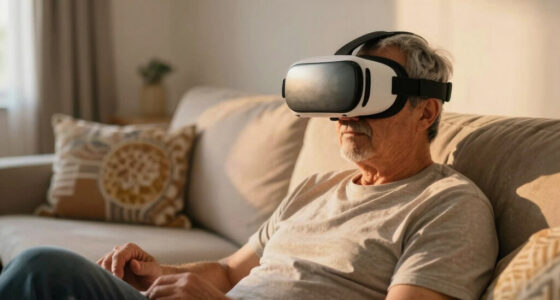
ultrasound vestibular stimulation headset
As an affiliate, we earn on qualifying purchases.
As an affiliate, we earn on qualifying purchases.
Unanswered Questions About Practical Implementation
It remains uncertain whether the ultrasonic vestibular stimulation system can be effectively miniaturized for consumer headsets or if it will be safe and comfortable for long-term use. The patent provides a conceptual framework, but no prototypes or commercial products have been announced. Further research is needed to evaluate its effectiveness, safety, and user acceptance in real-world XR environments.
Additional questions concern the system’s ability to adapt to individual user anatomy and motion profiles, as well as regulatory considerations related to ultrasonic exposure.
As an affiliate, we earn on qualifying purchases.
Next Steps Toward Commercial Application
Future research and development efforts will focus on creating prototypes and conducting user testing to assess safety and effectiveness. If successful, integration into consumer XR headsets as an optional feature could be pursued, pending regulatory approval. The timeline for commercial availability remains uncertain, depending on the outcomes of ongoing testing and regulatory processes.
VR headset with motion sickness reduction
As an affiliate, we earn on qualifying purchases.
As an affiliate, we earn on qualifying purchases.
Key Questions
Could ultrasound stimulation replace existing motion sickness mitigation techniques?
It is too early to determine. Ultrasound may serve as a complementary approach alongside visual or haptic methods. Further testing is necessary to assess its effectiveness and safety.
Will this technology be safe for long-term use?
Safety depends on ultrasonic parameters such as intensity and duration. While low-intensity focused ultrasound is generally considered safe in medical contexts, specific safety evaluations for XR applications are needed.
When might we see products utilizing this technology?
If development progresses successfully, prototypes could appear within 2-3 years, with commercial products following after regulatory approval and testing.
Would this system require hardware modifications to existing headsets?
Yes, integrating ultrasonic transducers and control circuitry would likely require hardware adjustments, potentially increasing device complexity and cost.
Is this technology applicable to all XR users?
While promising, effectiveness may vary based on individual anatomy and sensitivity. Custom calibration and safety considerations will be important for broad application.
Source: Road to VR
Halloween Picks
halloween
As an affiliate, we earn on qualifying purchases.