
TL;DR

Play games on Amazon Luna for your next adventure, included with Prime
- A rotating selection of games, no download needed
- Play on TV, laptop or phone
- Fast, free delivery for your gear, too
Electronauts, a music VR game, exemplifies effective interface design through ease-of-use, clear hierarchy, and flexibility. These principles are applicable across VR applications, not just music games.
Electronauts, a VR music game celebrating its eighth anniversary, demonstrates core principles of effective VR interface design—ease-of-use, hierarchy, and flexibility—that are relevant beyond gaming. This analysis underscores how these design choices enhance user experience and can inform future VR development.
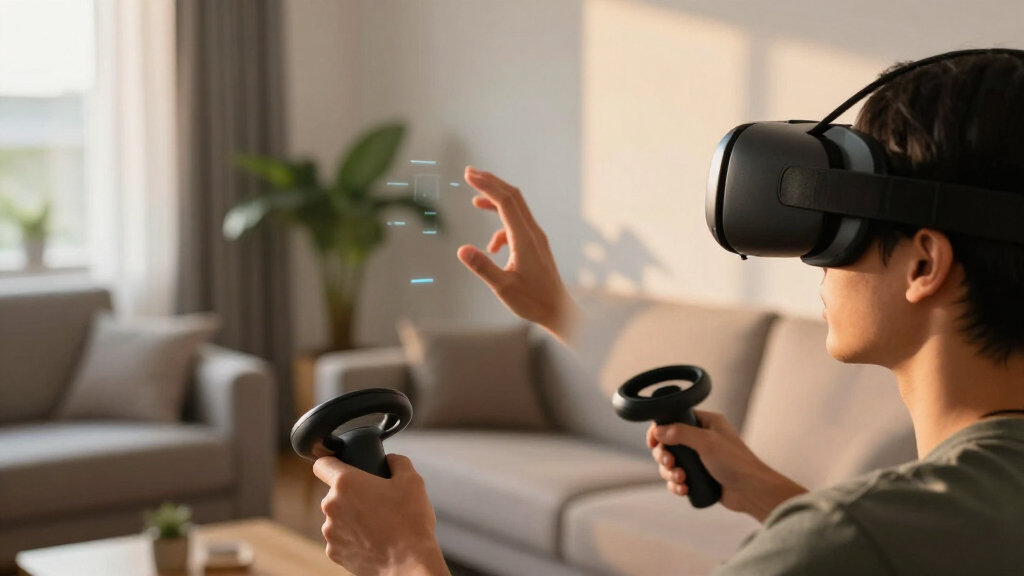
Electronauts’s interface employs a unique approach where players manipulate tools represented as cubes, which serve as mini-apps for different functions. Accessing these tools involves placing a cube on a pedestal, simplifying navigation and reducing cognitive load. The game’s use of physical drumsticks as interaction tools enhances precision, compensating for the lack of tactile feedback in VR. Instead of pressing buttons directly, players insert the drumstick into a button and pull the trigger, increasing accuracy and reliability.
Hierarchy is managed through a limit of three active cubes, preventing the interface from becoming overwhelming. This organization mirrors familiar app icons, making functions easy to find and remember. The design also offers flexibility, allowing users to rearrange tools physically, such as swapping sides for left-handed use, which improves accessibility and user comfort. These principles contribute to a seamless, intuitive experience even under time pressure, demonstrating their broader applicability in VR interface design.
Everyone Should Know These VR Interface Basics
What can an eight-year-old music game teach us about building great VR? Electronauts turns tools into cubes, buttons into drumstick targets, and menus into physical space — a masterclass in ease-of-use, hierarchy, and flexibility that applies far beyond gaming.
Three Principles Behind the Interface
Electronauts succeeds because every design choice serves one of three goals. Together they keep the experience seamless and intuitive — even under time pressure on a virtual stage.
Ease of Use
Tools are physical cubes — mini-apps you can see, grab, and place. Dropping a cube on its pedestal activates it, collapsing navigation into one obvious gesture.
- Cubes = mini-apps
- Pedestal = launcher
- Low cognitive load
Clear Hierarchy
Only three cubes can be active at once. Functions mirror familiar app-icon organization, so everything is easy to find and remember at a glance.
- 3 active slots max
- App-icon mental model
- No visual overload
Flexibility
Users physically rearrange their toolkit — swap sides for left-handed play, reorder favorites. The interface adapts to the body, not the other way around.
- Rearrange tools freely
- Left-hand friendly
- Accessibility built-in
From Cube to Sound in Four Moves
The entire tool lifecycle is a physical chain. No menus, no mode-switches — just objects doing what objects do.
Grab a Cube
Each cube is a self-contained mini-app
Place on Pedestal
Docking activates the tool instantly
Strike with Stick
Drumstick in, trigger pull — precise input
Swap Anytime
Three-slot limit keeps focus sharp
Why Drumsticks Beat Buttons
VR has no tactile feedback, so poking a floating button is guesswork. Electronauts compensates: insert the drumstick into the button, then pull the controller trigger — insert → trigger — a two-stage confirmation that makes every hit accurate and reliable.
Traditional VR UI vs. the Electronauts Model
The same interface problems, two very different answers. The highlighted column shows the physical-tool approach.
| Design Challenge | Typical VR Interface | Electronauts Approach | Usability Gain |
|---|---|---|---|
| Tool Access | Nested floating menus ✗ | Cube on a pedestal ✓ | One gesture, zero digging |
| Button Input | Poke with fingertip ray ✗ | Insert stick, pull trigger ✓ | Compensates for no touch feedback |
| Feature Scope | Everything visible at once ~ | Three active tools max ✓ | Hierarchy prevents overwhelm |
| Handedness | Fixed right-hand layout ✗ | Physically swap sides ✓ | Accessible by default |
| Learnability | Tutorial-dependent ~ | Mirrors real objects ✓ | Shorter learning curve |
The Impact, Measured in Principles
A qualitative read of how strongly each design lever moves VR usability — and why researchers keep citing this game eight years on.
“Electronauts’s interface demonstrates how physical interaction and hierarchical organization can significantly improve VR usability.”
— Anonymous Researcher · via Road to VRCan these principles scale? It is not yet clear how easily cube-and-pedestal physicality transfers to complex tasks, productivity tools, or educational environments. That is the next frontier of VR interface research.
One Continuous Chain of Interaction
Every element hands off to the next — a vocabulary of objects that any VR application could borrow.
What Designers Ask Next
The four questions that frame where VR interface research goes from here.
What makes the interface effective?
Physical drumsticks for precise input, hierarchical cube organization, and freely rearrangeable tools combine into an intuitive, adaptable experience.
Do the principles apply outside music games?
Yes — ease-of-use, hierarchy, and flexibility are domain-agnostic and can improve training, education, and productivity VR.
What are the limitations?
Proven in a music context, it remains uncertain how well the model scales to more complex or non-entertainment experiences.
What is the next research step?
Testing physical tool-based interfaces in diverse environments, refining interaction methods, and building hierarchical systems for complex tasks.
Impact of Electronauts’s Design Principles on VR Usability
The principles exemplified by Electronauts—ease-of-use, clear hierarchy, and flexibility—are vital for improving VR user experiences across applications. They help reduce learning curves, increase accessibility, and enable users to adapt interfaces to their preferences, which is crucial for broader adoption of VR technology in education, training, and productivity tools.

Pimax Crystal Super VR Headset, 3840×3840 per Eye, Ultrawide, 140° FOV, Eye- Tracking, Ultra-Sharp for Flight & Racing Simulators & Gaming, DP Connection with PC
- High-Resolution Per Eye: 3840×3840 pixels with local dimming
- Exceptional Visual Clarity: 50 PPD with aspherical lenses
- Ultra-Wide Field of View: 140° for immersive experience
As an affiliate, we earn on qualifying purchases.
As an affiliate, we earn on qualifying purchases.
Evolution of VR Interface Design and Electronauts’s Role
VR interface design has traditionally struggled with balancing complexity and usability. Electronauts’s approach, using physical tools and a hierarchical organization, offers a model for intuitive interaction. Since its release eight years ago, the game’s interface remains relevant, illustrating how thoughtful design can overcome VR’s tactile limitations and enhance user engagement. This analysis builds on prior research emphasizing the importance of physicality and adaptability in VR interfaces.
“Electronauts’s interface demonstrates how physical interaction and hierarchical organization can significantly improve VR usability.”
— an anonymous researcher
VR controllers with precision tracking
As an affiliate, we earn on qualifying purchases.
As an affiliate, we earn on qualifying purchases.
Unanswered Questions About Broader Application of These Principles
While Electronauts’s design principles are compelling, it is not yet clear how easily they can be adapted to other VR applications outside music or entertainment. Further research is needed to determine their effectiveness in complex tasks, productivity tools, or educational environments, and how these principles scale with more sophisticated interfaces.
As an affiliate, we earn on qualifying purchases.
Future Research and Development in VR Interface Design
Developers and researchers are expected to explore how the principles demonstrated by Electronauts can be integrated into a wider range of VR applications. Future efforts may include testing physical tool-based interfaces in training, design, and collaborative work, as well as refining hierarchical systems for more complex tasks. Ongoing innovation will likely focus on balancing physicality, flexibility, and user control to enhance VR usability across sectors.
VR ergonomic controllers for accessibility
As an affiliate, we earn on qualifying purchases.
As an affiliate, we earn on qualifying purchases.
Key Questions
What makes Electronauts’s interface design effective?
Its use of physical tools like drumsticks for interaction, hierarchical organization of functions into cubes, and flexible rearrangement options contribute to intuitive, precise, and adaptable user experiences.
Can these design principles be applied outside music VR games?
Yes, the core concepts of ease-of-use, hierarchy, and flexibility are broadly applicable and can improve usability in other VR applications, including training, education, and productivity tools.
What are the limitations of Electronauts’s interface design?
While effective in a music context, it remains uncertain how well these principles can be scaled or adapted to more complex or different types of VR experiences outside of entertainment.
What is the next step for VR interface research?
Future research will focus on testing these principles in diverse VR environments, refining physical interaction methods, and developing scalable hierarchical systems for complex tasks.
Source: Road to VR
Fall Picks
fall essentials
As an affiliate, we earn on qualifying purchases.