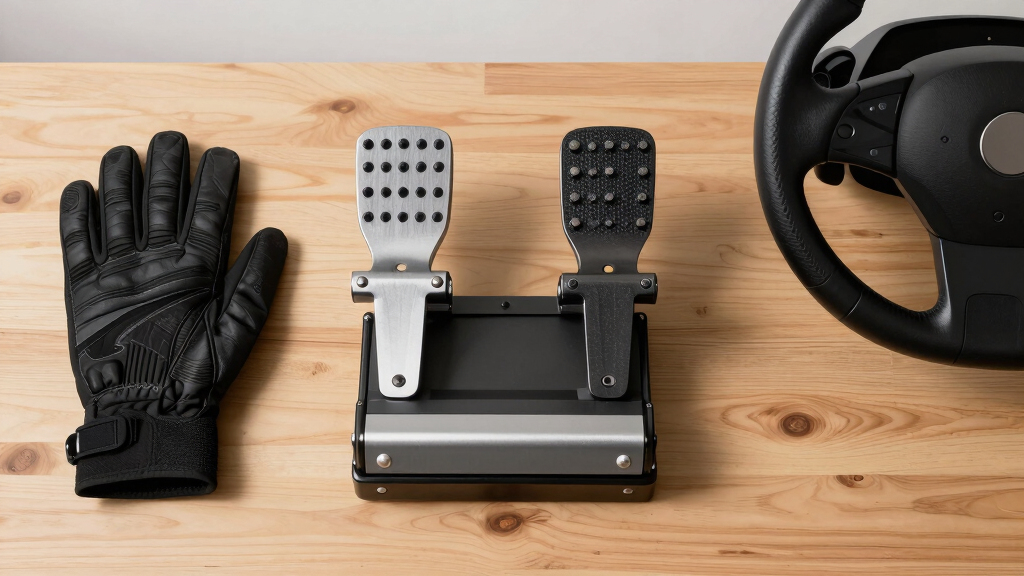

Choosing the right load cell pedals for VR sim racing can significantly elevate your immersion and control. The MOZA SR-P Pedals set offers a balanced mix of realism and versatility, making it ideal for most users. For those seeking maximum precision and customization, the ASETEK La Prima™ pedals excel with adjustable arms and high durability. Meanwhile, the Simjack UT pedals stand out for their advanced load cell technology and software customization. Each of these options balances different priorities: performance, price, and feature set, with tradeoffs in compatibility, complexity, or cost.
Key Takeaways
- The MOZA SR-P provides high-resolution magnetic encoders and a realistic feel, suited for serious enthusiasts seeking durability.
- ASETEK La Prima™ offers extensive customization and upgradeability, perfect for those wanting to fine-tune their racing experience.
- Simjack UT emphasizes software flexibility and load cell precision, ideal for users who value configurability and linear response.
- All three options are PC-compatible but vary in complexity and cost, with tradeoffs between simplicity and advanced features.
- Understanding your racing style and budget helps determine whether you prioritize realism, customization, or affordability.
| MOZA SR-P Pedals Set of Load Cell Brake and Throttle for PC Racing Game |  | Best Overall Load Cell Pedals for VR Sim Racing | Load Cell Capacity: 100kg | Encoder Resolution: 16-bit | Material: High-strength steel | VIEW LATEST PRICE | See Our Full Breakdown |
| Simjack UT Sim Racing Pedals 200KG Load Cell Brake Pedal PC Racing Simulator Pedals Pressure Sensor HE Hydraulic Pedal |  | Best for Customization and Advanced Load Cell Tech | Load Cell Capacity: 200kg | Processor: 32-bit dual-core | Sensor Type: Independent ADC | VIEW LATEST PRICE | See Our Full Breakdown |
| ASETEK SimSports La Prima™ Load Cell Sim Racing Pedals |  | Best for Customization and Durability | Load Capacity: 440 pounds | Material: Die-cast aluminum | Adjustment: Yes (arms and elastomers) | VIEW LATEST PRICE | See Our Full Breakdown |
More Details on Our Top Picks
MOZA SR-P Pedals Set of Load Cell Brake and Throttle for PC Racing Game
The MOZA SR-P set offers a solid combination of precision and versatility. Its high-strength steel construction ensures longevity, while the 16-bit magnetic encoders provide a smooth, high-resolution input that surpasses Hall sensors common in cheaper pedals. The load cell brake with a 100kg capacity delivers consistent, realistic braking force, which is vital for immersion and control. Compared to other options, its detachable design and adjustable pedal spacing make it highly adaptable for different setups. The main tradeoff is its relatively higher price and the need for a compatible PC setup, which might be a barrier for casual users.
Pros:- High-resolution 16-bit magnetic encoders for smooth response
- Heavy-duty steel construction ensures durability
- Detachable pedals for customization and ease of setup
Cons:- Higher cost compared to entry-level pedals
- Requires a PC setup, not compatible with consoles
- Adjustments may require additional brackets or mounts
Best for: Serious sim racers who want a durable, high-precision pedal set that works seamlessly with PC VR rigs.
Not ideal for: Beginners or those on a tight budget who may prefer simpler, less costly pedal options.
- Load Cell Capacity:100kg
- Encoder Resolution:16-bit
- Material:High-strength steel
- Connectivity:USB
- Pedal Adjustment:Yes
- Detachable Pedals:Yes
Bottom line: A top choice for enthusiasts seeking durability and realism in VR sim racing, despite its premium price.
Simjack UT Sim Racing Pedals 200KG Load Cell Brake Pedal PC Racing Simulator Pedals Pressure Sensor HE Hydraulic Pedal
The Simjack UT pedals shine with their sophisticated load cell technology and software customization. Its 32-bit dual-core processor and independent ADC chip provide incredibly responsive, linear input, ideal for racers who want precise control in VR. The pedals’ high-quality steel build and adjustable damping make them suitable for prolonged sessions. Unlike the MOZA, the Simjack offers extensive software integration, allowing detailed pedal curve adjustments and profile saving, which gives it an edge for users who love fine-tuning. The tradeoff is a more complex setup process and a higher price point, which could be overwhelming for newcomers.
Pros:- Advanced load cell sensors for linear response
- Customizable pedal damping and configuration
- Powerful processing for real-time data and stability
Cons:- Complex software setup may be intimidating
- Higher price point limits affordability
- Limited compatibility outside Windows
Best for: Experienced racers who desire maximum control, software configurability, and a professional-grade pedal experience.
Not ideal for: Casual racers or beginners who prefer plug-and-play simplicity or are sensitive to cost.
- Load Cell Capacity:200kg
- Processor:32-bit dual-core
- Sensor Type:Independent ADC
- Material:CNC stainless steel
- Compatibility:PC Windows
- Pedal Adjustment:Yes
Bottom line: Ideal for dedicated sim racers seeking detailed customization and top-tier load cell performance, though it demands a more involved setup.
ASETEK SimSports La Prima™ Load Cell Sim Racing Pedals
The ASETEK La Prima™ pedals are built for durability and fine-tuned realism. Their die-cast aluminum construction withstands forces up to 440 pounds, surpassing many competitors in longevity. The adjustable arms and interchangeable elastomers allow racers to set resistance levels that match their driving style, making them highly adaptable. The option to upgrade to Forte pedals extends their lifespan and performance, catering to those who want a long-term investment. Compared with the MOZA and Simjack, La Prima emphasizes physical customization and robustness over electronic complexity. Its main limitation is PC-only compatibility and a somewhat higher price for the upgrade options.
Pros:- Heavy-duty die-cast aluminum build
- Adjustable resistance via elastomers
- Upgradeable to higher-end Forte pedals
Cons:- Higher initial cost compared to basic pedals
- Limited to PC use only
- Manual adjustments needed for fine-tuning
Best for: Racers who prioritize durability, long-term customization, and upgrade paths, suitable for both casual and competitive VR racing.
Not ideal for: Racers seeking the most advanced software features or those who prefer plug-and-play setups with minimal adjustments.
- Load Capacity:440 pounds
- Material:Die-cast aluminum
- Adjustment:Yes (arms and elastomers)
- Upgradeability:Yes (Forte upgrade kit)
- Compatibility:PC only
- Testing:1 million activations
Bottom line: A reliable, customizable option that balances durability with performance, ideal for long-term users who want to grow with their setup.
How We Picked
Our selection process focused on load cell technology accuracy, build quality, compatibility with VR and PC, customization options, and user feedback. We compared the sensors’ responsiveness, the materials’ durability, and the ease of integration into a VR racing setup. Cost was also a factor, ensuring each product offers value for different budgets. We prioritized products that balance realism, reliability, and user experience, with clear distinctions in their target audiences and use cases.
Factors to Consider When Choosing Best Load Cell Pedals For VR Sim Racing
Selecting the best load cell pedals for VR sim racing involves understanding how load cell sensors translate pedal pressure into game input, and how that impacts control accuracy. Consider your budget, the level of customization you desire, and the type of racing experience you want to achieve. The right pedals should balance performance, durability, and ease of use, especially in a VR environment where precision is key.
Understanding Load Cell Technology
Load cell sensors measure pressure directly, providing a more realistic and consistent pedal feel compared to potentiometers. This technology is preferred in high-end sim racing because it offers linear response and better modulation, especially important when braking in VR where feedback and precision matter more than ever.
Key Factors to Consider
Durability is essential for long-term use, especially with intense VR sessions. Compatibility with your existing setup, including software and hardware, will influence your choice. Customization features like adjustable resistance and pedal positioning are valuable for tailoring the feel to your driving style. Budget also plays a significant role, with premium options offering more features but at higher costs.
Balancing Price and Performance
Entry-level pedals may lack load cell sensors or have limited adjustability, but they can still improve your VR experience. Mid-range options like MOZA provide a good balance of features and price, while premium pedals like ASETEK La Prima™ or Simjack UT deliver advanced customization and durability for dedicated racers willing to invest more.
Frequently Asked Questions
What is load cell technology, and why is it important for VR sim racing?
Load cell technology uses sensors to measure the pressure applied to the pedal directly, resulting in a linear and consistent response that closely mimics real-world racing. This accuracy is especially beneficial in VR, where tactile feedback enhances immersion and control during braking and acceleration.
Are load cell pedals compatible with VR headsets?
While load cell pedals don’t directly connect to VR headsets, they integrate with your PC or console racing setup, which in turn interacts with VR software. As long as your VR system supports your racing wheel and pedals, compatibility is generally not an issue, provided the pedals connect via USB and are supported by your software.
How important is pedal adjustability for VR sim racing?
Adjustability allows you to customize pedal resistance, spacing, and angle, which can significantly improve comfort and control in VR. Precise adjustments help match the pedal feel to your preferences, leading to better immersion and performance, especially during long sessions or competitive racing.
Can I upgrade my load cell pedals later?
Some high-end pedals like ASETEK La Prima™ offer upgrade paths, such as switching to more advanced models like Forte. Upgradability can extend the lifespan of your setup and allow you to enhance performance as your skills develop or as new features become available.
What should I consider if I’m new to VR sim racing?
If you’re just starting out, look for pedals that are easy to set up and use, with straightforward calibration and compatibility. Budget-conscious options can still provide a significant upgrade over basic controller inputs, but investing in a load cell pedal with some adjustability can help you learn and improve faster in VR environments.
Conclusion
For newcomers or casual VR racers, a mid-range pedal like the MOZA SR-P offers excellent value with high resolution and durability. Serious enthusiasts and professional racers should consider the Simjack UT for its software flexibility or the ASETEK La Prima™ for durability and future upgrades. Your choice depends on your budget, desired level of customization, and how much you value realism versus ease of use. Each of these pedals elevates VR sim racing, but matching the right one to your needs will provide the most satisfying experience.