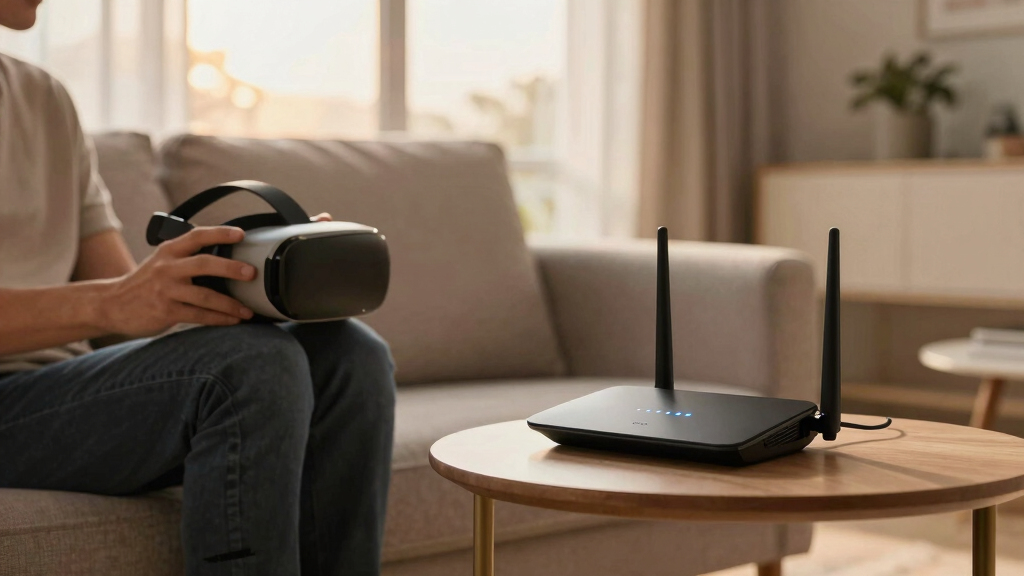

Choosing the best Wi-Fi 7 routers for VR requires balancing speed, coverage, and device support to handle demanding virtual reality applications. The NETGEAR Nighthawk WiFi 7 (BE9300) stands out for its top-tier speed of 9.3Gbps and extensive coverage, making it ideal for high-intensity VR setups. The ASUS RT-BE9700 offers impressive dual-band performance and mesh capabilities, perfect for seamless multi-room VR experiences. However, buyers face tradeoffs between price, complexity, and future-proofing. Keep reading for a detailed breakdown of these contenders and what makes each suitable for different needs.
Key Takeaways
- High-speed Wi-Fi 7 routers with multi-gig ports significantly improve VR streaming quality and reduce latency.
- Mesh systems like the Deco 7 Pro excel in covering large homes but might be more expensive than single routers.
- Dual-band options can be sufficient for smaller setups but may struggle with multiple high-bandwidth VR devices simultaneously.
- More advanced tri-band routers support dedicated VR traffic, minimizing lag and jitter during gameplay.
- Price often correlates with features—higher-priced models generally offer more future-proofing and better performance for demanding VR applications.
| NETGEAR Nighthawk WiFi 7 Router (BE9300) – 9.3Gbps, Tri-Band, 2.5 Gbps Internet Port, Covers 2,500 sq. ft., Supports 100 Devices |  | Best Overall for Large Homes and High Device Loads | Wireless Speed: 9.3 Gbps | Bands: Tri-Band (2.4 GHz, 5 GHz, 6 GHz) | Coverage: 2,500 sq. ft. | VIEW LATEST PRICE | See Our Full Breakdown |
| TP-Link Deco 7 Pro BE63 Tri-Band WiFi 7 Whole Home Mesh System (2-Pack) |  | Best for Seamless Whole-Home Coverage and Smart Homes | Coverage: 5,800 sq.ft. | Wi-Fi Standard: Wi-Fi 7 | Speed: Up to 10 Gbps | VIEW LATEST PRICE | See Our Full Breakdown |
| ASUS RT-BE9700 WiFi 7 Router – Tri-Band (6GHz), 9.7 Gbps, Dual WAN, Mesh |  | Best for Gaming and Demanding VR Applications | WiFi Standard: WiFi 7 (802.11be) | Bands: Tri-Band (2.4GHz, 5GHz, 6GHz) | Max Speed: 9.7 Gbps | VIEW LATEST PRICE | See Our Full Breakdown |
| TP-Link Tri-Band WiFi 7 Router (Archer BE550) |  | Best for High-Speed Streaming and Gaming | WiFi Standard: WiFi 7 | Speed: Up to 9.2 Gbps | Bands: Tri-band | VIEW LATEST PRICE | See Our Full Breakdown |
| GL.iNet GL-BE9300 Flint 3 Tri-Band Wi-Fi 7 Router |  | Best for Customizable and Secure VR Networks | Wireless Standard: Wi-Fi 7 | Maximum Speed: 12.5 Gbps | Coverage: 2000 sq. ft. | VIEW LATEST PRICE | See Our Full Breakdown |
| TP-Link Tri-Band WiFi 7 Router (Archer BE600) |  | Best Overall for Large Homes and Advanced Security | WiFi Technology: WiFi 7 | Bands: Tri-Band (6GHz, 5GHz, 2.4GHz) | Total Bandwidth: 9.7 Gbps | VIEW LATEST PRICE | See Our Full Breakdown |
| eero 7 Dual-Band Mesh Wi-Fi 7 Router – Supports Internet Plans up to 2.5 Gbps, Coverage up to 2,000 sq. ft., 1-Pack |  | Best Value for Easy Expansion and Compatibility | Wi-Fi Standard: Wi-Fi 7 (IEEE802.11a/b/g/n/ac/ax/be) | Coverage: 2000 sq. ft. | Internet Speed Support: up to 2.5 Gbps | VIEW LATEST PRICE | See Our Full Breakdown |
| NETGEAR Nighthawk Dual-Band WiFi 7 Router (RS90) |  | Best for Fast, Reliable VR Streaming on a Budget | WiFi Standard: WiFi 7 | Speed: up to 3.6 Gbps | Coverage: up to 2,000 sq. ft. | VIEW LATEST PRICE | See Our Full Breakdown |
| Wi-Fi 7 routers for VR | Coverage | Bands |
|---|---|---|
| NETGEAR Nighthawk WiFi 7 Route | 2,500 sq. ft. | Tri-Band (2.4 GHz, 5 GHz, 6 GHz) |
| TP-Link Deco 7 Pro BE63 Tri-Ba | 5,800 sq.ft. | Tri-band (6 GHz, 5 GHz, 2.4 GHz) |
| ASUS RT-BE9700 WiFi 7 Router | — | Tri-Band (2.4GHz, 5GHz, 6GHz) |
| TP-Link Tri-Band WiFi 7 Router | — | Tri-band |
| GL.iNet GL-BE9300 Flint 3 Tri- | 2000 sq. ft. | — |
| TP-Link Tri-Band WiFi 7 Router | Up to 2,600 sq. ft. | Tri-Band (6GHz, 5GHz, 2.4GHz) |
| eero 7 Dual-Band Mesh Wi-Fi 7 | 2000 sq. ft. | — |
| NETGEAR Nighthawk Dual-Band Wi | up to 2,000 sq. ft. | — |
More Details on Our Top Picks
NETGEAR Nighthawk WiFi 7 Router (BE9300) – 9.3Gbps, Tri-Band, 2.5 Gbps Internet Port, Covers 2,500 sq. ft., Supports 100 Devices
The NETGEAR Nighthawk BE9300 stands out for its impressive combination of high speeds up to 9.3 Gbps and coverage suitable for large homes, making it a strong choice for VR setups that demand seamless, fast connections across extensive areas. Compared with the TP-Link Archer BE550, it offers slightly higher speeds and broader coverage, but at the cost of a larger footprint and potentially more complex setup. This router supports up to 100 devices, which is vital for households with numerous smart gadgets or multiple VR headsets running simultaneously. Its wired ports are plentiful, ensuring fast, reliable wired connections. However, some ISP gateways may require bridge mode to integrate smoothly, and it does not include a modem, which could add to initial setup complexity. This pick is best for users with large homes or those running multiple VR devices and smart home tech, who need a robust, high-capacity network. For smaller spaces or simpler setups, the extra features may be unnecessary and more complicated than needed.
Pros:- High-speed tri-band WiFi 7 performance up to 9.3 Gbps
- Wide coverage of up to 2,500 sq. ft. suitable for large homes
- Supports up to 100 devices simultaneously
- Multiple wired ports for fast, reliable connections
Cons:- Some ISP gateways require bridge mode, adding setup complexity
- No built-in modem, necessitating existing internet infrastructure
Best for: Large households with multiple VR headsets and smart devices demanding extensive coverage and high throughput
Not ideal for: Small apartments or users with simple internet needs who prefer a straightforward, budget-friendly router
- Wireless Speed:9.3 Gbps
- Bands:Tri-Band (2.4 GHz, 5 GHz, 6 GHz)
- Coverage:2,500 sq. ft.
- Device Capacity:Up to 100 devices
- WAN Port:2.5 Gigabit Ethernet
- LAN Ports:Two 2.5 Gigabit, two 1 Gigabit Ethernet
- Compatibility:Most internet providers
- Security:WPA3 encryption, Advanced Router Protection
Our verdict“This router is ideal for large homes with many devices and demanding VR streaming needs, where coverage and speed are priorities.”
TP-Link Deco 7 Pro BE63 Tri-Band WiFi 7 Whole Home Mesh System (2-Pack)
The TP-Link Deco 7 Pro BE63 excels in delivering expansive coverage up to 5,800 sq.ft., making it particularly well-suited for VR setups spread across large, multi-room environments. Its mesh design ensures seamless roaming between units, unlike the single-router NETGEAR Nighthawk BE9300, which may require multiple extenders for similar coverage. With speeds up to 10 Gbps, it handles multiple VR streams and smart devices with ease, supporting over 200 devices simultaneously. The system includes multi-gig wired ports and a user-friendly Deco app for quick setup. Its primary tradeoff involves the need for a separate modem, and the advanced features can be complex for less tech-savvy users. This system is best for large households or multi-room VR gaming, where whole-home coverage and device support are critical. Small apartments or those with minimal devices will find this system overly large and potentially unnecessary.
Pros:- Extensive coverage up to 5,800 sq.ft. with mesh technology
- Supports ultra-fast Wi-Fi 7 speeds up to 10 Gbps
- Supports over 200 devices simultaneously
- Includes multi-gig wired ports and easy management via the Deco app
Cons:- Requires a separate modem for internet connectivity
- Advanced features may be overwhelming for non-technical users
Best for: Large homes or multi-room VR setups requiring extensive, seamless coverage and device support
Not ideal for: Users with small apartments or simple internet needs who prefer a single-router solution
- Coverage:5,800 sq.ft.
- Wi-Fi Standard:Wi-Fi 7
- Speed:Up to 10 Gbps
- Bands:Tri-band (6 GHz, 5 GHz, 2.4 GHz)
- Ports:Four 2.5G WAN/LAN, USB 3.0
- Device Support:Over 200 devices
Our verdict“This mesh system is perfect for large, multi-room VR environments where seamless coverage and high device capacity are needed.”
ASUS RT-BE9700 WiFi 7 Router – Tri-Band (6GHz), 9.7 Gbps, Dual WAN, Mesh
The ASUS RT-BE9700 offers an impressive speed of up to 9.7 Gbps, making it ideal for high-performance VR gaming and streaming. Its multi-link operation enhances stability, especially when multiple VR headsets or streams are active, setting it apart from single-link routers like the NETGEAR BE9300. The router supports dual WAN and AiMesh, enabling flexible, whole-home mesh coverage. Its advanced security features, including VPN support, make it suitable for privacy-conscious users. The main drawback is its complex setup process, which could challenge beginners, and its size may require dedicated space. This model is best for tech-savvy gamers or streamers who need maximum speeds and reliable, wide coverage. Users with simpler needs or limited space might prefer less feature-rich options.
Pros:- Very high WiFi speeds up to 9.7 Gbps
- Supports multi-link operation for enhanced stability
- Versatile dual WAN and AiMesh support for flexible coverage
- Strong security with VPN support
Cons:- Complex setup process may be difficult for novices
- Large size requiring ample space
Best for: Gamer and power users demanding maximum speed, stability, and mesh flexibility for VR and streaming
Not ideal for: Beginners or those seeking a straightforward setup with minimal configuration
- WiFi Standard:WiFi 7 (802.11be)
- Bands:Tri-Band (2.4GHz, 5GHz, 6GHz)
- Max Speed:9.7 Gbps
- WAN Ports:2
- Security:AiProtection, VPN
- Operating Modes:Wireless Router, AiMesh Node, Access Point, Repeater
Our verdict“This router suits advanced users who prioritize speed, stability, and extensive coverage for demanding VR applications.”
TP-Link Tri-Band WiFi 7 Router (Archer BE550)
The TP-Link Archer BE550 delivers speeds up to 9.2 Gbps, making it a solid choice for VR gaming, 4K streaming, and high-demand internet use. Compared with the ASUS RT-BE9700, it offers similar top speeds but emphasizes ease of setup via the Tether app, making it more accessible for non-technical users. Its support for EasyMesh allows expanding coverage, though it may not match the extensive coverage of mesh systems like the TP-Link Deco 7 Pro. The multiple 2.5G ports prepare for future-proof wired connectivity, but actual speeds can be affected by ISP limitations. This router is well-suited for gamers and streamers who want fast Wi-Fi 7 performance without complex configuration, but those in large, multi-room setups might prefer mesh solutions.
Pros:- Fast Wi-Fi 7 speeds up to 9.2 Gbps
- Easy setup via the Tether app
- Supports EasyMesh for expanding coverage
- Multiple 2.5G ports for wired connections
Cons:- Limited coverage compared to mesh systems
- Speeds depend on ISP and network environment
Best for: Gamers and streamers seeking fast Wi-Fi 7 speeds in a straightforward, easy-to-setup router
Not ideal for: Large households needing extensive mesh coverage or multi-room VR support
- WiFi Standard:WiFi 7
- Speed:Up to 9.2 Gbps
- Bands:Tri-band
- Maximum Speed:5760 Mbps (6 GHz), 2880 Mbps (5 GHz), 574 Mbps (2.4 GHz)
- Ports:1 x 2.5G WAN, 4 x 2.5G LAN
- Setup:Tether App
Our verdict“This router is a great choice for users who want fast Wi-Fi 7 performance with simple setup, ideal for single-room VR gaming and streaming.”
GL.iNet GL-BE9300 Flint 3 Tri-Band Wi-Fi 7 Router
The GL.iNet GL-BE9300 Flint 3 offers impressive speeds up to 12.5 Gbps and a robust feature set, including advanced security protocols and parental controls, making it suitable for high-density VR environments or professional use. Its Linux-based operating system provides a high level of customization, unlike the more consumer-focused options like the TP-Link Archer BE550. Covering about 2,000 sq. ft., it balances performance with security, ideal for users who want control over their network security and device management. However, its complex feature set may require technical knowledge to optimize, and the price point might be high for casual users. This router is perfect for tech-savvy users who need maximum security and flexibility in a demanding VR setup.
Pros:- Ultra-fast speeds up to 12.5 Gbps
- Advanced security protocols and parental controls
- Linux-based OS allows high customization
- Supports remote access and VPN
Cons:- Requires technical knowledge for optimal setup
- Potentially high cost for casual users
Best for: Tech-savvy users needing a highly customizable, secure VR network with advanced controls
Not ideal for: Casual users or those seeking a plug-and-play router with minimal configuration
- Wireless Standard:Wi-Fi 7
- Maximum Speed:12.5 Gbps
- Coverage:2000 sq. ft.
- Number of Ports:5
- Port Speed:2500 Mbps
- Security Protocols:wpa2-psk, wpa3, wpa2-enterprise, wpa-enterprise
Our verdict“This router is best for advanced users who require high security, customization, and maximum speed for demanding VR environments.”
TP-Link Tri-Band WiFi 7 Router (Archer BE600)
The TP-Link Archer BE600 stands out as the most comprehensive choice for those seeking expansive coverage and advanced features. Its tri-band setup with 9.7 Gbps capacity ensures smooth VR experiences across large spaces, outperforming dual-band options like the NETGEAR RS90 in speed and coverage. However, its complex setup can challenge less tech-savvy users, and its size demands ample placement space. Compared to the eero 7, it offers superior security with TP-Link HomeShield and more wired options, making it ideal for tech enthusiasts and large households. Its premium price reflects its high-end features, but the setup process may be a hurdle for some. bestFor: Tech-savvy homeowners needing large coverage and security-focused features. notIdealFor: Beginners or those with limited space who prefer plug-and-play simplicity. pros: Supports WiFi 7 for high-speed connections; Wide coverage up to 2,600 sq. ft.; Multiple multi-gigabit ports for wired devices; Advanced security features including parental controls. cons: Setup complexity may deter non-technical users; Large size requires ample space; Premium price point. verdict: Best suited for users who want top-tier coverage and security despite setup challenges.- WiFi Technology:WiFi 7
- Bands:Tri-Band (6GHz, 5GHz, 2.4GHz)
- Total Bandwidth:9.7 Gbps
- Coverage:Up to 2,600 sq. ft.
- Ports:1x 10 Gbps WAN/LAN, 1x 2.5 Gbps WAN/LAN, 3x 2.5 Gbps LAN, USB 3.0
- Processor:Quad-core CPU
Our verdict“Best Overall for Large Homes and Advanced Security — a strong pick in this lineup.”
eero 7 Dual-Band Mesh Wi-Fi 7 Router – Supports Internet Plans up to 2.5 Gbps, Coverage up to 2,000 sq. ft., 1-Pack
The eero 7 offers a compelling balance between affordability and performance, especially for users seeking straightforward setup and reliable coverage. Its dual-band design with support for internet plans up to 2.5 Gbps makes it suitable for most VR applications in mid-sized homes, surpassing standard Wi-Fi 6 routers in speed. Its compatibility with previous eero models facilitates easy network expansion, unlike the more specialized TP-Link Archer BE600. Nevertheless, it’s limited to a single unit in the basic package, which may require additional purchases to cover larger spaces. Compared to the NETGEAR RS90, it provides easier management and a more user-friendly interface, making it ideal for less technical users. bestFor: Home users seeking simple, expandable Wi-Fi 7 coverage with minimal fuss. notIdealFor: Power users or large households needing maximum wired connections and security features. pros: Supports internet speeds up to 2.5 Gbps; Easy to set up and expand; Compatible with previous eero models; Good coverage up to 2,000 sq. ft. cons: Limited to a single device in the base package; Not suitable for very large homes without multiple units; Requires compatible internet service. verdict: Best suited for those who want reliable Wi-Fi 7 coverage with straightforward setup and expandability.- Wi-Fi Standard:Wi-Fi 7 (IEEE802.11a/b/g/n/ac/ax/be)
- Coverage:2000 sq. ft.
- Internet Speed Support:up to 2.5 Gbps
- Number of Ports:2 auto-sensing 2.5 GbE ports
- Supported Devices:120+
- Dimensions:5.12 in. x 5.12 in. x 2.52 in.
Our verdict“Best Value for Easy Expansion and Compatibility — a strong pick in this lineup.”
NETGEAR Nighthawk Dual-Band WiFi 7 Router (RS90)
The NETGEAR Nighthawk RS90 excels at delivering high-speed WiFi 7 performance with a maximum of 3.6 Gbps, making it a strong choice for VR in smaller or medium-sized homes. Its coverage of up to 2,000 sq. ft. and support for 50 devices align well with typical VR setups that require stable, high-bandwidth connections. Compared to the dual-band eero 7, it offers faster speeds but falls short in device capacity and ease of expansion. The RS90’s management via the Nighthawk app is intuitive, although it requires a separate modem or gateway, which could add complexity and cost. The need for a subscription for NETGEAR Armor after the trial phase is a consideration for budget-conscious users. bestFor: VR enthusiasts who prioritize raw speed and reliable coverage over expansive wired options. notIdealFor: Large households or those seeking simple, all-in-one solutions, due to additional hardware needs. pros: Supports high-speed WiFi 7 up to 3.6 Gbps; Good coverage for medium homes; Supports MU-MIMO and OFDMA for multiple devices; Easy app-based setup. cons: Requires separate modem or gateway; Limited device capacity compared to larger mesh systems; Subscription needed for full security features. verdict: Ideal for users who want high-speed VR streaming with straightforward management, within a smaller space.- WiFi Standard:WiFi 7
- Speed:up to 3.6 Gbps
- Coverage:up to 2,000 sq. ft.
- Device Capacity:50 devices
- Ethernet Ports:4 x 1 Gigabit, 1 x 2.5 Gigabit WAN
- Processor:Quad-core 2.0 GHz
Our verdict“Best for Fast, Reliable VR Streaming on a Budget — a strong pick in this lineup.”

How We Picked
Our evaluation focused on performance metrics critical for VR, such as maximum throughput, latency, and device handling capacity. We prioritized routers with multi-gigabit speeds and advanced mesh capabilities, as these features directly impact VR streaming quality and stability. Build quality, ease of setup, and future-proofing with Wi-Fi 7 standards also played key roles. To determine rankings, we compared specifications, user reviews, and expert insights, aiming to identify models that balance power and practicality for serious VR users.
| Wi-Fi 7 routers for VR | Bands |
|---|---|
| NETGEAR Nighthawk WiFi 7 Route | Tri-Band (2.4 GHz, 5 GHz, 6 GHz) |
| TP-Link Deco 7 Pro BE63 Tri-Ba | Tri-band (6 GHz, 5 GHz, 2.4 GHz) |
| ASUS RT-BE9700 WiFi 7 Router | Tri-Band (2.4GHz, 5GHz, 6GHz) |
| TP-Link Tri-Band WiFi 7 Router | Tri-band |
| GL.iNet GL-BE9300 Flint 3 Tri- | — |
| TP-Link Tri-Band WiFi 7 Router | Tri-Band (6GHz, 5GHz, 2.4GHz) |
| eero 7 Dual-Band Mesh Wi-Fi 7 | — |
| NETGEAR Nighthawk Dual-Band Wi | — |
Factors to Consider When Choosing Best Wi-Fi 7 Routers For VR
When selecting a Wi-Fi 7 router for VR, understanding key factors beyond raw specs can prevent costly mistakes. Consider your home size, device density, and whether you need mesh coverage or a single high-performance unit. Compatibility with your internet plan and future-proof features like multi-gig ports ensure your setup remains effective as demands grow. Also, prioritize ease of setup and security features to safeguard your network during intensive VR sessions. These considerations help tailor your choice to your specific environment and gaming needs.Performance and Speed
For VR, high throughput and low latency are non-negotiable. Wi-Fi 7 routers boast multi-gig speeds, often exceeding 9Gbps, which support seamless streaming and minimal lag. However, having the fastest model isn’t always necessary—consider your actual bandwidth needs and internet plan. A router with advanced QoS (Quality of Service) settings can prioritize VR traffic, reducing jitter and latency during gameplay. Avoid models with bottlenecked ports or insufficient device handling if you plan to connect multiple VR headsets or other high-bandwidth devices simultaneously.
Coverage and Mesh Capabilities
VR setups in larger homes or multi-room environments benefit from mesh systems that extend coverage evenly across spaces. Mesh routers like the Deco 7 Pro provide seamless connectivity, but they tend to cost more than single units. For smaller apartments, a powerful single-router setup might suffice. Remember, coverage isn’t just about range; it’s also about consistent signal strength and avoiding dead zones that can cause lag spikes in VR. Proper placement and the ability to expand your network are key considerations.
Device Capacity and Scalability
VR often involves multiple devices—headsets, controllers, sensors—all sharing the same network. Routers with high device capacity and robust processing power prevent congestion and maintain stable connections. Dual-band models may be adequate for light use but can struggle under the load of several VR devices. Tri-band routers with dedicated channels for VR traffic are better suited for demanding setups, as they help isolate VR data streams from other network activity, reducing lag and jitter.
Ease of Use and Future-Proofing
While advanced features are attractive, ease of setup and management matter, especially for users less familiar with networking. Look for routers with user-friendly apps, clear setup instructions, and strong security options. Future-proofing features like multi-gig ports, Wi-Fi 7 compatibility, and support for the latest internet plans ensure your investment remains relevant. Remember, a more complex router might deliver better performance but could require more technical know-how to optimize fully.
Price and Value
Higher-priced routers often come with cutting-edge features and longer-lasting hardware, but they aren’t necessary for every user. Consider your current setup and expected future needs—if you’re upgrading an existing VR setup, investing in a premium model might be justified. Conversely, budget options can still deliver solid performance for smaller or less demanding environments. Balance your budget with the features most critical for your VR experience to avoid overspending on unnecessary extras.
Frequently Asked Questions
Do I need a Wi-Fi 7 router for VR?
While Wi-Fi 7 is not strictly necessary for VR, it provides significant advantages like higher speeds, lower latency, and better device handling, which can greatly improve VR experiences. If you’re using multiple VR headsets or plan to stream high-quality content, a Wi-Fi 7 router future-proofs your setup and minimizes lag. For casual VR use with a single device, a high-quality Wi-Fi 6 router might still suffice, but Wi-Fi 7 offers more headroom for growth.
How important is mesh capability for VR setups?
Mesh systems are particularly beneficial if your VR space spans multiple rooms or larger areas, helping distribute a strong, consistent signal. They reduce dead zones and can simplify network management across a large home. However, mesh setups tend to be more expensive and complex to configure. For small or open-plan spaces, a single high-performance router may be enough, making mesh less critical unless coverage issues arise.
Should I prioritize speed or coverage in my router?
The answer depends on your environment. If you have a small apartment with minimal walls, speed is the key factor—look for a router with high throughput. In contrast, if your home is large or has many walls, coverage becomes more important, and a mesh system might serve you better. Balancing both aspects is ideal, but understanding your space and device needs helps determine which feature to prioritize.
Are multi-gig ports necessary for VR?
Multi-gig ports are increasingly common and can future-proof your network by supporting internet plans exceeding 1Gbps. For VR, they are more relevant if you’re connecting wired devices like gaming PCs or VR servers directly via Ethernet. They ensure your wired connections won’t bottleneck your wireless performance. If your internet speed is below 2Gbps, a standard gigabit port may suffice, but multi-gig ports provide more flexibility as your bandwidth needs grow.
How do I choose between a router and a mesh system for VR?
The choice depends on your home layout and device density. Routers are simpler and often more affordable for small spaces, providing excellent performance if the signal is strong everywhere. Mesh systems excel in larger or multi-room environments, offering broader coverage and seamless roaming. Consider your home’s size, potential dead zones, and your budget when deciding—mesh is typically better for extensive setups, while router-only solutions work well in smaller, open spaces.
Conclusion
For most serious VR users, the NETGEAR Nighthawk WiFi 7 (BE9300) delivers the highest performance and future-proofing, making it ideal as the best overall choice. Those seeking value might prefer the TP-Link Archer BE550, offering solid speed at a more affordable price. For larger homes or multi-room setups, a mesh option like the Deco 7 Pro provides extensive coverage without sacrificing performance. Beginners or casual users can start with dual-band models, but enthusiasts should prioritize tri-band and multi-gig support for optimal VR experiences. Ultimately, your specific environment and needs should drive your choice.