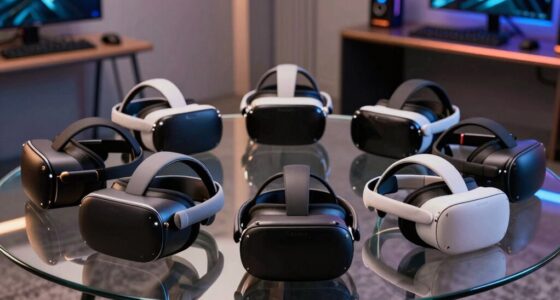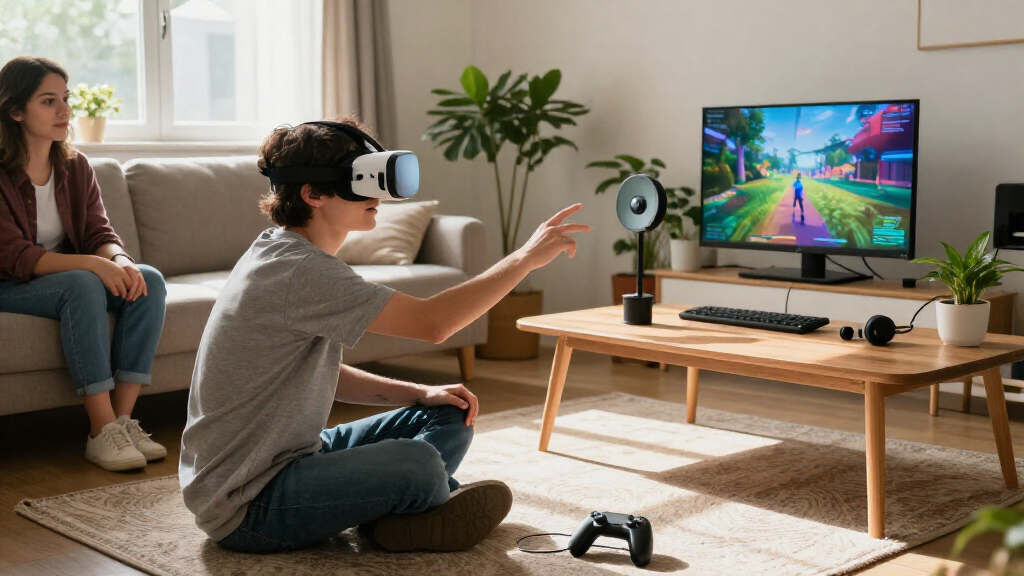
Choosing the best VR gaming headsets in 2027 depends heavily on whether you prioritize standalone convenience or PC-powered fidelity. My top pick for most gamers is the Meta Quest 3, which balances mixed-reality features, a vast game library, and decent resolution without needing a powerful PC. For enthusiasts seeking crystal-clear visuals, the Pimax Crystal Super delivers unmatched sharpness and field of view, though it demands a high-end rig. The main tradeoff lies between the ease of wireless standalone play and the graphical horsepower of tethered PCVR. Continue reading to see how these options stack up against budget-friendly renewed models and legacy devices.
Complete the kit


Play games on Amazon Luna for your next adventure, included with Prime
- A rotating selection of games, no download needed
- Play on TV, laptop or phone
- Fast, free delivery for your gear, too
Key Takeaways
- The Meta Quest 3 remains the most versatile choice due to its mixed-reality passthrough and dual-mode capability, outperforming the Quest 2 in clarity and comfort.
- PCVR enthusiasts should look at Pimax models for superior resolution and field of view, accepting the hassle of cables and higher hardware requirements.
- Renewed Meta Quest 2 units offer the lowest barrier to entry for VR gaming, though they lack the color passthrough and resolution of newer generations.
- The original Oculus Quest and Rift S are now considered legacy hardware, suitable only for extremely tight budgets or specific legacy game compatibility.
- Storage capacity matters less than resolution; a 128GB headset is sufficient for most users, while 512GB models are only worth the premium for heavy app installers.
| Pimax Crystal Light PC VR Headset, 2880 × 2880 per Eye, QLED Display with Local Dimming |  | Best for High-Detail PC VR | Platform: PC VR | Display: QLED with local dimming and HDR support | Resolution: 2880 × 2880 per eye | VIEW LATEST PRICE | See Our Full Breakdown |
| Oculus Quest All-in-One VR Gaming Headset, 64 GB |  | Best for Simple Standalone Play | Storage: 64 GB | Display: OLED | Display resolution: 1440 × 1600 | VIEW LATEST PRICE | See Our Full Breakdown |
| Meta Quest 3 512GB VR Headset with GOLF+ |  | Best Overall Standalone Gaming Headset | Storage: 512 GB | RAM: 8 GB | Processor: Snapdragon XR2 Gen 2 | VIEW LATEST PRICE | See Our Full Breakdown |
| Meta Quest 2 All-in-One VR Headset, 256 GB (Renewed) |  | Best for a Larger Library on an Older Platform | Model: Quest 2 | Storage: 256 GB | Display type: LCD | VIEW LATEST PRICE | See Our Full Breakdown |
| Meta Quest 3S 128GB VR Headset with GOLF+ |  | Best for New Quest Players and Included Content | Storage: 128 GB | RAM: 8 GB | Processor: Snapdragon XR2 Gen 2 | VIEW LATEST PRICE | See Our Full Breakdown |
| Meta Quest 3S 128GB VR Headset (Renewed Premium) |  | Best for Standalone Mixed-Reality Gaming | Storage: 128 GB | Processor: Snapdragon XR2 Gen 2 | Memory: 8 GB RAM | VIEW LATEST PRICE | See Our Full Breakdown |
| Pimax Crystal Super PC VR Headset, 3840 × 3840 per Eye, 140° FOV, Eye Tracking |  | Best for High-Detail PC Simulation | Display: QLED with Mini-LED local dimming | Resolution: 3840 × 3840 per eye | Field of view: 140 degrees | VIEW LATEST PRICE | See Our Full Breakdown |
| Oculus Quest All-in-One VR Gaming Headset, 128GB |  | Best for Simple Cord-Free Setup | Storage: 128 GB | Display: OLED | Resolution: 1440 × 1600; product data also lists 720 × 800 | VIEW LATEST PRICE | See Our Full Breakdown |
| Oculus Rift S PC-Powered VR Gaming Headset |  | Best for Entry-Level PC VR | Platform: PC VR | Operating system: Windows | Display: LCD | VIEW LATEST PRICE | See Our Full Breakdown |
| Meta Quest 2 All-in-One VR Headset, 128GB, with Silicone Controller Covers and Adjustable Knuckle Straps |  | Best Value for Active Standalone Play | Storage: 128 GB | Display resolution: 1832 × 1920 pixels per eye | Display type: LCD | VIEW LATEST PRICE | See Our Full Breakdown |
| Meta Quest 3 512GB Mixed Reality VR Headset (Renewed Premium) |  | Best Renewed Mixed Reality Pick | Storage: 512 GB | Processor: Snapdragon XR2 Gen 2 | Memory: 8 GB RAM | VIEW LATEST PRICE | See Our Full Breakdown |
| Meta Quest 2 128GB All-in-One VR Headset (Renewed) |  | Best Entry-Level Renewed Pick | Storage: 128 GB | Display resolution: 1832 × 1920 pixels per eye | Field of view: 89 degrees | VIEW LATEST PRICE | See Our Full Breakdown |
| VR gaming headset | Refresh rate | Storage | Field of view | Display |
|---|---|---|---|---|
| Pimax Crystal Light PC VR Head | Up to 120 Hz | — | — | QLED with local dimming and HDR support |
| Oculus Quest All-in-One VR Gam | 90 Hz | 64 GB | 110 degrees | OLED |
| Meta Quest 3 512GB VR Headset | 120 Hz | 512 GB | — | LCD |
| Meta Quest 2 All-in-One VR Hea | 90 Hz | 256 GB | 90 degrees | — |
| Meta Quest 3S 128GB VR Headset | 60 Hz | 128 GB | 110 degrees | — |
| Meta Quest 3S 128GB VR Headset | 90 Hz | 128 GB | 96 degrees | LCD; 2064 × 2208 pixels |
| Pimax Crystal Super PC VR Head | Up to 90 Hz | — | 140 degrees | QLED with Mini-LED local dimming |
| Oculus Quest All-in-One VR Gam | 90 Hz | 128 GB | — | OLED |
| Oculus Rift S PC-Powered VR Ga | — | — | 110 degrees | LCD |
| Meta Quest 2 All-in-One VR Hea | 90 Hz | 128 GB | 110 degrees | — |
| Meta Quest 3 512GB Mixed Reali | Up to 120 Hz | 512 GB | 110 degrees | — |
| Meta Quest 2 128GB All-in-One | Up to 120 Hz | 128 GB | 89 degrees | — |
More Details on Our Top Picks
Pimax Crystal Light PC VR Headset, 2880 × 2880 per Eye, QLED Display with Local Dimming
For PC players who put image detail ahead of portability, the Pimax Crystal Light stands apart from the standalone Meta Quest 3 and Quest 3S. Its 2880 × 2880 resolution per eye, QLED panel, local dimming, and HDR support are aimed at making fine scenery and dark scenes more legible in simulations and other demanding PC games. Glass aspheric lenses are designed to preserve clarity across more of the view, while inside-out tracking avoids the need for external tracking stations. A refresh rate of up to 120 Hz and fixed foveated rendering add flexibility for compatible PC setups. The tradeoff is a firm commitment to PC VR: this is not an untethered headset like the Quest models, and its 815 g weight may wear on you during long sessions.
Pros:- High per-eye resolution paired with QLED, local dimming, and HDR support
- Glass aspheric lenses are designed for edge-to-edge clarity and reduced distortion
- Inside-out tracking does not require external tracking stations
- Supports refresh rates up to 120 Hz and fixed foveated rendering
Cons:- Requires a compatible PC, unlike standalone headsets such as Meta Quest 3
- At 815 g, it may feel heavy during extended play
Best for: PC VR players and simulation fans with a compatible gaming computer who prioritize sharp visuals and can accommodate a heavier wired-style setup.
Not ideal for: Players who want a self-contained wireless headset, or those sensitive to headset weight during extended sessions.
- Platform:PC VR
- Display:QLED with local dimming and HDR support
- Resolution:2880 × 2880 per eye
- Refresh rate:Up to 120 Hz
- Lenses:Glass aspheric
- Tracking:Inside-out camera tracking
- Compatibility:SteamVR
- Weight:815 g
Our verdict“Choose the Pimax Crystal Light if detailed PC VR visuals matter more to you than wireless freedom and a lighter fit.”
Oculus Quest All-in-One VR Gaming Headset, 64 GB
The Oculus Quest 64 GB suits buyers who want to play without setting up a gaming PC or external tracking hardware. Its inside-out tracking and Oculus Touch controllers support seated or standing play, so the setup is more self-contained than the PC-dependent Pimax Crystal Light. The OLED display, 90 Hz refresh rate, and 110-degree field of view provide a straightforward foundation for VR gaming, while the listed PC compatibility gives it another use beyond standalone play. Its age and 64 GB storage make it a narrower fit than the 256 GB renewed Quest 2 or the newer Meta Quest 3. A Facebook account is required to log in, and the listed 4.6-pound weight is a serious comfort concern for longer sessions.
Pros:- Standalone play does not require a PC or external tracking accessories
- Inside-out tracking supports movement in smaller or larger play spaces
- Oculus Touch controllers support hand gestures and interactions
- Supports both seated and standing play
Cons:- 64 GB storage is more limited than the 256 GB renewed Quest 2 and 512 GB Meta Quest 3
- A Facebook account is required to log in
- Listed weight of 4.6 pounds may make extended sessions uncomfortable
Best for: Buyers seeking an all-in-one headset for seated or standing VR who do not want external tracking accessories and can work within limited storage.
Not ideal for: Players building a large game library, those who want a newer standalone platform, or anyone put off by the required Facebook login and listed weight.
- Storage:64 GB
- Display:OLED
- Display resolution:1440 × 1600
- Refresh rate:90 Hz
- Field of view:110 degrees
- Tracking:Inside-out
- Controllers:Oculus Touch
- Compatibility:PC and standalone
Our verdict“Pick this Quest for self-contained VR basics if its limited storage, account requirement, and listed weight fit your needs.”
Meta Quest 3 512GB VR Headset with GOLF+
The Meta Quest 3 is the strongest all-round choice here for players who want a modern standalone headset without giving up room for a substantial game library. Its 512 GB storage, Snapdragon XR2 Gen 2 processor, and 120 Hz refresh rate make it a more capable general gaming pick than the older 64 GB Oculus Quest, while full-color passthrough adds mixed reality play that the Quest 2 does not list. Dual RGB cameras let you see your surroundings in color without taking the headset off, which broadens its use beyond traditional VR. The included GOLF+ content is a bonus, not the main reason to choose it. The clear compromise is endurance: battery life is listed at up to 2.2 hours, and some experiences require pairing with the Meta Horizon app.
Pros:- Standalone wireless design supports play without a PC
- 512 GB storage offers more room than the 128 GB Quest 3S
- Full-color passthrough and dual RGB cameras support mixed reality
- 120 Hz refresh rate and Snapdragon XR2 Gen 2 processor
Cons:- Battery life is listed at up to 2.2 hours
- Some experiences require pairing with the Meta Horizon app
- LCD display does not match the OLED panel listed for the older Oculus Quest
Best for: Players who want a current, wireless headset for VR games, mixed reality, and fitness, with enough storage for a broad installed library.
Not ideal for: Players who need long sessions away from charging or want PC VR image detail like the Pimax Crystal Light.
- Storage:512 GB
- RAM:8 GB
- Processor:Snapdragon XR2 Gen 2
- Display:LCD
- Resolution per eye:2064 × 2208 pixels
- Refresh rate:120 Hz
- Battery life:Up to 2.2 hours
- Platform:Standalone Meta Quest
- Cameras:Dual RGB color cameras
Our verdict“Choose the Meta Quest 3 for a versatile standalone library and mixed reality, provided you can live with short sessions between charges.”
Meta Quest 2 All-in-One VR Headset, 256 GB (Renewed)
This renewed Meta Quest 2 with 256 GB is a sensible option for buyers who want standalone VR and more storage than the 64 GB Oculus Quest, without making the newer Meta Quest 3 their pick. The 1832 × 1920 resolution per eye and 90 Hz display give it a clear baseline for gaming, while the included motion controllers, adjustable knuckle straps, and silicone grips help keep the controls secure during play. Unlike the PC-only Pimax Crystal Light, it works as a standalone headset. Its older-generation display and 90-degree field of view are less ambitious than the Quest 3’s listed 120 Hz refresh rate and full-color passthrough. This is also a renewed product with a 90-day limited warranty, so buyers should weigh that shorter coverage against its larger storage capacity.
Pros:- 256 GB storage provides more room than the 64 GB Oculus Quest
- Standalone design does not require a PC
- Includes controllers, adjustable knuckle straps, and silicone grips
- 1832 × 1920 resolution per eye with a 90 Hz display
Cons:- Renewed unit includes only a 90-day limited warranty
- 90 Hz refresh rate and 90-degree field of view trail the listed Meta Quest 3 specifications
- Does not list the full-color passthrough offered by Meta Quest 3
Best for: Standalone VR buyers who want 256 GB of storage and included controller grip accessories, and are comfortable choosing a renewed older-generation model.
Not ideal for: Players seeking mixed reality features, a newer headset platform, or longer warranty coverage than 90 days.
- Model:Quest 2
- Storage:256 GB
- Display type:LCD
- Resolution:1832 × 1920 pixels per eye
- Refresh rate:90 Hz
- Field of view:90 degrees
- Operating platform:Standalone
- Included items:Headset, controllers, and knuckle straps
- Warranty:90-day limited warranty
Our verdict“Choose this renewed Quest 2 if standalone play and 256 GB storage matter more than newer features or longer warranty coverage.”
Meta Quest 3S 128GB VR Headset with GOLF+
The Meta Quest 3S 128 GB gives first-time buyers a wireless route into current Quest gaming, mixed reality, and fitness without needing a PC. It shares the Snapdragon XR2 Gen 2 processor and 8 GB of RAM listed for the Meta Quest 3, and this bundle adds GOLF+ with in-game credits plus a three-month catalog trial. Compared with the 512 GB Meta Quest 3, its storage is much tighter and its per-eye resolution is lower; the listed 60 Hz refresh rate is also a notable limit for gaming. On the other hand, its 128 GB capacity exceeds the older 64 GB Oculus Quest, and its standalone format is simpler than the PC-dependent Pimax Crystal Light. The 2.5-hour listed battery life still calls for charging breaks.
Pros:- Standalone wireless design supports gaming and mixed reality without a PC
- Snapdragon XR2 Gen 2 processor and 8 GB of RAM
- Includes GOLF+ with 1,800 in-game credits
- Three-month trial provides access to a catalog of over 100 games
Cons:- 128 GB storage is substantially less than the 512 GB Meta Quest 3
- Listed 60 Hz refresh rate is lower than the 90 Hz Oculus Quest and 120 Hz Meta Quest 3
- Battery life is listed at 2.5 hours
Best for: New Quest buyers who want wireless VR, mixed reality, and bundled games and can manage a 128 GB library and shorter play sessions.
Not ideal for: Players who want a high refresh rate, extensive onboard game storage, or the sharper listed per-eye resolution of the Meta Quest 3.
- Storage:128 GB
- RAM:8 GB
- Processor:Snapdragon XR2 Gen 2
- Resolution:1832 × 1920 per eye
- Refresh rate:60 Hz
- Field of view:110 degrees
- Battery life:2.5 hours
- Platform:Standalone Meta Quest
- Included content:GOLF+ with 1,800 in-game credits; three-month trial for a catalog of over 100 games
Our verdict“Pick the Quest 3S bundle for a standalone entry into Quest gaming and included content, not for a high refresh rate or a large game library.”
Meta Quest 3S 128GB VR Headset (Renewed Premium)
The Meta Quest 3S is the most flexible pick here for players who want wireless VR plus color views of the room around them. Its Snapdragon XR2 Gen 2 processor and 8GB of RAM support current standalone games, while hand tracking and Touch controllers let you choose between controller-based play and simpler interactions. Compared with the older Oculus Quest All-in-One VR Gaming Headset, this model adds color passthrough and a newer processor, making mixed-reality games a better fit. The tradeoff is its LCD display and 90 Hz refresh rate, which are less compelling for buyers focused on display refinement, and the listed battery life is up to three hours. Its 128GB capacity also calls for some game-library management.
Pros:- Standalone wireless play avoids a PC and headset cable.
- Snapdragon XR2 Gen 2 processor and 8GB of RAM support responsive standalone gaming.
- Dual RGB cameras provide full-color passthrough for mixed-reality use.
- Supports both hand tracking and Touch controllers.
Cons:- Listed average battery life is up to three hours, which can limit longer sessions.
- LCD display and 90 Hz refresh rate are less suited to buyers seeking a more refined display experience.
- 128GB storage may require managing a large installed game library.
Best for: Players who want a wireless headset for standalone games, fitness, and color-passthrough mixed-reality experiences without buying a gaming PC.
Not ideal for: PC-VR simulation enthusiasts or players who want extended sessions without charging breaks; the Pimax Crystal Super offers higher resolution, while this headset is limited to standalone play and a listed three-hour average battery life.
- Storage:128 GB
- Processor:Snapdragon XR2 Gen 2
- Memory:8 GB RAM
- Display:LCD; 2064 × 2208 pixels
- Refresh rate:90 Hz
- Field of view:96 degrees
- Battery:4324 mAh; up to 3 hours average life
- Weight:515 g
Our verdict“Choose the Quest 3S if wireless gaming and color passthrough matter more than a high-end display or long uninterrupted sessions.”
Pimax Crystal Super PC VR Headset, 3840 × 3840 per Eye, 140° FOV, Eye Tracking
The Pimax Crystal Super is the specialist pick for PC players who put visual detail and a broad view ahead of convenience. Its 3840 × 3840 resolution per eye, QLED and Mini-LED local dimming, and 140-degree field of view are aimed at detailed simulator cockpits and expansive scenes. Eye tracking and adjustable IPD add ways to tailor the fit and interaction, while integrated spatial audio keeps the setup self-contained at the headset. Compared with the Oculus Rift S, the Pimax offers far higher stated resolution and a wider field of view, but it also asks more of the buyer: a Windows PC, DisplayPort, USB, and a wired setup. Its refresh rate reaches 90 Hz, so it is not the pick for someone chasing wireless play or the highest listed refresh rate.
Pros:- 3840 × 3840 resolution per eye targets very detailed PC VR visuals.
- QLED with Mini-LED local dimming supports contrast-focused imagery.
- 140-degree field of view shows more of the virtual scene.
- Eye tracking and adjustable IPD provide added fit and interaction options.
Cons:- Requires a wired connection to a compatible Windows PC.
- Needs both DisplayPort and USB connections, adding setup requirements.
- Refresh rate is listed at up to 90 Hz.
Best for: PC flight- and driving-simulator players with a capable Windows computer who value fine visual detail, a wide field of view, and eye tracking.
Not ideal for: Players who want a standalone or wireless headset, or who lack a PC with DisplayPort and USB connections; the Quest 3S is a simpler fit for untethered play.
- Display:QLED with Mini-LED local dimming
- Resolution:3840 × 3840 per eye
- Field of view:140 degrees
- Refresh rate:Up to 90 Hz
- Lens technology:Aspherical
- Tracking:Inside-out tracking; eye tracking
- Connectivity:Wired; DisplayPort and USB
- Compatibility:PC; Windows 10
- Audio:Integrated 3D spatial audio and noise-canceling microphone
Our verdict“Pick the Crystal Super for a PC simulation setup where resolution and field of view matter more than wireless freedom.”
Oculus Quest All-in-One VR Gaming Headset, 128GB
The original Oculus Quest suits buyers who want to play without a PC, external sensors, or a wired room setup. Inside-out tracking and the Guardian system support seated and standing play while helping mark nearby obstacles, and the included Touch controllers make games built around hand movement accessible. Its OLED display distinguishes it from the LCD panels in the Quest 2 and Quest 3S, but its listed 1440 × 1600 resolution is lower than the newer standalone options. The product data also gives a conflicting secondary resolution figure of 720 × 800, so buyers should treat that listing cautiously. Unlike the newer Quest 3S, this model lacks the stated color-passthrough feature, and login requires a Facebook account.
Pros:- Standalone design supports play without a PC or headset cable.
- OLED display differentiates it from the LCD panels in the Quest 2 and Quest 3S.
- Touch controllers support hand-driven game interactions.
- Guardian system and inside-out tracking support play in seated or standing spaces.
Cons:- Requires a Facebook account to log in.
- Listed resolution is lower than the newer Meta Quest 3S.
- Product data gives conflicting resolution figures, which makes the display specification less clear.
Best for: First-time VR players seeking a self-contained headset for seated or standing games and who are comfortable with the listed account requirement.
Not ideal for: Players who want newer standalone hardware, color-passthrough mixed reality, or a clearly consistent resolution specification; the Quest 3S is a stronger fit for those needs.
- Storage:128 GB
- Display:OLED
- Resolution:1440 × 1600; product data also lists 720 × 800
- Refresh rate:90 Hz
- Tracking:Inside-out
- Platform:Standalone
- Controller:Touch controllers
- Login requirement:Facebook account
Our verdict“Choose the original Quest for straightforward cord-free VR if its older display and Facebook login requirement fit your needs.”
Oculus Rift S PC-Powered VR Gaming Headset
The Oculus Rift S is the PC-connected choice for players who want room-scale tracking without mounting external sensors. Oculus Insight tracks movement from the headset, while the Halo headband and fit wheel offer a more adjustable way to secure it than a basic strap. Its 2560 × 1440 LCD display and 110-degree field of view make it a more PC-focused option than the standalone Quest models, but the experience depends on having a compatible Windows PC and accepting a cable connection. Compared with the Pimax Crystal Super, the Rift S has much lower stated resolution and a narrower field of view, yet its tracking setup is less demanding. A Facebook account is also required, which can rule it out for buyers who prefer not to link that account.
Pros:- Oculus Insight provides room-scale tracking without external sensors.
- 2560 × 1440 LCD display supports PC VR gaming.
- Halo headband adjusts with a fit wheel for a customizable fit.
- Touch controllers support intuitive in-game hand movements.
Cons:- Requires a compatible Windows PC and a wired PC setup.
- Requires a Facebook account to log in.
- Its stated resolution and field of view trail the Pimax Crystal Super.
Best for: PC owners who want room-scale VR with Touch controllers and inside-out tracking, without installing external tracking sensors.
Not ideal for: Players without a Windows PC, those seeking wireless standalone play, or simulator fans prioritizing very high resolution; the Pimax Crystal Super is built for the latter.
- Platform:PC VR
- Operating system:Windows
- Display:LCD
- Maximum resolution:2560 × 1440
- Field of view:110 degrees
- Tracking:Oculus Insight; room-scale without external sensors
- Controllers:Oculus Touch
- Connectivity:USB 3.0, Bluetooth
- Login requirement:Facebook account
Our verdict“Choose the Rift S if you already have a Windows PC and want sensor-free room-scale tracking without paying the setup complexity of a specialist headset.”
Meta Quest 2 All-in-One VR Headset, 128GB, with Silicone Controller Covers and Adjustable Knuckle Straps
This Meta Quest 2 bundle is the practical pick for players who want standalone gaming and extra controller protection in the box. Its 1832 × 1920 pixels-per-eye LCD display gives games a sharper stated resolution than the original Oculus Quest, while the silicone covers help shield controllers from sweat and scratches. Adjustable knuckle straps are useful during active games because they help keep the controllers secured without requiring a constant grip. Compared with the newer Meta Quest 3S, this headset is an older-generation option and the supplied data does not list its processor or RAM, so buyers have less information for judging performance. Setup requires a smartphone app and wireless internet, and PC VR needs a separately sold Oculus Link cable; it is best treated as a standalone headset first.
Pros:- Standalone play does not require a PC or console.
- 1832 × 1920 pixels per eye provides a clearly stated display resolution.
- Silicone controller covers help resist sweat, dust, and scratches.
- Adjustable knuckle straps help secure controllers during movement-heavy games.
Cons:- Initial setup requires a smartphone app and wireless internet.
- Oculus Link cable for PC VR is sold separately.
- The supplied product data does not specify processor or memory.
Best for: Standalone VR players who want a ready-to-use controller bundle for active games and value the included silicone covers and knuckle straps.
Not ideal for: Buyers prioritizing newer-generation hardware, included PC-VR connectivity, or freedom from app and internet setup; the Quest 3S is the newer standalone alternative in this lineup.
- Storage:128 GB
- Display resolution:1832 × 1920 pixels per eye
- Display type:LCD
- Refresh rate:90 Hz
- Field of view:110 degrees
- Connectivity:USB Type-C
- Sensors:Gyroscope, accelerometer, magnetometer
- Included accessories:Two Touch controllers, silicone cover, glasses spacer, charging cable, power adapter
Our verdict“Choose this Quest 2 bundle for standalone gaming with useful controller accessories, but skip it if you want newer hardware or PC VR ready out of the box.”
Meta Quest 3 512GB Mixed Reality VR Headset (Renewed Premium)
The renewed Quest 3 is the stronger fit for players who want current standalone gaming plus mixed reality, without relying on a PC. Its Snapdragon XR2 Gen 2 processor, 8GB of RAM, and 512GB of storage give it more room and processing headroom than the renewed Meta Quest 2 128GB. Full-color passthrough also lets supported games place virtual elements in a view of your room, rather than limiting play to a fully virtual scene. The listed 120Hz refresh rate and 110-degree field of view support an immersive presentation, while the wireless setup suits active games. The tradeoff is a listed battery life of about 2.2 hours, and renewed condition means buyers should check the seller’s terms. Choose it over the Quest 2 for newer hardware and mixed reality; skip it if longer sessions matter more than those upgrades.
Pros:- Standalone wireless play avoids requiring a gaming PC.
- Full-color passthrough supports mixed-reality experiences in the room.
- Snapdragon XR2 Gen 2 and 8GB RAM offer newer processing hardware than the Quest 2.
- 512GB storage leaves more room for games and apps than the Quest 2 128GB.
Cons:- Listed battery life is about 2.2 hours, limiting longer play sessions.
- Renewed condition may not suit buyers who want a new device.
- Standalone performance and visuals do not replace a PC-focused headset for users seeking high-end PC VR.
Best for: Players seeking a renewed, standalone headset for current Quest games, mixed-reality experiences, and a larger game library stored locally.
Not ideal for: Buyers who want long uninterrupted sessions, prefer a new headset, or need PC-focused high-end visuals like those offered by the Pimax Crystal Light.
- Storage:512 GB
- Processor:Snapdragon XR2 Gen 2
- Memory:8 GB RAM
- Display resolution:4K+
- Refresh rate:Up to 120 Hz
- Field of view:110 degrees
- Battery life:About 2.2 hours
- Platform:Standalone Meta Quest
- Warranty:1 year
Our verdict“Choose this renewed Quest 3 for standalone gaming and mixed reality with more storage and newer hardware than the Quest 2, if its short battery life fits your sessions.”
Meta Quest 2 128GB All-in-One VR Headset (Renewed)
The renewed Quest 2 128GB suits buyers who want room-scale VR without adding a PC to their setup. Its inside-out tracking and included Touch controllers provide the core pieces for movement-based games, while standalone operation keeps setup simpler than a PC headset such as the Pimax Crystal Light. It can also connect to a personal computer, giving players another way to access VR content. Compared with the renewed Quest 3, though, this model has less storage, an 89-degree field of view, and no listed full-color mixed-reality feature; it is the more basic choice, not the more capable one. Battery life is listed at up to 2.5 hours, still a limit for extended sessions. The 90-day limited warranty and renewed condition also call for closer attention than a new headset would.
Pros:- Standalone operation allows play without a computer.
- Inside-out, room-scale tracking supports movement-based games.
- Includes two Touch controllers and setup accessories.
- PC compatibility adds another way to access VR content.
Cons:- 128GB storage is less than the renewed Quest 3’s 512GB.
- The 89-degree field of view is narrower than the Quest 3’s listed 110 degrees.
- Renewed condition and a 90-day limited warranty may concern buyers seeking stronger purchase coverage.
Best for: First-time VR buyers who want room-scale standalone gaming, included controllers, and the option to connect to a personal computer.
Not ideal for: Players seeking newer mixed-reality features, wider field of view, more storage, or the longer warranty listed for the renewed Quest 3.
- Storage:128 GB
- Display resolution:1832 × 1920 pixels per eye
- Field of view:89 degrees
- Refresh rate:Up to 120 Hz
- Tracking:Inside-out, room-scale
- Battery life:Up to 2.5 hours
- Compatibility:Standalone; compatible with personal computers
- Weight:1.8 pounds
- Warranty:90-day limited warranty
Our verdict“Pick the renewed Quest 2 if you want an accessible standalone entry into room-scale VR and can accept older hardware, limited storage, and a shorter warranty.”

How We Picked
I evaluated these headsets based on display clarity, comfort, ecosystem availability, and value per dollar. Visual fidelity was a primary differentiator, separating high-end PCVR options like the Pimax Crystal Super from mid-range standalone devices like the Meta Quest 3S. I also weighed the importance of mixed reality features, which have shifted from a novelty to a core utility for many users.
| VR gaming headset | Platform | Display | Tracking |
|---|---|---|---|
| Pimax Crystal Light PC VR Head | PC VR | QLED with local dimming and HDR support | Inside-out camera tracking |
| Oculus Quest All-in-One VR Gam | — | OLED | Inside-out |
| Meta Quest 3 512GB VR Headset | Standalone Meta Quest | LCD | — |
| Meta Quest 2 All-in-One VR Hea | — | — | — |
| Meta Quest 3S 128GB VR Headset | Standalone Meta Quest | — | — |
| Meta Quest 3S 128GB VR Headset | — | LCD; 2064 × 2208 pixels | — |
| Pimax Crystal Super PC VR Head | — | QLED with Mini-LED local dimming | Inside-out tracking; eye tracking |
| Oculus Quest All-in-One VR Gam | Standalone | OLED | Inside-out |
| Oculus Rift S PC-Powered VR Ga | PC VR | LCD | Oculus Insight; room-scale without external sensors |
| Meta Quest 2 All-in-One VR Hea | — | — | — |
| Meta Quest 3 512GB Mixed Reali | Standalone Meta Quest | — | — |
| Meta Quest 2 128GB All-in-One | — | — | Inside-out, room-scale |
Factors to Consider When Choosing Best VR Gaming Headsets
Selecting a VR headset in 2027 requires balancing technical specs with practical usability. Not every gamer needs 4K per eye, and not every player wants to be tethered to a desktop. Here is what you should prioritize.
Standalone Versus PC-Powered
Standalone headsets like the Meta Quest series offer freedom of movement and ease of setup, making them ideal for casual players and fitness enthusiasts. PC-powered headsets such as the Pimax Crystal Light provide higher graphical fidelity and access to SteamVR’s massive library but require a powerful computer and cable management. Decide if you value convenience and portability over raw graphical power. If you already own a high-end gaming PC, a hybrid headset that supports both modes offers the best of both worlds.
Resolution and Screen Door Effect
Resolution determines how sharp the image looks and how visible the grid between pixels (screen door effect) is. High-resolution panels (2000×2000 per eye or higher) significantly reduce immersion-breaking artifacts. The Pimax Crystal Super excels here with 4K per eye, while older models like the Rift S may show more pixelation. For a truly immersive experience, aim for at least 1832×1920 per eye, which is the standard for the Quest 3 generation.
Field of View (FOV) and Comfort
A wider field of view increases immersion but can cause visual distortion or discomfort if the optics are not well-calibrated. The Pimax Crystal series offers a wider FOV (140°) compared to the standard 110° of most Meta headsets. However, comfort is equally critical; look for headsets with counterweight systems or balanced strap designs to reduce neck strain during long sessions. Poor weight distribution can ruin the experience regardless of visual quality.
The Value of Renewed and Legacy Hardware
Renewed units are refurbished devices that have been inspected and cleaned, often selling at a steep discount. They are a great option for beginners who want to try VR without a large financial commitment. However, be aware that legacy hardware like the original Oculus Quest may no longer receive software updates or have access to newer games. Check the seller’s warranty policy carefully, as renewed items may have shorter support windows than new units.
Storage Needs and Game Library
Most VR games are smaller than traditional AAA titles, so 128GB is usually sufficient for the average user. 512GB models are only necessary if you plan to keep dozens of large games installed simultaneously or use the headset for media storage. Do not overpay for storage you will not use; prioritize better optics or comfort features instead. You can always uninstall and reinstall games as needed, though download times may vary.
Frequently Asked Questions
Do I need a powerful PC for these headsets?
It depends on the model. The Meta Quest series works as a standalone device, so no PC is required for native games. However, if you want to play high-end PCVR titles from Steam, you will need a modern GPU (like an RTX 3060 or higher) to handle the rendering load. Pimax headsets are exclusively PC-powered, meaning they will not work without a capable computer. Always check the minimum system requirements for the specific headset you choose.
Is the Meta Quest 3 worth the upgrade over the Quest 2?
Yes, for most users. The Quest 3 features pancake lenses that provide significantly sharper clarity and reduced distortion compared to the Quest 2’s fresnel lenses. It also includes full-color mixed reality passthrough, allowing you to see your real environment in color, which the Quest 2 cannot do. While the Quest 2 remains a budget-friendly entry point, the Quest 3 offers a more future-proof and visually comfortable experience.
Can I use a VR headset for work or productivity?
Yes, many modern headsets support productivity apps. The Meta Quest 3 and 3S offer mixed reality features that let you place virtual screens around your physical desk, making them useful for multitasking. Some Pimax models also support virtual desktop applications, though their high resolution is more focused on gaming immersion. Check if the headset supports your specific productivity software or has a dedicated link feature for PC connectivity.
What is the difference between ‘Renewed’ and ‘Used’ headsets?
Renewed headsets are professionally inspected, cleaned, and tested to meet specific functional standards, often coming with a warranty. Used headsets are sold as-is by individuals or third-party sellers with no guarantees on condition or functionality. When buying renewed, look for sellers who offer at least a 90-day warranty. This reduces the risk of receiving a unit with degraded lenses or battery issues, which are common wear-and-tear items.
Why are Pimax headsets more expensive than Meta Quest?
Pimax headsets focus on high-end specifications like 4K per eye resolution, wide field of view, and eye tracking, which require more expensive manufacturing components. They are niche products designed for enthusiasts who demand maximum visual fidelity and have the PC hardware to support them. Meta headsets target the mass market, prioritizing ease of use, a large game ecosystem, and lower production costs. You are paying for raw performance and specialized features rather than convenience and ecosystem breadth.
Conclusion
The Meta Quest 3 stands as the best overall VR gaming headset for 2027 due to its balanced mix of performance, mixed reality capabilities, and game library. For budget-conscious players, the Meta Quest 2 (Renewed) offers the most accessible entry into VR gaming, despite its older optics. Enthusiasts seeking the highest visual fidelity should choose the Pimax Crystal Super, provided they have the PC hardware to drive it. Beginners will find the Meta Quest 3S to be the best starting point, offering modern features at a lower price point than the flagship Quest 3. Ultimately, match the headset to your existing hardware and gaming habits to get the most value from your purchase.