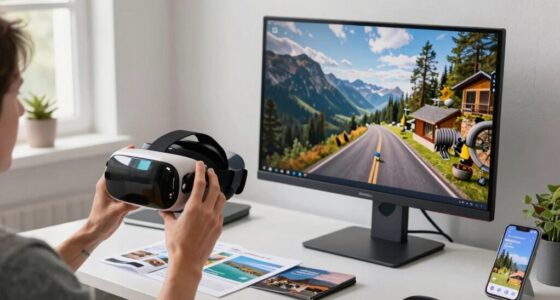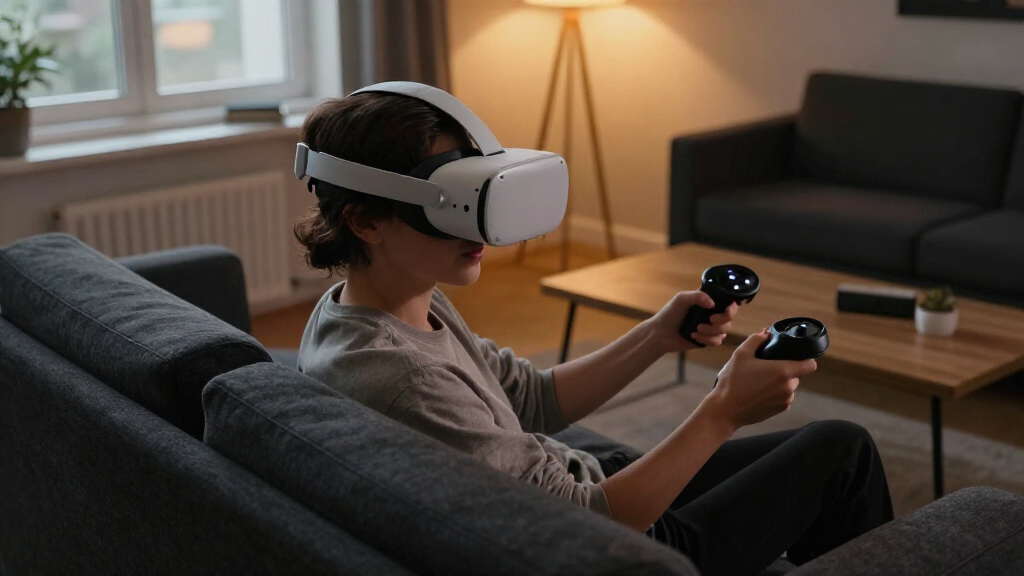

Meta Quest 3 and PlayStation VR2 suit different kinds of VR player. Quest 3 runs games without a computer or console, can connect to a gaming PC, and also supports mixed reality. PS VR2 requires a PlayStation 5, but its console-powered games, eye tracking, headset rumble, and OLED display make it a focused option for PS5 owners. The central choice is flexibility versus a more specialized console gaming experience: choose Quest 3 for an independent headset with broader uses, or PS VR2 if you already own a PS5 and want its VR exclusives and visual features.

Play games on Amazon Luna for your next adventure, included with Prime
- A rotating selection of games, no download needed
- Play on TV, laptop or phone
- Fast, free delivery for your gear, too

Meta Quest 3 512GB VR Headset – Golf+ Included – Tee Off in VR
- ✔ Storage: 512GB
- ✔ RAM: 8GB
- ✔ Processor: Snapdragon XR2 Gen 2

Meta Quest 3S 128GB VR Headset – Golf+ Included
- ✔ Storage: 128GB
- ✔ RAM: 8GB
- ✔ Processor: Snapdragon XR2 Gen 2

Meta Quest 3S 128GB VR Headset (Renewed)
- ✔ Condition: Renewed
- ✔ Storage: 128GB
- ✔ RAM: 8GB
Prices and game availability change by region and over time, so check current offers and the titles you want before buying. This comparison focuses on the hardware and ecosystem differences that shape everyday use.
At a Glance
| Criteria | Meta Quest 3 | PlayStation VR2 | Winner |
|---|---|---|---|
| Setup and platform | Standalone; optional PC connection | Requires PS5 and a wired connection to the console | A |
| Game library | Broad standalone catalog, mixed reality titles, and PC VR access | PS VR2 titles and PS5 VR support; smaller, platform-specific library | Depends |
| Visual experience | LCD, pancake lenses, sharp image across a wide viewing area | OLED with strong contrast and HDR; fresnel lenses have a narrower clear area | Depends |
| Tracking and immersion | Inside-out tracking; hand tracking; no external sensors | Eye tracking, headset feedback, and adaptive triggers on supported games | B |
| Comfort and convenience | Wireless play; compact controllers; battery-powered | Wired play; no headset battery to recharge | A |
| Beyond gaming | Mixed reality, fitness, apps, and social experiences | Primarily focused on PS5 gaming | A |
| Value | More flexible; no console required, but performance depends on headset or PC mode | Strong fit for PS5 owners seeking its supported games and features | Depends |
Meta Quest 3 512GB VR Headset – Golf+ Included – Tee Off in VR
The Meta Quest 3 512GB is the most complete gaming pick here because its supplied specifications combine the lineup’s largest storage capacity with its strongest stated display figures: 2064 × 2208 pixels per eye and up to 120 Hz. That higher refresh ceiling can make supported games feel smoother, while the additional storage gives us more room to keep a varied library installed. Against the 128GB Quest 3S models, it is the easier recommendation for players who expect to rotate among larger games without constantly managing space.Its wireless standalone design and dual RGB passthrough cameras also let us move between VR and mixed-reality experiences without relying on a gaming PC. The included Golf+ content and game trial offer a starting set of experiences, although bundled content should not determine the purchase by itself. The main catch is practical: the listed battery life is about 2.2 hours, and 512GB is fixed rather than expandable. This is our top choice for overall capability, but frequent long sessions may require charging breaks or an external battery solution. Compared with either 3S, it favors visual headroom and storage over the simpler entry-level proposition.
Pros:
- Highest listed per-eye resolution in this comparison
- 120 Hz refresh rate gives supported games room for smoother motion
- 512GB storage is more accommodating for a large installed library
- Standalone wireless play with RGB passthrough and mixed-reality support
Cons:
- Listed battery life is only about 2.2 hours
- Storage cannot be expanded
- Supplied field-of-view claim is unusual; confirm the exact specification with the seller
Best for: Standalone players who want the strongest listed display specifications and enough storage for a broad installed game library.
Not ideal for: Players seeking longer sessions between charges, expandable storage, or the lowest-complexity entry into VR.
Bottom line: We recommend Quest 3 for players who prioritize visual headroom and storage over longer battery life.
“We recommend Quest 3 for players who prioritize visual headroom and storage over longer battery life.”
Meta Quest 3S 128GB VR Headset – Golf+ Included
For a first standalone headset, the new Quest 3S 128GB offers a straightforward way into wireless VR gaming. Its listing pairs the Snapdragon XR2 Gen 2 processor and 8GB RAM with a 128GB library, so the core platform is not presented as a step down in processing from Quest 3. The trade is that we get less room for installed games and lower listed display resolution and refresh rate than the premium Quest 3. That makes it a sensible fit for newcomers who want to start with a focused set of titles rather than keep a large library ready at all times.Dual RGB passthrough cameras support mixed-reality use, and bundled Golf+ content plus a game trial can help new owners find something to play early. Still, included experiences are a bonus rather than a substitute for checking which games we actually want. The listing gives battery life as about 2.5 hours and weight as 515g, so the headset remains better suited to shorter sessions than all-day play. Compared with the renewed 3S below, this is the new-condition choice with a different supplied spec profile; compared with Quest 3, it gives up resolution, refresh headroom, and storage to serve as the simpler entry point.
Pros:
- Standalone wireless operation avoids a PC or console tether
- Same named Snapdragon XR2 Gen 2 processor and 8GB RAM as Quest 3
- RGB passthrough cameras enable mixed-reality experiences
- Golf+ and a three-month game trial are included in the supplied description
Cons:
- 128GB can constrain a library of larger games
- Listed resolution and 60 Hz refresh rate trail the Quest 3 specifications
- 515g weight and about 2.5 hours of battery life may limit extended sessions
Best for: New VR players who want a current standalone headset for a manageable selection of games and experiences.
Not ideal for: Players who want a large game library installed, a higher refresh ceiling, or long sessions without charging.
Bottom line: We’d choose the new Quest 3S as the approachable entry point if a compact game library is enough.
“We’d choose the new Quest 3S as the approachable entry point if a compact game library is enough.”
Meta Quest 3S 128GB VR Headset (Renewed)
This renewed Quest 3S 128GB is worth considering for buyers who are comfortable with renewed hardware and want the smaller-capacity standalone format. The supplied listing claims a 90 Hz refresh rate, a 96-degree field of view, and approximately three hours of battery life. Those figures differ from the new Quest 3S listing, which specifies 60 Hz, a 110-degree field of view, and about 2.5 hours. Because these are conflicting product details, we should treat the renewed listing’s numbers as claims to confirm with the seller, not as a dependable upgrade over the new model.Like the other 3S, it names the Snapdragon XR2 Gen 2 processor, 8GB RAM, 128GB storage, RGB passthrough, and wireless standalone play. That positions it well for buyers who want the basic Quest 3S format and do not need Quest 3’s 512GB capacity or higher stated resolution. The renewed condition is the defining tradeoff: condition, included accessories, warranty, and return terms matter more here than the nominal spec sheet. Its 515g weight is also shared with the new 3S listing, so neither is an especially light option for long sessions. Buyers should verify the exact hardware and coverage before choosing it over a new 3S.
Pros:
- Standalone wireless format with the Snapdragon XR2 Gen 2 and 8GB RAM
- RGB passthrough is listed for mixed-reality use
- Listing claims 90 Hz refresh and about three hours of battery life
- USB-C and a 3.5 mm auxiliary jack are listed
Cons:
- Renewed condition makes seller terms and included accessories important to verify
- Supplied 3S specifications conflict with the new 3S listing
- 128GB storage and 515g weight remain limitations
Best for: Experienced buyers who are comfortable purchasing renewed hardware and will verify condition, included accessories, and seller terms.
Not ideal for: Buyers who want a new unit, unambiguous specifications, or the larger storage and stronger listed display profile of Quest 3.
Bottom line: We’d consider this renewed 3S only after confirming its condition and resolving the listing’s specification discrepancies.
“We’d consider this renewed 3S only after confirming its condition and resolving the listing’s specification discrepancies.”
As an Amazon Associate we earn from qualifying purchases.
Key Differences
The platform choice affects the whole purchase. Quest 3 is self-contained, so it is easier to take to another room, share with family, or use away from a gaming setup. It also has access to standalone games and can connect to a capable PC for PC VR. PS VR2 is tethered to a PS5, which limits where it can be used, but the console supplies the processing power for supported games. If you already own a PS5, that makes setup familiar and can make the headset an attractive addition to your existing system.
Image quality is a tradeoff, rather than a simple win. PS VR2’s OLED panels produce deep blacks and vivid contrast, which can make dark scenes feel more convincing. Quest 3’s pancake lenses give a broad, clear viewing area, and its LCD image is sharp, though blacks look less rich. PS VR2 adds eye tracking and headset feedback in supported games; Quest 3 counters with wireless play, hand tracking, mixed reality, and a wider range of uses outside traditional gaming. In practice, the titles you want and the features they use matter more than a spec-sheet winner.
For most people buying their first headset, Quest 3 is the safer recommendation because it works without extra hardware and serves more purposes. PS VR2 makes more sense when the buyer owns a PS5, has checked that its game library matches their interests, and values its distinctive console VR features enough to accept a cable and narrower platform.
Detailed Comparison
Setup and platform (Meta Quest 3 wins — major)
Quest 3 wins for convenience and independence: put it on, launch a standalone game, and play without connecting a console or computer. PS VR2 needs a PS5 and a cable between console and headset. For existing PS5 owners, that requirement is less of a hurdle; for everyone else, it adds a substantial cost and limits where the headset can be used. This is a major difference for first-time buyers and anyone who wants room-to-room flexibility.
Game library (major difference)
Quest 3 offers a broad standalone catalog and can also access PC VR when paired with suitable hardware. PS VR2 has a focused library of PS5 VR games, including titles designed around its controllers and eye tracking, but it cannot draw on Quest’s standalone store. Neither wins for every player: check the specific games you want, since library fit is a more meaningful measure than catalog size alone. The gap is major if one platform has a must-play title for you.
Visual experience (moderate difference)
PS VR2 wins on black levels and contrast thanks to its OLED display, a noticeable advantage in dark or cinematic scenes. Quest 3’s pancake lenses provide a wider clear area and a sharp image across more of the view; PS VR2’s fresnel lenses can require more careful positioning for a clear sweet spot. The gap is moderate and depends on the game and what your eyes notice most: rich contrast favors PS VR2, while lens clarity across the view favors Quest 3.
Tracking and immersion (PlayStation VR2 wins — moderate)
PS VR2 has the edge in supported games through eye tracking, headset rumble, and controller features such as adaptive triggers. These can make compatible experiences feel more responsive and immersive, but their value depends on game support. Quest 3 tracks the headset and controllers from built-in cameras, and it supports hand tracking, which is useful when a game or app does not call for controllers. PS VR2’s advantage is moderate for players who prioritize compatible PS5 titles.
Comfort and convenience (Meta Quest 3 wins — moderate)
Quest 3 wins for cable-free movement and easy room-to-room use. Its built-in battery does limit play time before recharging, and comfort depends on fit and personal preference. PS VR2 does not rely on a headset battery during play, but the cable can catch or restrict movement. Neither headset fits everyone equally well; try the fit if possible, especially if you expect long sessions. The day-to-day convenience gap is moderate and favors Quest 3 for active play.
Beyond gaming (Meta Quest 3 wins — major)
Quest 3 wins clearly if you also want mixed reality, fitness apps, media, social experiences, or general VR apps. Its cameras let compatible software blend virtual content with the room around you. PS VR2 is designed chiefly for gaming on PS5, so it is a narrower purchase. This difference is major for buyers who want one headset to cover several activities and minor for someone who only wants console VR.
Value (major difference)
Value depends on what you already own. Quest 3 avoids the need for a console and can serve gaming and non-gaming uses, giving it broader appeal for the cost. PS VR2’s value improves substantially for a PS5 owner who wants its particular games and display features; buying a PS5 just to use it changes the calculation. Compare current local prices and the cost of any required hardware. The winner depends on your existing setup and intended use.
Meta Quest 3: Pros and Cons
Pros:
- Works without a console or PC
- Wireless standalone play, with optional PC VR access
- Mixed reality, hand tracking, and varied non-gaming uses
- Pancake lenses provide a broad clear viewing area
Cons:
- LCD display has weaker black levels than PS VR2’s OLED
- Battery limits uninterrupted play time
- PC VR performance requires a capable computer and connection setup
PlayStation VR2: Pros and Cons
Pros:
- OLED display delivers deep blacks and strong contrast
- Eye tracking and headset feedback add immersion in supported games
- PS5 supplies the processing power for supported VR titles
- No headset battery to recharge while playing
Cons:
- Requires a PlayStation 5
- Wired connection restricts movement and placement
- Platform-specific library is narrower than Quest’s broader ecosystem
Who Should Choose What
Choose Meta Quest 3 if:
- You want a headset that works without buying a console or PC.
- You value wireless play, mixed reality, fitness, or apps beyond gaming.
- You want access to standalone games plus the option of PC VR.
Choose PlayStation VR2 if:
- You already own a PS5 and want to play PS VR2-supported titles.
- You care more about OLED contrast and supported eye-tracking features than wireless freedom.
- You prefer a headset focused on console gaming and accept a wired setup.
Skip both if: Skip both if you cannot comfortably wear a headset, do not have space for safe play, or the games you want are not available on either platform. Check comfort and the current game catalog before purchasing.
Value for Money
Quest 3 is usually the better value for a buyer without existing gaming hardware: it is usable on its own and covers more than gaming. Its added flexibility matters only if you will use those features; someone who wants only a particular PS5 VR game may get more from PS VR2. For PS5 owners, PS VR2 can be worth paying for when its library, OLED contrast, and supported immersion features are the point of the purchase. If you would need to buy a PS5 as well, add that cost before deciding.
Final Verdict
Choose Meta Quest 3 if you want the more versatile first headset: it is self-contained, wireless, and useful for gaming and mixed reality without another platform purchase. Choose PlayStation VR2 if you already own a PS5, have verified that its games suit you, and want OLED contrast and its supported eye-tracking and headset-feedback features. The deciding factor is your platform and game list. For most first-time buyers, Quest 3 is the more practical choice; for a PS5 owner seeking a dedicated console VR experience, PS VR2 can be the better fit.
Frequently Asked Questions
Do I need a PS5 to use PlayStation VR2?
Yes. PS VR2 connects to a PlayStation 5 and requires it to run supported games. Quest 3 works on its own, though a capable PC can expand its VR options.
Which headset has better graphics?
It depends on the game and what you notice. PS VR2’s OLED display gives darker blacks and stronger contrast. Quest 3 has pancake lenses with a broad clear viewing area, and its standalone graphics depend on its own hardware. Connecting Quest 3 to a gaming PC can provide access to more demanding PC VR experiences.
Is Quest 3 wireless?
Yes, it supports standalone wireless play. It can also connect to a PC for PC VR, using a wired or wireless connection depending on setup and software.
Which headset should a first-time VR buyer choose?
Quest 3 is the more straightforward choice for most first-time buyers because it needs no console and supports gaming and other uses. Choose PS VR2 instead if you already own a PS5 and its game library is the main reason you want VR.