TL;DR

Get VR and gaming gear delivered free — and shop member deals
- Fast, free delivery on millions of items
- Access to Prime Big Deal Days deals on October 6–7
- Prime Video, Amazon Music and more included
Immersix has developed a retina-based eye-tracking technology for XR devices that offers highly precise, stable, and secure tracking. This innovation could significantly improve VR experiences by eliminating calibration issues and enabling more immersive interactions.
Immersix has introduced a retina-based eye-tracking technology that promises to deliver highly precise, stable, and secure tracking for VR and XR headsets. This innovation is expected to significantly enhance user experience by eliminating calibration issues common in current systems, marking a key development in eye-tracking for virtual reality.
The startup Immersix has developed a novel eye-tracking module that focuses on tracking the retina rather than the pupil, offering several advantages. The system uses a small camera and IR LED to capture detailed images of the retina, which is unique for each user and remains stable over years. This allows for a one-time calibration that stays valid even if the headset is removed and put back on, addressing a major limitation of existing eye-tracking solutions.
According to Immersix, the device’s hardware is compact—consisting of just two tiny modules near the nose—and consumes less than 10 milliwatts of power, with the ability to operate at up to 120Hz. During calibration, users perform specific eye movements to map their retina, creating a detailed fingerprint that the system uses for ongoing tracking. The software matches the visible retina region at any moment with the stored full map, enabling highly accurate eye orientation detection with claimed sub-degree precision.
The company asserts that this approach makes the eye-tracking system resistant to head movements and headset shifts, maintaining calibration quality over time and with repeated use. During a demonstration, a prototype headset was used, showing the technology’s potential to outperform current solutions that often degrade after repeated donning and doffing.
How Retina Tracking Could Transform VR With Unmatched Precision
Immersix is shifting eye tracking from the pupil to the retina—promising stable calibration, sub-degree precision, biometric security, and more natural virtual interactions from two tiny, low-power modules.
A persistent retinal map replaces fragile calibration
Instead of estimating gaze from pupil position alone, Immersix captures the retina’s stable vascular pattern. A stored map becomes both an orientation reference and a unique biometric signature.
Image the retina
A miniature camera and infrared LED reveal a detailed portion of the retinal pattern.
Build a full map
Guided eye movements create a one-time retinal fingerprint and orientation reference.
Locate each view
Software matches the currently visible retinal region against the stored full map.
Calculate gaze
The matched location reveals eye orientation—even after headset shifts or removal.
Retina tracking versus pupil tracking
The proposed advantage is not simply more samples. It is a more stable biological reference that could resist the calibration drift experienced by conventional systems.
| Comparison point | Traditional pupil tracking | Immersix retina tracking |
|---|---|---|
| Primary reference | Pupil position and corneal reflections | ✓Detailed retinal pattern |
| Calibration behavior | Can require repeated recalibration | ✓Designed for one persistent map |
| Headset movement | Fit changes may reduce accuracy | ✓Claimed resistance to shifting |
| Biometric potential | Limited identity assurance | ✓Unique retinal authentication |
| Commercial maturity | Already available in products | ~Prototype; validation still needed |
What precision could unlock inside VR
Reliable knowledge of exactly where a user is looking could improve graphics, interface control, interaction design, accessibility, comfort, and identity protection at the same time.
Sharper foveated graphics
Render maximum detail at the gaze point while reducing work in peripheral vision, potentially improving visual quality and efficiency.
Natural gaze control
Stable eye input could make menus, object selection, targeting, and social cues feel immediate rather than approximate.
Less setup friction
A persistent calibration could reduce repetitive onboarding and preserve accuracy after users remove and replace a headset.
Retinal authentication
A retina is unique and difficult to spoof, creating the possibility of continuous identity checks within shared XR devices.
Compact integration
Two tiny modules near the nose and sub-10-milliwatt consumption could suit increasingly slim, power-sensitive headsets.
More dependable input
Accurate gaze interaction may expand hands-free control options for users who cannot rely on conventional controllers.
High promise, early proof
The published specifications are compelling, but they remain company claims from a prototype demonstration. Consumer-scale performance has not yet been established.
Current confidence by dimension
Editorial assessment based on the disclosed development stage—not independent benchmark data.
What still needs validation
Long-term reliability across different users and environments
Manufacturing cost and production yield at consumer scale
Integration into slim headsets without comfort compromises
Independent comparisons with leading pupil-based systems
The commercial reality check
Immersix may have addressed a fundamental technical weakness, but adoption depends on whether headset makers can integrate the system economically and reliably.
Is the technology ready for consumer headsets?
Not yet. It has reached prototype demonstration, while broader testing, product engineering, and manufacturing partnerships are still required.
Could it improve VR security?
Potentially. A unique retinal pattern could support strong authentication, although privacy safeguards and secure biometric storage would be essential.
What could prevent widespread adoption?
Cost, integration complexity, long-term reliability, privacy requirements, production scalability, and performance across diverse eyes remain unresolved.
Why does persistent calibration matter?
It could remove repeated setup, preserve precision after donning and doffing, and make gaze-based interfaces dependable enough for everyday use.
What comes next?
Further testing, independent performance data, headset-manufacturer partnerships, and product integration will determine whether the concept becomes an XR standard.
Potential Impact on VR User Experience and Security
This technology could dramatically improve the quality of VR experiences by offering more accurate and stable eye-tracking, which is crucial for realistic interactions, foveated rendering, and user interface control. Additionally, since the retina is unique and difficult to spoof, the system offers enhanced security features, including user authentication.
By eliminating the need for frequent recalibration, Immersix’s approach could reduce setup times and improve comfort, making VR more accessible and user-friendly. If adopted widely, this could set a new standard for eye-tracking in XR devices, influencing both hardware design and software applications across the industry.
As an affiliate, we earn on qualifying purchases.
Limitations, Development Stage, and Industry Position
Immersix’s retina-tracking system is currently at the prototype stage, demonstrated during the VR/AR Expo China in May 2024. The company claims significant advantages over existing pupil-tracking solutions, which often suffer from calibration drift and less precision. The technology’s reliance on detailed retina imaging is innovative but still requires further testing in real-world VR headsets and consumer products.
Previous eye-tracking solutions primarily focus on pupil position, which can be affected by head movements and require frequent recalibrations. Immersix’s approach aims to address these issues fundamentally, but it remains to be seen how well it performs in commercial VR headsets, especially in terms of manufacturing, cost, and integration.
“Our retina-based tracking provides unmatched accuracy and stability, enabling truly immersive VR experiences without the hassle of constant recalibration.”
— Immersix spokesperson
As an affiliate, we earn on qualifying purchases.
Performance and Scalability in Consumer Devices Still Unclear
While the prototype demonstration shows promising results, it is not yet confirmed how well the retina-tracking system will perform in commercial VR headsets at scale. Details about manufacturing costs, integration challenges, and long-term reliability are still emerging. It remains uncertain whether the technology can be adopted widely without significant modifications.
As an affiliate, we earn on qualifying purchases.
Next Steps: Testing, Partnerships, and Product Integration
Immersix plans to continue refining its technology through further testing and development. The company aims to partner with VR hardware manufacturers to integrate its retina-tracking modules into upcoming headsets. Expect more detailed performance data and potential product announcements within the next 12-18 months as the technology moves toward commercial deployment.
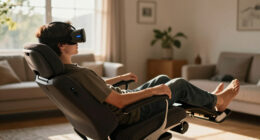
immersive VR headset with eye tracking
As an affiliate, we earn on qualifying purchases.
As an affiliate, we earn on qualifying purchases.
Key Questions
How does retina tracking differ from traditional eye-tracking?
Retina tracking uses detailed images of the blood vessels in the retina for precise and stable eye orientation detection, unlike traditional methods that track the pupil position, which can be affected by head movements and require frequent recalibration.
What are the main advantages of Immersix’s technology?
The key benefits include highly accurate, stable tracking that does not degrade over time or with headset removal, improved security through retina-based authentication, and reduced calibration needs.
Is this technology ready for commercial VR headsets?
Not yet. The current stage is prototype demonstration; further testing, development, and industry partnerships are needed before it can be integrated into consumer products.
Could this technology improve VR security?
Yes, because the retina is unique and difficult to spoof, it offers a potential new level of biometric security for VR and XR devices.
What challenges remain before widespread adoption?
Manufacturing costs, integration with existing hardware, long-term reliability, and ensuring scalability are key issues that need to be addressed.
Source: The Ghost Howls
Fall Picks
fall essentials
As an affiliate, we earn on qualifying purchases.