
TL;DR

Get VR and gaming gear delivered free — and shop member deals
- Fast, free delivery on millions of items
- Access to Prime Big Deal Days deals on October 6–7
- Prime Video, Amazon Music and more included
Meta has announced an upgraded non-invasive brain-computer interface, Brain2Qwerty v2, which decodes neural signals into coherent sentences with higher accuracy. The development marks progress toward communication aids for speech-impaired individuals and potential future telepathy-like interfaces.
Meta has introduced Brain2Qwerty v2, an advanced non-invasive brain-computer interface (BCI) capable of decoding neural signals into full sentences with significantly improved accuracy. This development moves the company closer to enabling direct thought-to-text communication, which could benefit individuals with speech impairments and potentially pave the way for telepathy-like interfaces in the future. The announcement underscores ongoing progress in non-invasive neural decoding technologies, with implications for healthcare and human-computer interaction.
Meta’s Brain2Qwerty v2 builds upon last year’s initial prototype, which could decode individual characters from brain signals using electroencephalography (EEG) and magnetoencephalography (MEG). The new version employs an end-to-end deep learning architecture combined with large language models (LLMs), allowing it to interpret raw brain signals directly and decode entire sentences in real time. According to Meta, the system was trained on approximately 22,000 sentences from nine volunteers, each recorded over 10 hours while actively typing, with the system achieving a 61% word accuracy rate. The most successful participant reached a 78% accuracy, with over half of sentences decoded with one word error or less. Meta states that decoding accuracy improves with increased data volume, suggesting further performance gains are possible through data scaling.
While the system is not yet near perfect, it significantly outperforms earlier non-invasive methods, which achieved around 8% word accuracy. The project aims to develop communication tools for people with neurological injuries or diseases that impair speech, avoiding invasive procedures such as those used in surgical brain implants. Experts note that invasive methods, while more accurate, pose risks like brain hemorrhage and infection, and face challenges in long-term stability. Currently, MEG devices are large and expensive, but smaller, room-temperature sensors like Cerca’s optically-pumped magnetometers are emerging. Nonetheless, background magnetic interference remains a major obstacle for consumer adoption of non-invasive neural interfaces.
Potential Impact on Communication for Speech-Impaired
This advancement indicates a meaningful step toward non-invasive neural interfaces capable of translating thoughts into text with increasing accuracy. For individuals with speech impairments caused by stroke, ALS, or other neurological conditions, this could dramatically improve quality of life by enabling more natural communication without surgery. Additionally, the progress hints at future possibilities for direct brain-to-brain communication, or telepathy-like interfaces, although substantial technical hurdles remain before such applications become feasible at scale.
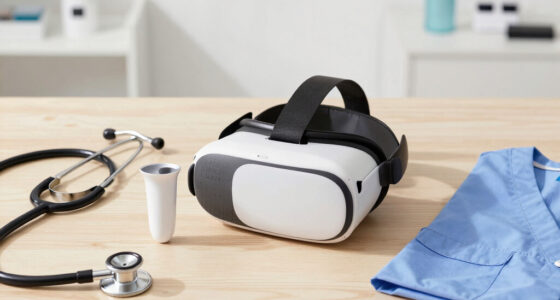
EEG brain-computer interface device
As an affiliate, we earn on qualifying purchases.
As an affiliate, we earn on qualifying purchases.
Progress and Challenges in Non-Invasive Brain-Computer Interfaces
Meta’s latest development follows its 2023 release of Brain2Qwerty v1, which demonstrated the potential of non-invasive brain recordings to decode characters. The move toward sentence-level decoding with v2 reflects broader research efforts to harness AI and large language models for neural decoding. While invasive BCIs, like Elon Musk’s Neuralink, show higher accuracy, they carry risks such as infection and brain hemorrhage, limiting their scalability. Non-invasive methods like MEG are safer but face technical challenges, including interference from environmental magnetic fields and the size and cost of current devices. Researchers emphasize that scaling data and improving hardware are essential to closing the accuracy gap with invasive options.
“The use of end-to-end deep learning combined with large language models marks a significant leap in decoding complex neural signals into coherent language.”
— an anonymous researcher
non-invasive neural decoding headset
As an affiliate, we earn on qualifying purchases.
As an affiliate, we earn on qualifying purchases.
Remaining Technical and Practical Challenges
It is not yet clear how close this technology is to real-world, consumer-grade deployment. The current accuracy, while improved, still leaves room for significant errors, especially in noisy environments. Additionally, the size, cost, and environmental requirements of MEG devices limit immediate accessibility. Long-term stability, user comfort, and scalability are still under investigation, and it remains uncertain when such systems will be available outside research settings.
brain-to-text communication device
As an affiliate, we earn on qualifying purchases.
As an affiliate, we earn on qualifying purchases.
Next Steps Toward Practical Neural Communication Devices
Meta plans to continue refining its AI models, increasing training data, and improving hardware miniaturization. Future research aims to enhance decoding accuracy, reduce device size, and develop user-friendly interfaces. Clinical trials and collaborations with healthcare providers are likely to be the next milestones, with the goal of translating laboratory results into practical tools for speech-impaired individuals within the coming years.
As an affiliate, we earn on qualifying purchases.
Key Questions
How accurate is Meta’s Brain2Qwerty v2 now?
Meta reports a 61% word accuracy rate overall, with the best participant reaching 78%. Although promising, this is not yet reliable enough for everyday communication without errors.
Can this technology be used outside the lab?
Currently, no. The system relies on MEG devices that are large and require magnetic shielding, making widespread consumer use impractical at this stage. Miniaturized, portable versions are under development but are not yet available.
How does this compare to invasive brain interfaces?
Invasive interfaces like Neuralink offer higher accuracy but pose risks such as infection and long-term stability issues. Non-invasive methods like Meta’s are safer but less accurate, though they are improving rapidly.
When might this technology be available for everyday use?
It is uncertain. While research is advancing, practical, consumer-ready devices are likely years away, pending hardware miniaturization and further accuracy improvements.
What are the main obstacles remaining?
Major challenges include reducing device size, overcoming environmental magnetic interference, increasing decoding accuracy, and ensuring long-term stability and user comfort.
Source: Road to VR
Fall Picks
fall essentials
As an affiliate, we earn on qualifying purchases.