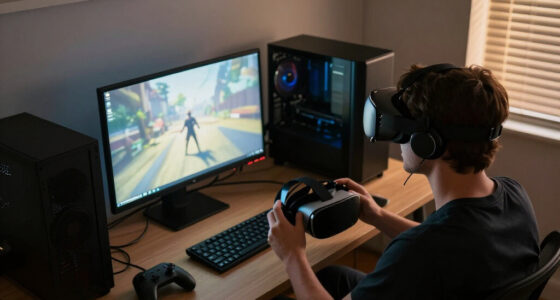

Meta Quest 3 and PlayStation VR2 appeal to people who want immersive gaming, but they solve different problems. Quest 3 is a self-contained headset with its own games, room-scale experiences, mixed-reality features, and an optional connection to a PC. PS VR2 is an accessory for PlayStation 5, built around console-powered VR games and features such as eye tracking, headset vibration, and advanced controller feedback.

Play games on Amazon Luna for your next adventure, included with Prime
- A rotating selection of games, no download needed
- Play on TV, laptop or phone
- Fast, free delivery for your gear, too

Meta Quest 3 512GB VR Headset Gorilla Tag Bundle
- ✔ Storage: 512GB
- ✔ RAM: 8GB
- ✔ Processor: Snapdragon XR2 Gen 2

Oculus Rift S PC-Powered VR Gaming Headset
- ✔ Type: PC-powered VR headset
- ✔ Tracking: Oculus Insight inside-out tracking
- ✔ Controllers: Oculus Touch

Meta Quest 2 Advanced All-In-One VR Headset 128GB
- ✔ Storage: 128GB
- ✔ Play format: Standalone
- ✔ Battery: Built-in rechargeable; runtime not specified
The decision is less about which headset is universally better and more about what you already own and what you want immersion to feel like. Quest 3 is the more flexible choice for people who value wireless play, portability, and a broad range of uses. PS VR2 makes more sense for PS5 owners who prioritize strong console graphics and want to play its supported VR titles. The differences in platform, game library, and setup are major; neither headset is the right buy if its ecosystem does not suit your gaming habits.
At a Glance
| Criteria | Meta Quest 3 | PlayStation VR2 | Winner |
|---|---|---|---|
| Platform and setup | Standalone; optional PC VR connection | Requires a PlayStation 5; headset connects by cable | A |
| Game library | Large standalone catalog, with PC VR options through a capable computer | PS VR2 catalog includes supported PS5 VR titles and exclusives | Depends |
| Visual immersion | Pancake lenses and mixed-reality passthrough; standalone graphics depend on the headset | OLED panels, HDR support, and PS5 rendering deliver strong game visuals | B |
| Tracking and feedback | Inside-out tracking, hand tracking, and standard controller vibration | Eye tracking, headset feedback, and adaptive triggers in supported games | B |
| Comfort and freedom of movement | Wireless play gives more freedom; battery life limits long sessions | No headset battery to manage, but the cable restricts movement | A |
| Use beyond gaming | Mixed reality, fitness, media, and social apps | Primarily a gaming accessory for PS5 | A |
| Overall value | More flexible if you want a headset that works without a console | Strong value for PS5 owners who will play its VR catalog | Depends |
Meta Quest 3 512GB VR Headset Gorilla Tag Bundle
The Meta Quest 3 earns the top spot because it is the most complete match for immersive gaming in this group: a high-resolution 4K+ display, a Snapdragon XR2 Gen 2 processor, and standalone wireless play. The claimed 30% resolution increase gives this model a clear visual advantage over the less specifically described displays of the Quest 2 and Rift S. Meanwhile, its 8GB of RAM and newer processor are intended to support responsive gameplay without making a PC part of the setup.Compared with the Quest 2, Quest 3 is the better choice for buyers who care most about display detail and newer processing hardware. Compared with the Rift S, it trades PC dependence for portability: there is no computer tether in the listed setup, but play time is tied to its built-in battery. The stated runtime is just over two hours, so players who prefer long uninterrupted sessions should plan around charging rather than assume all-night use.The included Gorilla Tag bundle adds themed cosmetics, 2,000 shiny rocks, and a three-month game trial. Those extras may make this package especially relevant to Gorilla Tag players, but they are not the main reason to choose the headset. We would prioritize the display, processor, storage, and wireless format first; buyers uninterested in the bundle should still judge it on those core gaming traits.
Pros:
- 4K+ display with a stated 30% resolution increase over the prior generation
- Snapdragon XR2 Gen 2 processor and 8GB RAM for current standalone gaming
- Wireless operation and 512GB storage suit a broad installed game library
- Gorilla Tag bundle includes cosmetics, in-game currency, and a three-month trial
Cons:
- Stated battery runtime is only a little over two hours of continuous use
- Bundle-specific extras add little value for players who do not play Gorilla Tag
Best for: Players who want a high-detail standalone headset, substantial built-in storage, and room to move without a PC cable.
Not ideal for: Gamers who need long sessions without charging, already have a PC-centric VR setup, or have no interest in the Gorilla Tag bundle extras.
Bottom line: We recommend the Quest 3 as the strongest all-around gaming headset here, provided its limited untethered runtime fits your sessions.
“We recommend the Quest 3 as the strongest all-around gaming headset here, provided its limited untethered runtime fits your sessions.”
Oculus Rift S PC-Powered VR Gaming Headset
The Oculus Rift S has a narrower but useful role: it is the pick for buyers who already have a compatible gaming PC and want a headset built around PC-powered VR. Its Oculus Insight inside-out tracking avoids external sensors, simplifying room-scale setup compared with arrangements that require separate tracking hardware. Updated Oculus Touch controllers also provide a dedicated way to interact with games, while the halo headband offers an adjustable fit.Against the Quest 3 and Quest 2, the Rift S gives up standalone convenience. A compatible computer is mandatory, and the product information also specifies a Facebook account requirement. That makes it less suitable for someone seeking a quick, portable headset for a living room or travel. In return, PC-first buyers may prefer keeping VR within a computer-based gaming setup instead of relying on a standalone headset’s battery and onboard processing.The listing highlights improved optics, vivid colors, and reduced screen-door effect, but does not supply a numeric resolution to compare directly with Quest 3’s 4K+ display. We therefore would not choose it on an assumed visual-resolution advantage. Its case rests on PC-powered operation, inside-out tracking without external sensors, and a large game library. Buyers should also weigh the older Rift S format and account requirement against the two wireless alternatives before committing.
Pros:
- PC-powered setup suits players already invested in compatible computer gaming
- Oculus Insight inside-out tracking does not require external sensors
- Oculus Touch controllers support direct hand-based interaction
- Halo headband has a fit wheel for adjustment and secure positioning
Cons:
- Requires a compatible PC and is not a standalone headset
- Product details specify a Facebook account requirement
- No numeric display resolution is supplied for direct comparison with Quest 3
Best for: PC gamers with a compatible computer who want room-scale VR without installing external tracking sensors.
Not ideal for: Buyers without a compatible PC, anyone prioritizing untethered play, or players who do not want the specified Facebook account requirement.
Bottom line: The Rift S remains a focused option for PC-first players, but its computer and account requirements make it less flexible than either Quest headset.
“The Rift S remains a focused option for PC-first players, but its computer and account requirements make it less flexible than either Quest headset.”
Meta Quest 2 Advanced All-In-One VR Headset 128GB
The Meta Quest 2 is the simpler all-in-one alternative for buyers who want to play without a PC or console. Its built-in rechargeable battery, hand tracking, intuitive controllers, and 3D positional audio cover important parts of a self-contained VR experience. The supplied details also cite access to more than 500 titles, making breadth of available content one of its strengths rather than a claim about any one game.It sits behind the Quest 3 because the newer model has a specified 4K+ display, a newer named processor, double-digit storage capacity advantage, and clearer stated performance details. Quest 2’s 128GB may be enough for a selective library, but larger games can crowd it sooner. Compared with the Rift S, Quest 2 is the more convenient choice for users without a compatible gaming PC: it is designed to run on its own and avoids a computer tether.We would treat the unspecified battery duration as a real information gap for players planning long sessions; the built-in battery confirms portability, not a particular runtime. The listing notes account requirements for users aged 10 and up and that some apps are mature, so households should review account setup and content suitability. Quest 2 makes the most sense when standalone simplicity matters more than having the latest specified display and processing hardware.
Pros:
- Standalone wireless design works without a PC or console
- Hand tracking and intuitive controllers offer multiple interaction options
- 3D positional audio helps create a more spatial gaming experience
- Product details cite access to more than 500 titles across categories
Cons:
- 128GB storage is more restrictive than Quest 3’s 512GB
- Battery runtime is not specified, making long-session planning difficult
- Some apps are mature and account requirements apply for users aged 10 and up
Best for: Newer or occasional VR players who want an all-in-one headset, wireless play, and access to a broad range of games.
Not ideal for: Players who want the sharpest specified display, need generous storage for a large installed collection, or require a clearly stated battery runtime.
Bottom line: Choose Quest 2 for uncomplicated standalone VR and a broad library, not for the strongest display, largest storage, or best-documented endurance in this comparison.
“Choose Quest 2 for uncomplicated standalone VR and a broad library, not for the strongest display, largest storage, or best-documented endurance in this comparison.”
As an Amazon Associate we earn from qualifying purchases.
Key Differences
The biggest practical divide is platform dependence. Quest 3 runs games on the headset itself, so you can play without a console or computer. It can also connect to a gaming PC for compatible PC VR titles, though that adds hardware, setup, and another library to manage. PS VR2 instead uses the PS5 for its games and processing. If you already play on PS5, this can make high-end VR feel like a natural extension of your console setup; without a PS5, the headset is not a complete gaming purchase.
That difference shapes immersion. PS VR2 has an advantage in supported games that benefit from PS5 rendering, OLED contrast, HDR, eye tracking, and richer controller feedback. Quest 3 offers sharper-feeling pancake optics and the freedom to play wirelessly, while its mixed-reality passthrough supports experiences that blend virtual objects with the room. Its standalone games, however, must run on mobile-class hardware, and PC VR performance depends on the computer and connection.
Value follows the buyer, not just the headset price. Quest 3 is a stronger all-round purchase for someone seeking wireless VR, mixed reality, and varied uses without buying a console. PS VR2 can be the better gaming value for a PS5 owner who specifically wants its VR library and feedback features. Pay extra for either platform only if its games and strengths match how you plan to play.
Detailed Comparison
Platform and setup (Meta Quest 3 wins — major)
Quest 3 wins by a moderate margin on access and flexibility. It starts games on the headset, so no console, gaming PC, or play-space cable is required. A PC connection is optional rather than mandatory. PS VR2 needs a PS5 and connects to it by cable, adding a clear cost and limiting where the system can be used. For a PS5 owner, the cable setup is straightforward; for everyone else, it is a decisive barrier.
Game library (major difference)
This is a buyer-dependent matchup. Quest 3 has a broad standalone catalog spanning action games, rhythm titles, fitness, social play, and other experiences; PC connection can add another pool of VR games. PS VR2 has a smaller, console-focused selection, but supported titles include games built for its hardware and PlayStation ecosystem. Choose based on the specific games you want, not catalog size alone. The gap is major if one library contains your must-play titles.
Visual immersion (PlayStation VR2 wins — moderate)
PS VR2 wins for supported games that emphasize rich contrast and console rendering; Quest 3 wins on lens clarity and mixed-reality versatility. PS VR2’s OLED display and HDR support can make dark scenes and colors feel vivid, while its PS5 can render games beyond standalone mobile hardware. Quest 3’s pancake lenses provide a clearer viewing area than older Fresnel-style optics, and color passthrough enables mixed-reality play. The advantage is moderate and depends on game design: display specifications do not automatically make every PS VR2 game look better.
Tracking and feedback (PlayStation VR2 wins — moderate)
PS VR2 wins by a moderate margin for tactile game immersion. Its eye tracking can support features such as foveated rendering in compatible games, while headset vibration and controller adaptive triggers add physical cues. Quest 3 provides inside-out tracking, hand tracking, and capable motion controllers, but does not match those particular feedback features. Quest’s hand tracking is useful in supported apps, though most gaming still relies on controllers.
Comfort and freedom of movement (Meta Quest 3 wins — moderate)
Quest 3 wins for unrestricted movement, with a moderate practical advantage. Its wireless design makes room-scale play easier and avoids catching or stepping on a headset cable. The tradeoff is battery life: long sessions may require a charging break or a battery accessory. PS VR2 draws power from the console connection, so there is no headset battery to manage, but the cable can tug or limit turns. Comfort also depends on fit, facial interface, and individual preference.
Use beyond gaming (Meta Quest 3 wins — major)
Quest 3 wins clearly. It supports mixed-reality apps, fitness, media, and social experiences directly on the headset, as well as gaming. PS VR2 is primarily a gaming accessory for PS5, so it is harder to justify as a general-purpose headset. If you want VR for occasional workouts, media viewing, or room-based experiences as well as games, Quest 3 offers more ways to use the hardware.
Overall value (major difference)
There is no universal winner. Quest 3 provides better value for buyers who want standalone gaming, wireless play, mixed reality, and broad use from one device. PS VR2 can be the better value for an existing PS5 owner who will play several supported VR titles and values console-powered visuals and feedback. If buying a PS5 solely to use PS VR2, the total system cost changes the equation sharply; if a capable gaming PC is already available, Quest’s PC option may be more attractive.
Meta Quest 3: Pros and Cons
Pros:
- Runs games without a console or computer.
- Wireless design supports room-scale play with fewer movement restrictions.
- Can connect to a capable PC for compatible PC VR games.
- Mixed-reality and non-gaming apps make it useful beyond a dedicated console setup.
Cons:
- Standalone games are constrained by headset hardware compared with PS5-powered titles.
- Battery life can interrupt extended sessions.
- Its tactile feedback features are less advanced than PS VR2’s in supported games.
- A PC connection adds cost and setup if you want demanding PC VR experiences.
PlayStation VR2: Pros and Cons
Pros:
- PS5 rendering can deliver stronger visuals in supported games.
- OLED display, HDR support, eye tracking, headset feedback, and adaptive triggers deepen compatible experiences.
- No headset battery needs charging during play.
- A compelling extension for PS5 owners who want its VR titles.
Cons:
- Requires a PlayStation 5, raising the entry cost for people without one.
- The cable restricts movement compared with wireless Quest play.
- Its primary role is gaming, with fewer reasons to use it outside PS5 VR.
- Its value depends heavily on whether its supported game catalog matches the buyer’s tastes.
Who Should Choose What
Choose Meta Quest 3 if:
- You want to play VR without buying a console or gaming PC.
- Wireless room-scale play, portability, or mixed-reality experiences matter to you.
- You want one headset for gaming, fitness, media, and social apps.
- You already own a capable gaming PC and want the option of compatible PC VR.
Choose PlayStation VR2 if:
- You already own a PS5 and want a console-powered VR experience.
- You care more about supported games’ graphics, OLED contrast, and tactile feedback than wireless freedom.
- You have checked the PS VR2 game catalog and found titles you expect to play regularly.
- You prefer a wired headset that draws power from the console rather than managing a headset battery.
Skip both if: Skip both if you do not expect to use VR regularly, cannot tolerate a headset, or neither platform has games you want. Also skip PS VR2 if you do not own a PS5 and do not plan to buy one.
Value for Money
Quest 3 is the safer value for a buyer who wants VR without committing to a console ecosystem. Its standalone operation, wireless play, mixed-reality features, and broader non-gaming uses spread the cost across more activities. PC VR can add value if you already own a suitable computer, but buying a powerful PC just for that purpose can erase the advantage.
PS VR2 is worth paying for when you already own a PS5, want games from its supported catalog, and care about its visual and tactile features. In that case, you are adding a purpose-built gaming experience to hardware you already have. If you need to buy a PS5 solely to use the headset, the combined cost is harder to justify against Quest 3. Do not pay a premium for features you will rarely notice: the library and your existing equipment matter more than a spec-sheet win.
Final Verdict
For most people choosing a first gaming headset, Meta Quest 3 is the more practical recommendation. It works on its own, offers wireless freedom, and has uses beyond gaming. Choose it if flexibility and a low-friction start matter more than console-level graphics in selected games.
Choose PlayStation VR2 if you already own a PS5 and want its VR games, stronger console-powered visuals, and richer supported-game feedback. Its cable and narrower purpose are reasonable tradeoffs for that audience. The biggest deciding factor is ecosystem fit: Quest 3 suits people who want VR as a flexible platform; PS VR2 suits PS5 owners who want a dedicated gaming upgrade. If you are unsure which games you will play, check both catalogs before buying.
Frequently Asked Questions
Which headset is better for someone buying VR for the first time?
Quest 3 is the easier first purchase for most newcomers because it works without another system and supports wireless play. PS VR2 is the better first headset only if you already own a PS5 and specifically want its supported games.
Does PS VR2 look better than Quest 3?
Not in every respect. PS VR2 can deliver stronger contrast and HDR effects through its OLED display, and PS5 power can improve visuals in supported games. Quest 3’s pancake lenses offer clear viewing and its mixed-reality passthrough opens a different kind of experience. The result depends on the game and what visual qualities matter to you.
Can Meta Quest 3 play PC VR games?
Yes, Quest 3 can connect to a capable gaming PC for compatible PC VR games. That option requires a suitable computer and connection setup; the headset’s standalone games do not require either.
Is PS VR2 worth buying without a PS5?
Generally, no. PS VR2 is designed around the PS5, so buying the console as well makes the total cost much higher. Consider it when you already own a PS5, want games in its catalog, and expect to use the headset often.
Which headset is better for room-scale gaming?
Quest 3 has the movement advantage because it is wireless. PS VR2 can support room-scale play, but its cable remains a practical limitation. Quest 3’s battery life is the countertradeoff during longer sessions.